
AI compliance is the set of controls and processes that help ensure artificial intelligence systems meet applicable laws, regulatory obligations, internal policies, and governance standards across development and deployment through production use. The rise of generative AI has accelerated the urgency to develop these controls and processes by introducing risks such as shadow AI, hallucinations, and cyberattacks.
Organizations that deploy large language models (LLMs) and AI-powered applications face a rapidly evolving body of AI regulations with real financial consequences. While government regulation of AI is not keeping pace with AI advancements, new regulations are taking effect.
The European Union’s (EU) AI Act is being enforced on a phased timeline. Prohibited practices are banned, and transparency obligations for limited-risk systems are in effect. In the United States, the Federal Trade Commission (FTC) is accelerating enforcement of AI-related deceptive and unfair practices, and AI regulation in American states is closing gaps that federal law has not yet addressed.
This guide covers what AI compliance means in practice, which regulations apply and to whom, what auditors expect as evidence, how open-source supply chain risk changes the compliance function, and a practical roadmap for building a regulatory compliance program that holds up in 2026 and beyond.
What Is AI Compliance?
AI compliance is the set of practices, controls, and governance structures organizations implement to ensure their AI systems align with applicable regulations, ethical standards, and internal policies. It differs from AI governance, the broader strategic framework of policies and principles that guide responsible AI development. Compliance is the enforcement mechanism, or the specific compliance processes and controls that translate governance principles into legal and regulatory requirements.
An AI governance framework defines what trustworthy AI looks like for an organization. Compliance processes operationalize that framework against specific regulations. General compliance frameworks like Service Organization Controls (SOC) 2, the American Health Insurance Portability and Accountability Act (HIPAA), and the EU’s General Data Protection Regulation (GDPR) provide a foundation, but AI compliance extends beyond them.
AI technologies introduce risks that legacy compliance tools were not designed to address. Today, AI tools take inventory of AI systems, enforce governance policies, and generate audit-ready evidence at scale. These models are probabilistic, not deterministic, so their behavior can drift in production. Conventional controls can make automated decision-making difficult to audit. Data lineage, or the process of tracking the entire journey of information used in an AI model, can be opaque, and AI technology stacks rely on fast-moving open-source components. That combination makes “prove it” evidence, including lineage records, operational logs, software bills of materials (SBOMs), and documented approvals, as important as the engineering itself.
The core pillars of an audit-ready AI compliance program are data privacy and data protection; transparency and disclosure to users and regulators; fairness controls that prevent discriminatory outcomes; security and software supply chain integrity; human oversight and accountability; and end-to-end documentation with full traceability across the AI lifecycle.
Why AI Compliance Matters
Non-compliance carries direct financial exposure, from EU fines to FTC enforcement actions, and indirect costs that compound over time. Two 2024 incidents show what ungoverned AI costs in practice: contractual liability from chatbot errors and security breaches from unvetted AI features. Many compliance programs also overlook a growing source of risk: the open-source packages, models, and containers that comprise the AI supply chain.
Financial and Legal Risk
Non-compliance is expensive. The EU AI Act establishes penalties based on the severity of the violation: prohibited, high-risk, and misleading information:
- Violations involving prohibited AI practices can trigger fines up to €35 million or 7% of an organization’s global annual turnover.
- Violations of high-risk and transparency obligations carry penalties up to €15 million or 3% of global annual turnover.
- Supplying incorrect or misleading information to regulators can result in fines up to €7.5 million or 1% of global annual turnover.
In the United States, no single federal AI statute exists, but federal agencies enforce compliance requirements. For example, the FTC can pursue AI-related deceptive and unfair practices. An expanding body of state, local, and sector-specific rules also exists.
Organizations operating across jurisdictions face regulations in each market. Sector-specific compliance requirements in financial services and healthcare compound that exposure, particularly where AI-driven decisions affect credit, employment, or medical treatment.
Reputational and Competitive Impact
The following two 2024 cases show what that exposure looks like in practice:
- Air Canada was held liable after its AI-powered chatbot gave a passenger fabricated information about a bereavement discount policy. The British Columbia Civil Resolution Tribunal ruled that Air Canada had to honor the policy the chatbot made up and pay the passenger for fees and damages.
- AI risk research firm PromptArmor identified a vulnerability in Salesforce’s Slack platform that would allow attackers to use an AI-powered feature to steal information users share in private Slack channels. The prompt-injection vulnerability would allow attackers to manipulate the LLM the application used for content generation. Salesforce patched the vulnerability within days of learning about it. The incident underscored the cybersecurity risks of using LLMs in production for enterprise software products and the need to apply AI model security best practices.
AI failures can cause reputational damage that affects all stakeholders: customers can lose trust in the platform, partners may reassess their integrations, procurement teams might add new requirements, and regulators could increase scrutiny. Enterprise buyers may increasingly require documented controls, auditability, and security attestations before awarding contracts where AI touches regulated workflows or customer data. A non-compliant AI posture is increasingly at best a liability and at worst, a disqualifier.
The AI Compliance Gap
Many AI compliance programs focus on model behavior, including fairness and transparency, but lack focus on the software supply chain. In practice, audit exposure and breach risk often originate in packages, containers, and provenance gaps rather than in the model card.
Omdia research shows that few organizations can trace a decision back through the environment, dependencies, and data that produced it. Of 500 IT leaders surveyed across North America and the UK and found only 17% have a unified observability strategy spanning teams, infrastructure, and governance.
The EU AI Act’s technical documentation requirements, specifically Article 11 and Article 17, require high-risk AI system providers to document data sources, component dependencies, provenance records, and validation evidence. Training data sourcing and validation of third-party components both fall within this requirement, as do controls over sensitive data handling.
As the Omdia research shows, many organizations lack sufficient data governance practices at this level of the technology stack and cannot produce required documentation on demand. A comprehensive compliance program accounts for every package, model weight, container image, and configuration file in the stack, along with the data governance controls that govern how sensitive data enters training and inference pipelines.
AI Compliance Regulatory Landscape
AI regulation varies sharply by jurisdiction, from the EU’s single comprehensive law to the United States’ patchwork of federal agency enforcement and state statutes. Organizations operating internationally must track requirements in every market where they develop, deploy, or serve AI systems. The sections below cover the EU AI Act, U.S. federal and state rules, and the frameworks now emerging in Canada, the United Kingdom, and China.
EU AI Act
The EU AI Act is the world’s first comprehensive AI regulatory framework, organized around a risk-based classification system:
Prohibited AI applications deemed to pose unacceptable risk are banned outright. Examples of banned use cases include social scoring by public authorities, AI-driven manipulation of human behavior, mass surveillance applications, and real-time remote biometric identification in public spaces, including its use by law enforcement agencies. Prohibited practice rules and obligations for general-purpose AI models apply.
High-risk AI systems are those used in hiring, credit scoring, healthcare diagnostics, and critical infrastructure management. High-risk use cases face strict requirements: conformity assessments, technical documentation, human oversight mechanisms, and registration in a public EU database before deployment. Providers of high-risk AI systems must document the algorithms and data pipelines that drive their systems’ outputs. High-risk AI system requirements are in effect, with a transition period for AI that is embedded in regulated products, which takes effect in August 2027.
Applications with limited risk, such as chatbots and deepfake generators, must disclose their AI nature to users. Requirements for limited risk AI systems are in effect.
Applications with minimal risk face no specific requirements.
The Act’s territorial scope extends beyond the EU. The Act applies when an AI system is placed on the EU market or used by EU residents, regardless of where the provider or deployer is headquartered.
U.S. Federal and State Regulations
The United States does not yet have a single comprehensive AI statute. Compliance obligations are managed with agency enforcement and an expanding body of sector-specific rules, with state and local laws adding further requirements.
At the federal level, the Federal Trade Commission uses Section 5 of the FTC Act to pursue AI-related deception and unfair practices. Industry-specific compliance requirements include HIPAA for healthcare AI applications, SEC guidance on AI-related disclosures in financial contexts, the Fair Credit Reporting Act and Consumer Financial Protection Bureau (CFPB) guidance on using advanced technologies for consumer scoring models, and existing fraud detection rules as they apply to AI-driven systems in financial services. While this area of AI compliance is yet emerging, regulators have applied existing anti-money-laundering requirements to AI-driven decision systems.
These state and local laws signal the direction of future federal AI regulations:
- Colorado Senate Bill 205 establishes algorithmic discrimination requirements for consequential decisions. The law went into effect on Feb. 1, 2026.
- In April 2025, the Montana legislature passed a “right to compute” law that requires deployers of AI systems controlling critical infrastructure to develop a risk management policy that references established standards.
- Arkansas legislation authorized and regulated the use of AI with Arkansas House Bill 1958 (Act 848). Additionally, HB 1071 banned the unauthorized commercial use of AI-generated deepfakes and voice simulations. HB 1876 granted ownership of generative AI-created content to the person who provided the input or prompt, provided it respects existing copyrights.
- The New York City Automated Employment Decision Tool Law (AEDT), enacted in 2021, requires bias audits for automated decision tools used to screen individuals for employment. Enforcement began in July 2023.
Other Global Frameworks
- Following debate and criticism that it did not serve the interests of stakeholders, Canada’s Artificial Intelligence and Data Act (AIDA), established in June 2022, was eliminated. AI regulation now faces an uncertain future in Canada. What comes next for AI regulation in Canada is expected to materialize in the coming months and years.
- The UK has taken a pro-innovation, sector-specific approach with no single AI law in place. AI is regulated primarily by existing bodies, or regulatory and governmental agencies, including the Information Commissioner’s Office (ICO), Financial Conduct Authority (FCA), Competition and Markets Authority (CMA), and Office of Communications (Ofcom). The government relies on five cross-sectoral AI principles overseen by existing regulators: safety, transparency, fairness, accountability, and redress. The House of Commons’ research briefing, AI Regulation in the UK, provides a helpful overview.
- China regulates AI through targeted, incremental rules rather than one comprehensive law. The Cyberspace Administration of China (CAC) leads enforcement, working alongside China’s foundational data protection statutes. Three measures anchor the framework: the Interim Measures for Generative AI Services, the Deep Synthesis Provisions, and the AI Content Labeling Rules.
International AI regulation requires keeping pace with regulatory changes across multiple jurisdictions, so compliance teams must monitor developments continuously. ISO/IEC 42001 provides a certifiable AI management system standard that maps to major compliance standards across jurisdictions. The OECD AI Principles, adopted by more than 40 countries, represent the first intergovernmental AI policy standard. These international initiatives provide a common compliance framework that helps organizations navigate diverse and evolving AI regulations.
AI Compliance Frameworks and Standards
Regulatory mandates establish what organizations must achieve. Compliance frameworks and standards provide the operational structure for how to achieve it. A compliance program built on recognized frameworks strengthens an organization’s position with auditors, procurement teams, enterprise buyers, and regulators who use the same frameworks as reference points.
NIST AI Risk Management Framework
The U.S. Department of Commerce National Institute of Standards and Technology (NIST) AI Risk Management Framework organizes AI risk management around four core functions:
- Govern establishes culture, policies, and accountability structures for AI risk across the organization.
- Map identifies and contextualizes risks within specific AI use cases and deployment environments.
- Measure assesses and tracks those risks quantitatively and qualitatively.
- Manage prioritizes and acts on risks based on their impact and the organization’s risk tolerance.
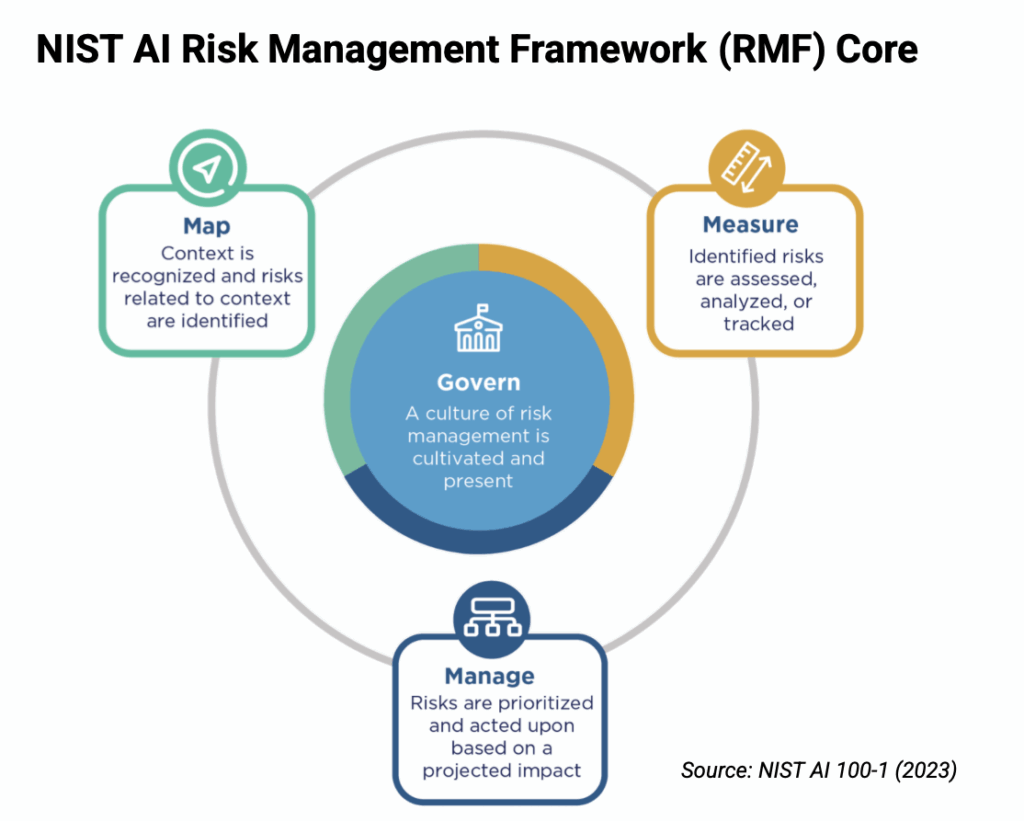
The AI RMF is voluntary but is increasingly referenced in federal procurement requirements and regulatory guidance. For U.S.-based organizations, it is the most practical compliance foundation available. The 2025 updates address generative AI risks and explainability requirements for high-stakes AI applications, along with updated guidance on software supply chain provenance in AI development. NIST also published a Cyber AI Profile in December 2025 that defines specific safeguards for managing cybersecurity risks in AI systems, including real-time monitoring requirements for deployed AI models.
Organizations implementing the AI RMF benefit from compliance tools that automate evidence collection and map controls to the framework’s four functions to streamline audit preparation.
ISO/IEC 42001 and Related Standards
ISO/IEC 42001 is a certifiable AI management system standard specifying requirements for establishing, implementing, maintaining, and continually improving an AI management system within an organization. ISO/IEC 23894 provides supplementary AI risk management guidance designed to work alongside it. Both standards are grounded in the principle of trustworthy AI: they provide compliance frameworks for responsible AI development and deployment that satisfy the documentation and audit requirements of major regulators.
Organizations already certified under ISO 27001 have a structural advantage: ISO/IEC 42001 is designed to integrate with existing management system infrastructure. Alignment with these compliance standards supports validation of AI system behavior against documented requirements, reducing the audit burden when regulators or enterprise customers request evidence.
Building an Internal Compliance Framework
An internal compliance framework translates regulatory obligations into repeatable controls and auditable evidence. The core components are an AI system inventory with risk classification, a defined governance structure with clear ownership, documented artifacts with approval workflows, and defined monitoring thresholds.
Governance, risk, and compliance (GRC) teams are typically responsible for maintaining this framework and ensuring that AI tools used across the organization meet applicable compliance requirements. An AI system inventory serves as the system of record for audits. Each entry should include the system’s owner, business purpose, risk tier under applicable regulations, data sources, deployment environment, third-party components, and current evidence status. Robust data governance practices determine how sensitive data flows into training and inference pipelines.
An AI bill of materials (AIBOM) captures model artifacts, data sources, packages, containers, licenses, and known limitations, linked to audit logs and approval workflows. Automation in this documentation process helps compliance teams streamline evidence collection and surface compliance issues before they become audit findings. Compliance is an ongoing program, not a one-time audit. Required artifacts must have defined owners, review cadences, version history, and risk-tiered approval controls.
AI Compliance Best Practices for 2026
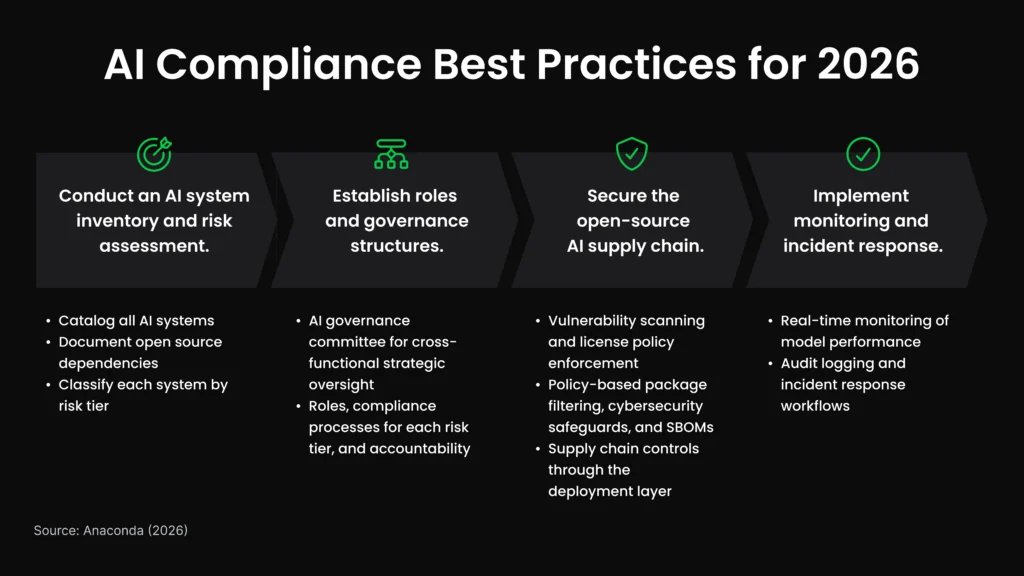
A working AI compliance program rests on four practices: a complete system inventory, defined governance roles, a secured open-source supply chain, and continuous monitoring. Each builds on the last. Skipping inventory work, for instance, leaves risk classification and governance assignments without a foundation.
1. Conduct an AI system inventory and risk assessment.
The first step in any compliance program is a complete catalog of all AI systems in use or under development. The inventory should be a living document, updated as the organization’s AI use expands and systems change. For each system, record the owner, purpose, risk tier, data sources, deployment environment, third-party components, and required evidence. Include AI-specific metadata, such as model type, inference environment, output scope, and version history, with each entry.
Open-source dependencies need explicit treatment. Document which packages, pre-trained machine learning models, container images, and configuration files each system relies on, along with their provenance, license terms, known vulnerability status, and patch history. Regulatory scrutiny begins where documentation gaps exist.
Once the inventory is complete, classify each system by risk tier using the EU AI Act categories or NIST AI RMF impact profiles. High-risk systems require conformity assessments, expanded technical documentation, human oversight mechanisms, and pre-deployment registration before they go live.
2. Establish clear roles and governance structures.
AI compliance spans legal, security, data science, and IT functions, with no natural organizational owner. Ambiguous ownership produces gaps. A working governance structure assigns an AI governance committee for cross-functional strategic oversight. The committee might include a compliance officer for regulatory alignment, a CISO for security posture, legal counsel for regulatory interpretation, and data science leads for model-level accountability.
An AI governance framework that formally documents these roles, defines compliance processes for each risk tier, and assigns accountability to named individuals can give stakeholders, including auditors and enterprise buyers, a clear point of contact for every compliance question.
Below is a sample RACI model for key compliance activities to prevent overlap and gaps. Review the RACI matrix at least once a year and as the regulatory landscape evolves.
RACI Model for AI Compliance: Responsible, Accountable, Consulted, and Informed
| Activity | Responsible | Accountable | Consulted | Informed |
|---|---|---|---|---|
| Vulnerability scanning | Security engineering | CISO | Data science lead | Compliance officer |
| Regulatory filings | Compliance officer | Legal counsel | CISO, data science | Executive leadership |
| Risk classification | Data science lead | Compliance officer | Legal, CISO | Business unit owner |
| Audit results reporting | Compliance officer | Legal counsel | CISO | All stakeholders |
3. Secure the AI supply chain.
The software supply chain represents the largest compliance gap in most AI programs and the highest audit exposure. Effective supply chain compliance requires controls at the package level, the deployment layer, and the API surface.
Include open-source components in your AI supply chain, where vulnerabilities are critical to identify and address. A best practice is to automate vulnerability scanning and license policy enforcement so you block non-compliant or vulnerable components before they enter development or production environments.
Manual vulnerability-review processes do not scale or meet regulatory documentation requirements; the toolchain must include policy-based package filtering and cybersecurity safeguards. This automation also extends to API endpoints that serve model outputs, where vulnerability scanning catches misconfigurations that could expose sensitive data.
Generate software bills of materials for all open-source components and maintain provenance metadata documenting each component’s origin, validation status, review history, and known issues. The EU AI Act’s technical documentation requirements under Articles 11 and 17 map directly to this capability.
Extend supply chain controls through the deployment layer.
4. Implement monitoring, audit trails, and incident response.
High-risk AI systems require real-time monitoring of model performance, including:
- Accuracy, output drift, latency, and throughput
- Periodic bias testing across protected demographic attributes
- Infrastructure vulnerability scanning
- Data quality monitoring across pipelines
Audit logging must capture user interactions, AI-driven model decisions, administrative actions, and API calls at a level of detail that supports regulatory review. Automating compliance checks against defined policy thresholds enables continuous enforcement rather than periodic review, and surfaces compliance issues before regulators do. Incident response workflows must define escalation paths, communication protocols, remediation timelines, and post-incident documentation requirements to satisfy compliance requirements for documented, time-bound responses.
How Anaconda Platform Supports AI Compliance
Anaconda Platform gives organizations a governed path from experimentation to production, the foundation any AI compliance program depends on. Trusted by over 50 million users and 95% of the Fortune 500, Anaconda addresses compliance where most AI development programs have the biggest gaps: the open-source supply chain.
Secure by default. Anaconda Platform delivers curated, vulnerability-scanned packages built from source, with SBOM generation, provenance tracking, automated dependency management, and security policy enforcement built in. Every package and model carries provenance and traceability across the AI workflow, from experimentation through deployment. The platform also provides license compliance filtering, role-based access control, and SSO integration via OpenID, SAML, and SCIM.
With the acquisition of Enkrypt AI, that same secure-by-default posture now extends into production: Enkrypt adds security, governance, and compliance controls that validate and monitor models, agents, and MCP servers once they’re live, surfacing risks that only appear at runtime, not at build time.
Builder velocity without compromising governance. Compliance controls work when builders don’t route around them, and Anaconda’s acquisition of Kilo Code makes that possible. Kilo brings governance into the agentic engineering layer, the model-agnostic coding environment where builders and AI agents write and ship code, so oversight travels with the work instead of arriving as a separate review step after the fact. Governance that lives where the building happens is governance builders don’t have a reason to bypass, turning a compliance program from a bottleneck into infrastructure.
Trusted workflows at scale. Reproducible environments and Anaconda Platform AI orchestration give compliance teams lineage and artifact tracking across every experiment, model, and result, with consistent runtime from local development through production. Reproducibility is what makes compliance evidence auditable: if a result can’t be reproduced, it can’t be verified.
Together, Kilo and Enkrypt mean this consistency now runs the full length of the lifecycle, from the first prompt a builder writes, through the models and agents that result, to the production system those agents run in.
Anaconda Platform also provides a curated catalog of pre-validated AI models with an AI bill of materials (AIBOM), lineage tracking, versioned artifacts, and policy controls, giving compliance teams a single source for model provenance instead of reconstructing it across disconnected systems.
Anaconda’s role in AI compliance follows from its broader position: a trusted foundation that helps builders and enterprises secure, orchestrate, and accelerate data and AI at scale. Govern what goes into a model, and the production system inherits that governance. Now, with Kilo and Enkrypt, that governance extends through how it’s built and how it behaves once it’s live.
To learn more about how Anaconda supports enterprise AI compliance, explore Anaconda Platform’s capabilities or read the AI Governance Platform Buyer’s Guide.
Frequently Asked Questions
What is the difference between AI compliance and AI governance?
AI governance is the strategic framework: the policies, principles, accountability structures, and organizational roles that define how an organization develops and uses AI responsibly. AI compliance is the enforcement mechanism within that framework; the specific compliance processes and controls that ensure governance policies satisfy legal and regulatory requirements. An organization can have strong governance principles and still fail a regulatory audit if it hasn’t translated those principles into documented controls and auditable evidence. Governance defines the standard; compliance demonstrates that the standard is met.
Does the EU AI Act apply to companies outside Europe?
Yes. The EU AI Act has extraterritorial scope. The Act applies when an AI system is placed on the EU market or used by EU residents, regardless of where the provider or deployer is headquartered. This operates similarly to how GDPR applies to any organization handling the personal data of EU residents. A U.S.-based company deploying high-risk AI applications to European customers must meet the Act’s conformity assessment, technical documentation, human oversight requirements, and pre-deployment registration obligations or face enforcement. Review Article 2 of the Act to learn about the scope of the Act’s provisions.
How do SBOMs and provenance tracking reduce AI compliance risk?
A software bill of materials is a structured inventory of every software package, model weight, library, and container image in an AI system, including each component’s version, license, and known vulnerability status. The EU AI Act’s Article 11 and Article 17 require high-risk AI providers to document data sources, component dependencies, provenance records, and validation evidence. Provenance tracking creates an auditable chain of custody from the component’s original source through validation and deployment. Together, these AI tools for supply chain documentation and data governance convert months of manual compliance auditing into a repeatable, automatable process and give auditors a single authoritative document rather than scattered records across teams.
How do I prepare for the EU AI Act’s deadlines?
Start with a complete AI system inventory classified by the Act’s risk tiers, and use the EU AI Act’s Compliance Checker to guide your efforts.
- Prohibited AI system practices are banned, and transparency obligations for limited-risk systems are in effect.
- Transparency obligations under Article 50, including chatbot disclosure and AI-generated content labeling, are also in effect.
- High-risk obligations for standalone Annex III systems, including those used in hiring, credit scoring, education, healthcare diagnostics, and critical infrastructure management, now require conformity assessments, expanded technical documentation, human oversight mechanisms, and pre-deployment registration by December 2, 2027.
- Rules for high-risk AI embedded in regulated products under Annex I apply starting August 2, 2028.
Assign a compliance officer to track regulatory changes and engage legal counsel with EU AI Act experience. Automate software bill of materials (SBOM) generation and vulnerability scanning for open-source components now. The extended timeline provides time to build the documentation infrastructure.
What is the fastest way to operationalize AI compliance without slowing model delivery?
Embedding compliance into development workflows is faster than compliance enforced as a gate before deployment. Organizations that automate policy enforcement at the package level block non-compliant or vulnerable components before they enter environments, which is better than discovering them during a pre-release audit. Automation also streamlines the generation of software bills of materials (SBOMs) and compliance documentation, so developers spend less time manually collecting evidence. Pre-validated, curated model catalogs reduce the documentation burden for each new model deployment. The goal is to make the compliant path the default, so teams don’t have to choose between delivery speed and regulatory safety.