








AI Artifacts
Secure your AI supply chain with open source python packages and models built from source, vetted, and documented before your teams choose them.
Coding assistants pull dependencies into your team’s builds faster than anyone can review them. AI projects run on Python. AI projects depend on Python and open source packages that may never have passed your company’s security and policy checks.
What is in our AI supply chain, and who is accountable for the quality? Today that answer takes weeks of hunting, time you do not have.
Are we affected, and where? Without a bill of materials already in hand, that is a long investigation, not a quick lookup.
Your teams choose the tools and dependencies. You are accountable for the security and compliance risks, often without knowing what was approved or why.
You can’t sign off on what you can’t see. So we build packages from source. 50M+ users and 95% of the Fortune 500 build on Anaconda, from 20,000+ packages and models we build, benchmark, and verify.
Vetted artifacts and controlled builds help your teams reduce supply chain risk before dependencies enter your environment, reducing downstream investigation and remediation.
No migration and no new tools for your developers. What changes is where they resolve packages and models from.
Bring us the environment you’re least comfortable signing off on. We’ll show you what’s actually in it.
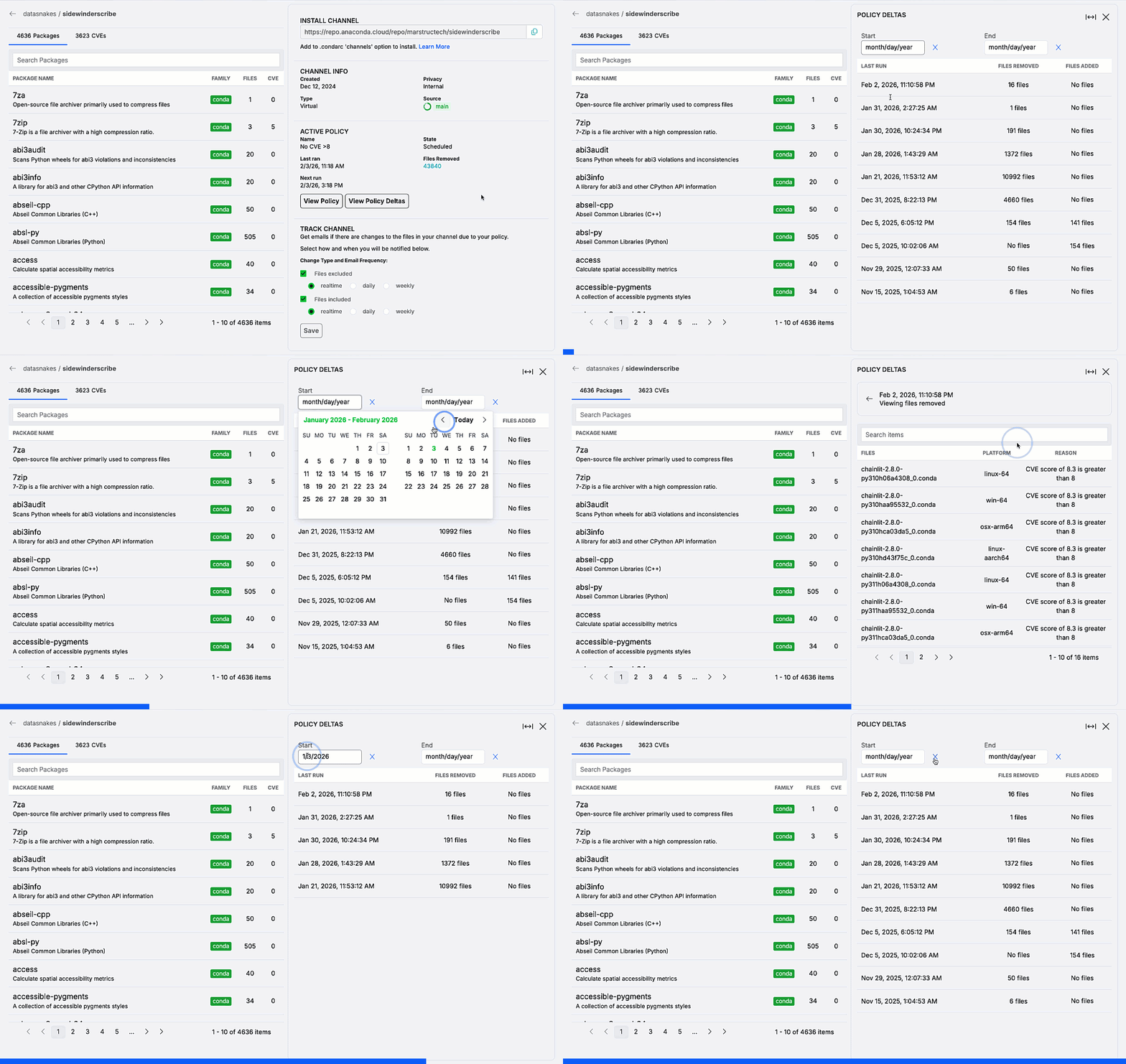
Connect your teams to the curated channel. They keep familiar conda and pip workflows and IDEs while accessing vetted artifacts.
Apply your security and license policies centrally, with rules your teams inherit automatically.
Less time triaging and gathering evidence. More time on the risks that need your judgment.
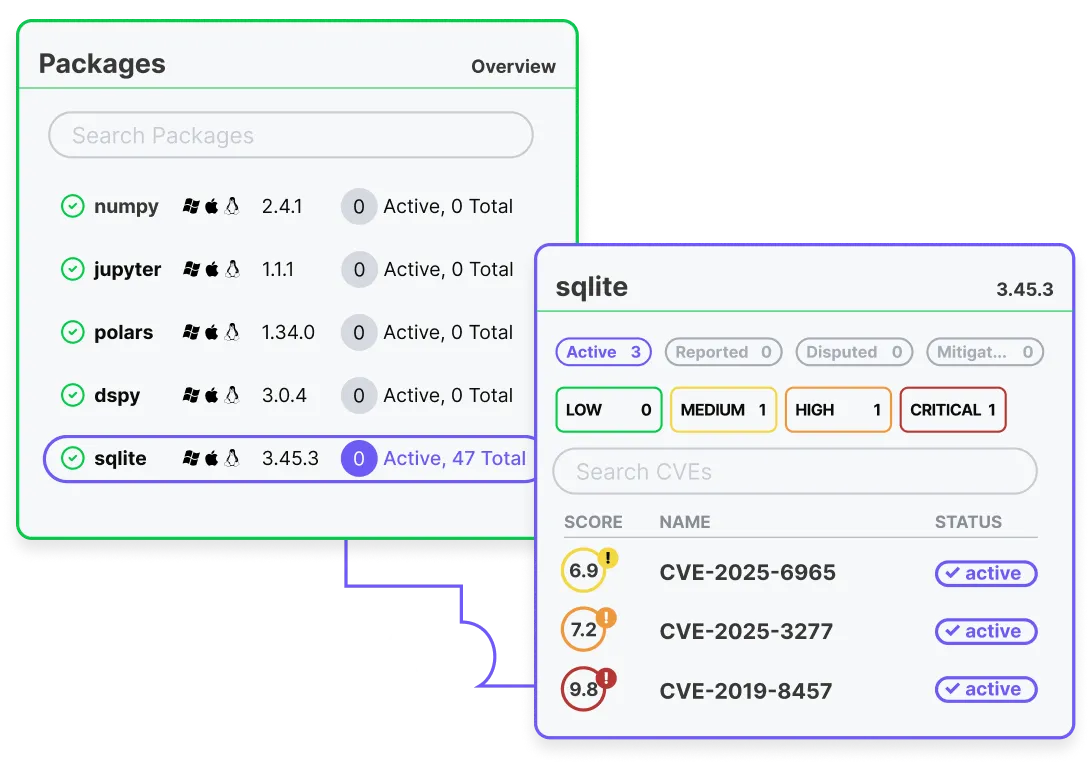
Exposure is a lookup in a record you already hold. Scope stays narrow because you can see exactly which packages are affected and where they run.
License data is already documented and policy is enforced automatically, so audit prep takes less manual work.
Developers install what they need without a review queue. The package that should not be there was never available, so there is nothing to route around.
Before & After
No one is accountable when a package breaks
Vendor accountability for every package
Anyone can build and publish a package
Every package built by Anaconda engineers
Build process varies from package to package
Built from source, every time
Binary dependencies hidden inside wheels
Binaries unbundled, with cross-language dependencies resolved
Vulnerability detection left to third-party scanners
CVE matching plus human review
SBOM and license data still emerging
SBOM and SPDX license data included
No testing of how an update affects downstream packages
Coordinated downstream testing before release
Fixing one library means rebuilding every package that bundles it
One update fixes a dependency everywhere
Choose hosted SaaS, your own infrastructure, or a fully air-gapped network. You decide where your artifacts live.
SAAS
Hosted by Anaconda. Policies apply automatically, vulnerability alerts include fix guidance, and SSO takes three clicks.
Your own infrastructure
Air-gapped networks
It compounds when a vulnerability lands on a Friday. It compounds when an audit fails because a license question has no documented answer. Neither is a failure of your team. It’s what happens when AI is assembled from artifacts nobody qualified.
A scanner inspects a package after it is already a compiled binary in your environment and for conda packages almost always generates false positives and false negatives. Anaconda builds from source, so the evidence still exists when the work is done. Scanning is inspection. Anaconda is a qualification.
Free packages give you the code. They don’t give you an accountable builder or the evidence your security and compliance obligations call for. Anaconda adds packages built from source, an SBOM for each package, CVE matching with human review, policy enforcement, audit trails, and enterprise support. Your teams keep the same open source packages they rely on today. Set Anaconda policy to restrict AI supply chain access based on corporate policy.
No. Teams keep conda and pip workflows and the IDEs, Notebooks, and other tools they already use. What changes is the channel they resolve from, and role-based governance determines what is available in it.
Yes. Artifacts are available in air-gapped networks, meaning networks physically isolated from every other network. Anaconda publishes package and CVE data as signed bundles you download on a connected machine and carry across on portable media. Verify the SHA-256 checksums before you move them. Package bundles refresh monthly and CVE data daily, and your mirror picks them up on its next scheduled run, or whenever you force one.
Your mirror syncs conda, PyPI, and CRAN on the schedule you set. Active mirroring pulls new packages as soon as they are published. Passive mirroring fetches a package the first time someone requests it. Schedule either with cron. Vulnerability data refreshes hourly.
New upstream versions are held for review before release, which stops a poisoned “latest” release from reaching your pipeline minutes after publication. Developers pull normally. The delay applies to a small number of brand-new releases to ensure they do not include malicious code, not to packages teams use every day.
Differently from a package, and deliberately so. Open-weight models are curated from leading repositories and validated with industry-standard benchmarks, then documented with security scoring, licensing and performance metrics. You get an AI Bill of Materials describing provenance, licensing and composition.
Yes, by policy rather than by review queue. Set rules based on security vulnerabilities, licensing or compute requirements, block access to unapproved models, and route approvals automatically. Models are stored in your own private cloud with role-based access, SSO and audit trails, so no data leaves your environment.
For packages, an SBOM listing every package and dependency you pulled, plus provenance and source-hash verification. For models, an AI Bill of Materials covering provenance, licensing and composition, alongside security scoring and benchmark results. In both cases the record arrives with the artifact rather than being assembled later.
AI Artifacts supply the packages and models behind every project on the Anaconda Platform.
Packages, models, and agentic development environments to build with.
Get more AI ideas out of experimentation and into production, faster.
Gain control without becoming the gate. Know what’s entering AI development.