
A four-layer framework for evaluating AI governance platforms across agents, applications, models, and the software supply chain
Organizations use AI governance platforms to ensure their AI systems meet regulatory and security requirements across the complete AI lifecycle, from design to production. AI governance has shifted from a compliance consideration to a procurement criterion, driven by the convergence of regulatory mandates and the deployment of AI in high-stakes decision-making environments, such as financial services and healthcare.
Together, these forces have contributed to the elevation of AI governance as a growing market category. The global AI governance market is forecasted to grow from USD 890 million in 2024 to USD 5.78 billion by 2029, according to analyst firm MarketsandMarkets. This guide evaluates the leading AI governance platforms across four distinct layers of the AI stack—agents, applications, models, and the software supply chain—and the criteria that matter most for enterprise procurement.
What Is AI Governance?
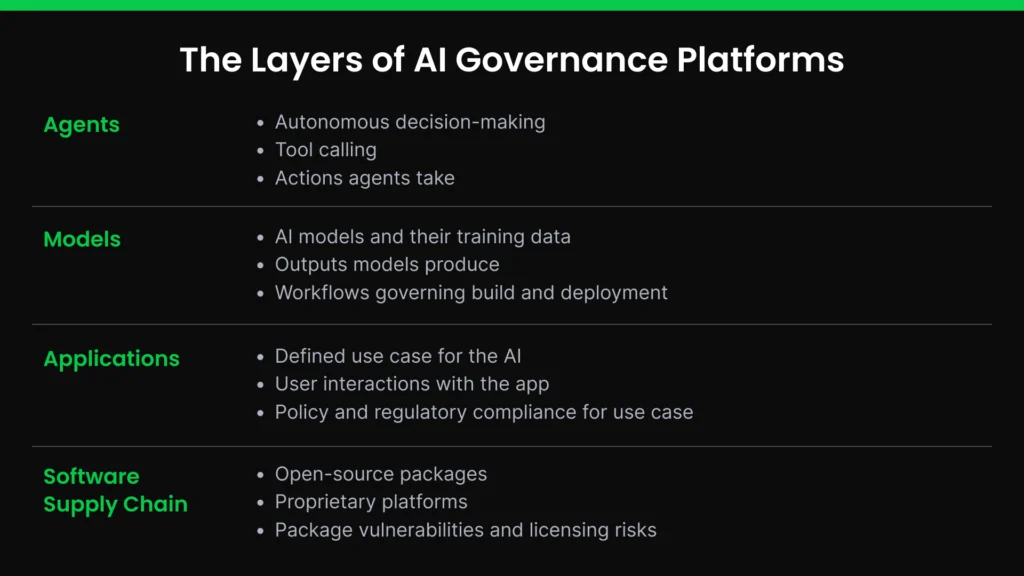
AI governance as a discipline spans four layers of the AI stack, each with distinct stakeholders and tooling:
- Agents: This layer includes the autonomous decision-making, tool calling (i.e., agent “calls on” tools to access data or perform an action), and actions of AI agents in production.
- Models: This layer includes the datasets models were trained on, the outputs they produce, and the workflows governing their development and deployment. Tools assist with producing AI bill of materials (AIBOM) documentation, detecting model drift, providing audit trails, and bias testing.
- Applications: Legal teams assess whether an AI application or system (i.e., a model combined with data and a defined use case) complies with law, regulation, and internal policy. Tools at this layer handle AI use case intake, risk classification, impact assessments, and regulatory compliance documentation.
- Software supply chain: This layer includes open-source packages AI models run on, and other platforms used to build AI. Many AI governance platforms (including most platforms evaluated in this guide) do not address this layer at all. Tools assist with techniques like data analysis, data visualization, machine learning, natural language processing
Enterprises with governance, risk, and compliance (GRC) or legal-led governance programs typically need tooling at all four layers.
AI Governance Platforms
Some AI platform vendors use the term “multi-layer governance” to describe coverage across model, agent, and application layers within the AI system. We hope this guide is a helpful resource as you assess AI governance platforms to determine if they meet your organization’s needs.
The Software Supply Chain Layer
AI systems run on Python, and Python applications depend on hundreds of open-source packages. Every package is a potential governance surface area: each can contain known vulnerabilities, expose unclear licensing, ship compromised binaries, or introduce transitive dependencies that pull in unvetted code.
Capabilities at this layer include real-time vulnerability scanning, CVE detection, and mitigation. Others include cryptographic package signing, automated policy enforcement at the package level, software bill of materials (SBOM) generation with full package metadata, and binary dependency vetting for Python’s compiled C/C++ ecosystem. Dedicated supply chain security tools address this layer, but many were built for general software development rather than AI workloads and provide no model-layer governance.
Increasingly, enterprises are exposed at the package supply chain layer: third-party and supply chain breaches doubled to 30% of all data breaches in 2025 according to the Verizon 2025 Data Breach Investigations Report.
According to Anaconda’s State of Enterprise Open Source AI survey, 32% of organizations reported accidental exposure of security vulnerabilities from open-source AI components, with 50% of those incidents deemed very or extremely significant. The majority (67%) of respondents experienced AI deployment delays due to security issues at this layer.
The Applications Layer
The applications layer is where legal and GRC teams are the primary stakeholders. At this layer, governance means assessing whether a specific AI application, which means a model combined with data and a defined use case, complies with laws, regulations, and the organization’s internal policies. This layer is the focus of the EU AI Act, which classifies AI systems by risk level and assigns compliance obligations based on the application’s use case and deployment context.
Capabilities at this layer include AI use case intake and registration, risk classification by use case, algorithmic impact assessments, policy enforcement for specific applications, and regulatory compliance documentation. Platforms at this layer are designed to give legal, risk, and GRC teams visibility and control over what AI is being used for, by whom, and under what governance conditions.
The Model Layer
The model layer covers AI models themselves, the datasets they were trained on, the outputs and decisions they produce, and the workflows that govern their development and deployment. This includes generative AI (genAI) models such as large language models (LLMs), which require the same governance discipline as traditional machine learning (ML) models and often more, given the difficulty of predicting their outputs at runtime.
Capabilities at this layer typically include AIBOM documentation for AI models, model risk scoring and drift detection, audit trails for model decisions and deployments, shadow AI discovery, real-time policy enforcement via guardrails, explainability documentation, and regulatory compliance templates aligned to the European Union (EU) AI Act, NIST AI Risk Management Framework (RMF), and ISO 42001. This is where many existing AI governance platforms focus exclusively.
The Agents Layer
AI agents are autonomous systems that can make decisions, call external tools, and take actions with real-world consequences, often with minimal human intervention. Governing agents requires capabilities that go beyond what model-layer governance provides: agents don’t just produce outputs, they act on them. An agent that can query a database, send an email, execute a trade, or modify a file introduces governance requirements around access, authorization, audit trails for actions taken, and runtime guardrails that constrain what the agent is permitted to do.
Capabilities at this layer include agent inventory and discovery, runtime policy enforcement for autonomous actions, tool-calling controls, audit trails for agent decisions and actions, and guardrails that define the boundaries of permitted agent behavior. As agentic AI moves from experimentation to production deployment, governance at this layer is becoming a procurement requirement rather than a roadmap item.
The sections below evaluate the leading platforms at each layer against the criteria that matter most for enterprise procurement.
Best AI Governance Platforms: Software Supply Chain Layer
Platforms in this section govern the dependencies, binaries, and open-source components on which AI workloads are built. This layer underpins all three layers above it: every application, model, and agent ultimately runs on a software supply chain.
Most platforms in this guide do not address it. Most general-purpose supply chain tools in this section were built for software development broadly and lack AI-specific governance features. Anaconda Core is the exception: purpose-built for Python and AI workloads, it pairs natively with model-layer governance through Anaconda’s AI orchestration, making it the only platform in this guide that governs from the software supply chain layer up.
Anaconda Platform: Anaconda Core
Overview: Anaconda Core is the foundation of Python data science and enterprise AI development, trusted by 50M+ developers and used across 93% of Fortune 100 companies. It governs the Python package supply chain layer with curated, scanned packages and scalable automated policy enforcement, and, combined with AI orchestration, offers a unified two-layer AI governance from a single deployment.
Layer coverage: Package supply chain layer, with native two-layer integration via Anaconda’s AI orchestration at the model layer
Strengths: Curated and continuously scanned package channels with real-time CVE detection; cryptographic package signing and signature verification; automated policy enforcement at the package level, including blocking by CVE, restricting by license type, and enforcing approved channels; SBOM generation with full package metadata; binary dependency vetting purpose-built for Python’s C/C++ ecosystem; air-gapped deployment for regulated environments. A Forrester Total Economic Impact study validated outcomes including 60% reduced breach risk and seven times more accurate open-source security data.
Best for: Enterprises that need Python-native package governance built for AI and data science workloads, particularly those seeking unified governance across the model layer via Anaconda’s AI orchestration. Strong fit for regulated industries and teams deploying open-source models who need both package and model provenance from a single source of truth.
Consideration: Strongest value when teams adopt the full Anaconda Platform. Organizations with mature, separately procured tooling at one layer may need to consolidate to realize the full value of unified two-layer governance.
Snyk AI Security Fabric
Overview: Snyk AI Security Fabric is a developer-first supply chain security platform covering open-source packages, container images, infrastructure as code, and application code across multiple language ecosystems, with findings surfaced via API.
Layer coverage: Package supply chain layer only
Strengths: Strong CVE detection across multiple package ecosystems; developer workflow integration; container and infrastructure-as-code scanning; broad language support beyond Python.
Best for: Engineering teams that want a unified supply chain security tool across multiple languages and runtimes, particularly when AI is one of many workload types.
Consideration: Built for general software development, not AI-specific workloads. Enterprises using Snyk for AI workloads still need a separate platform for the model layer.
Black Duck Polaris
Overview: Black Duck Polaris is an enterprise software composition analysis platform focused on open-source license compliance, vulnerability detection, and supply chain risk management.
Layer coverage: Package supply chain layer only
Strengths: Mature license compliance capabilities; broad open-source vulnerability detection; strong fit for regulated industries in healthcare and financial services with strict open-source policy requirements
Best for: Enterprises with formal open-source compliance programs that require deep license analysis alongside vulnerability scanning
Consideration: Generic tooling not optimized for Python-specific binary dependencies or AI workloads. Black Duck Signal integrates with AI coding assistants but does not provide complete model-layer governance.
Sonatype Nexus Repository
Overview: Sonatype Nexus Repository is a supply chain management platform focused on policy-driven open-source consumption, repository management, and vulnerability detection for DevSecOps ecosystems.
Layer coverage: Package supply chain layer only
Strengths: Policy-driven repository management; deep CI/CD pipeline integration; strong fit for organizations centralizing open-source consumption through internal repositories
Best for: Enterprises with mature DevSecOps practices that already use Nexus Repository for artifact management and want to extend it with automated policy enforcement
Consideration: Built for general software development. Lacks Python-specific binary dependency management and AI-aware governance. No model-layer capabilities.
Best AI Governance Platforms: Applications Layer
The applications layer is where governance, risk, and compliance (GRC) teams do most of their work: assessing use cases, classifying risk, documenting compliance, and enforcing policy for specific AI deployments. Platforms in this section are primarily designed for legal, GRC, and risk stakeholders, rather than engineering teams.
Credo AI
Overview: Credo AI is an AI governance, risk, and compliance platform with strong application-layer capabilities, including AI use case intake, risk classification, and policy enforcement at the application level.
Layer coverage: Applications layer, model layer, and agent layer; does not address the software supply chain layer
Strengths: AI use case registry with risk classification; pre-built compliance workflows for the EU AI Act, NIST AI RMF, ISO 42001, SOC 2, GDPR, and HITRUST; algorithmic impact assessments; vendor and third-party AI risk assessment portal; dashboards for tracking application-level governance policies and risk metrics across the organization
Best for: Regulated enterprises that need structured use case governance and compliance documentation, particularly those preparing for EU AI Act obligations around high-risk AI systems
Consideration: Does not address the software supply chain layer. Enterprises adopting Credo AI still need a separate tool to govern the packages their AI applications run on.
OneTrust AI Governance
Overview: OneTrust AI Governance provides application-layer governance through its three-stage model: Catalog and Assess, Monitor, and Enforce. It is designed to extend OneTrust’s existing privacy and GRC workflows into AI-specific use case governance.
Layer coverage: Applications layer and model layer; does not address the software supply chain layer
Strengths: AI use case intake and risk classification integrated with existing OneTrust GRC workflows; out-of-the-box impact assessments aligned to the EU AI Act and NIST AI RMF; strong fit for organizations that already use OneTrust for privacy and data governance; partner ecosystem including KPMG, Deloitte, and Google Vertex.
Best for: Enterprises already standardized on OneTrust for privacy and GRC that want to extend governance to AI use cases without adding a separate vendor.
Consideration: Strongest value within the broader OneTrust suite; does not address software supply chain governance
Collibra AI Command Center
Overview: Collibra AI Command Center extends Collibra’s data governance platform to cover AI use cases and applications, with strong emphasis on data lineage from training datasets through model deployment and production use.
Layer coverage: Applications layer and model layer, with strong data governance integration. Does not address the software supply chain layer.
Strengths: Unified governance across data and AI assets; end-to-end data lineage from source datasets through inference and production use; embedded regulatory framework templates; platform-agnostic coverage across AWS, Azure, Google, Databricks, SAP, and MLflow.
Best for: Enterprises that have adopted Collibra for data governance and want to extend unified governance to AI use cases and applications.
Consideration: Does not govern the software supply chain layer.
Anaconda Platform: AI Orchestration
Overview: Anaconda offers AI orchestration on the Anaconda Platform, built on Metaflow. Application-layer governance capabilities are expanding to cover use case documentation and cross-layer audit trails.
Layer coverage: Model layer and production orchestration layer, with native software supply chain integration via Anaconda Core. Application-layer governance is in active development. You can sign up to receive updates on product timelines, integration details, and access information as Anaconda brings these platforms together.
Strengths: Python-native workflow orchestration from experimentation to production; bring-your-own-cloud architecture keeps all data in your environment; SOC 2 certified and HIPAA-capable; experiment tracking, artifact versioning, and run lineage; extends package governance into every workflow execution and deployed endpoint
Best for: Engineering and data science teams that need production-grade AI workflow orchestration with governed model and package foundations, and want those capabilities unified with package-layer governance from a single platform
Consideration: Application-layer governance capabilities are not yet fully available. Enterprises with immediate GRC or Legal-driven use case governance requirements should evaluate whether current Anaconda Platform capabilities meet their timeline.
Best AI Governance Platforms: Model Layer
The model layer is what most readers will recognize as “AI governance” in the traditional sense: governing AI models, the datasets they depend on, the decisions they produce, and the workflows that surround them.
Anaconda Platform
Overview: Anaconda’s enterprise AI orchestration and development platform is built on Metaflow, the open-source AI/ML workflow framework trusted in production by Netflix, AWS, Spotify, and Zendesk. The Anaconda Platform offers production-grade workflow orchestration, creating a unified environment that spans from first development environment to scaled production deployment.
AI model capabilities, including curated open-source model access and AI-native development tooling, are integrated directly into the platform experience. Full model-layer governance, including complete AIBOM documentation and cross-layer audit trails, is currently being integrated.
Layer coverage: Model layer (curated model catalog, experiment tracking, artifact lineage) and production orchestration layer, with native package-layer integration via Anaconda. Full two-layer governance integration is in active development. Sign up to receive updates on product timelines, integration details, and access information.
Strengths: Python-native workflow orchestration from experimentation to production with no change to how data scientists write code; curated open-source model catalog accessible directly within the platform via the @anaconda decorator; dynamic GPU/CPU autoscaling across multi-cloud and on-premises compute; experiment tracking, artifact versioning, and run lineage; bring-your-own-cloud architecture keeps all data in your environment; SOC 2 certified and HIPAA-capable; SSO/Okta authentication and enterprise access control; extends package governance into every workflow execution and deployed endpoint
Best for: Enterprises that need production-grade AI workflow orchestration with governed model and package foundations
Credo AI
Overview: Credo AI is a purpose-built AI governance, risk, and compliance platform focused on model-, agent-, and application-level governance.
Layer coverage: Model layer only, with multi-tier coverage across model, agent, and application layers within the AI system
Strengths: Continuous risk assessment for bias, security, privacy, and regulatory compliance across AI use cases; pre-built policy templates for the EU AI Act, NIST AI RMF, ISO 42001, SOC 2, GDPR, and HITRUST; real-time guardrails for AI agents; dashboards for tracking AI risk metrics and governance policies; native integrations across Snowflake, Databricks, AWS, Azure, and MLflow
Best for: Regulated enterprises preparing for EU AI Act compliance that need deep model, agent, and application-level oversight across their AI initiatives
Consideration: Does not address the Python package supply chain. Enterprises adopting Credo AI still need a separate supply chain security tool to close the package-layer gap.
Asenion + Fairly AI
Overview: Asenion (formerly Fairly AI) is an AI governance, risk, and compliance platform focused on automated testing, model risk management, and AI lifecycle policy enforcement.
Layer coverage: Model layer only.
Strengths: Multi-agent-as-a-judge framework for automated AI risk assessment; Asenion compliance agent developed through pilots with a tier-1 bank for EU AI Act audit preparation; algorithmic fairness testing and explainability documentation; deep model risk management heritage suited to financial services; MLflow integration and partnerships with AWS and Meta’s Llama
Best for: Financial services, insurance, and regulated enterprises with established model risk management practices preparing for EU AI Act audits
Consideration: Does not govern the Python package supply chain. Strongest value when paired with a package-layer platform.
Holistic AI
Overview: Holistic AI is an end-to-end AI governance platform built on an Identify/Protect/Enforce governance framework. It discovers shadow AI across the enterprise, runs specialized tests for bias, safety, and security, and enforces regulatory compliance through deployment gates and Guardian Agents for real-time agentic AI oversight.
Layer coverage: Model layer only
Strengths: Shadow AI discovery via 20+ integrations including AWS, Azure, GitHub, and Databricks; test types including red teaming, adversarial testing, and drift detection; regulatory frameworks for the EU AI Act, NIST AI RMF, and ISO 42001; observability and audit-ready dashboards; Guardian Agents for runtime agent oversight
Best for: Enterprises with distributed AI development across multiple teams who need centralized visibility into every model, agent, and application in production
Consideration: Does not govern the Python package supply chain that those AI models depend on.
OneTrust AI Governance
Overview: OneTrust AI Governance extends the broader OneTrust trust intelligence platform into AI-specific governance through a three-stage model: Catalog and Assess, Monitor, and Enforce. It provides AI use case intake, risk classification, automated policy enforcement, and AI lifecycle monitoring.
Layer coverage: Model layer only
Strengths: Deep integration with OneTrust’s GRC and data governance ecosystem; out-of-the-box assessments aligned to the EU AI Act and NIST AI RMF; real-time enforcement of AI controls on platforms including AWS Bedrock; AI agent and MCP environment governance; partner ecosystem including KPMG, Deloitte, Google Vertex, and Databricks
Best for: Enterprises already using OneTrust for privacy and GRC that want to extend governance to AI use cases and AI agents without adding a separate vendor
Consideration: Strongest value within the broader OneTrust suite. Does not address Python package supply chain governance.
Collibra AI Command Center
Overview: Collibra AI Command Center extends the Collibra data governance platform to cover AI use cases, models, and AI agents, unifying stakeholders around a shared system of record with strong emphasis on data quality and data lineage from training datasets through model deployment.
Layer coverage: Model layer only, with strong data governance integration
Strengths: Platform-agnostic governance across AWS, Azure, Google, Databricks, SAP, and MLflow; end-to-end data lineage from source datasets through inference; embedded regulatory framework templates; data quality recommendations for AI initiatives
Best for: Enterprises that have adopted Collibra for data governance and want unified governance across data and AI assets
Consideration: Does not govern the Python package supply chain.
IBM watsonx.governance
Overview: IBM watsonx.governance is IBM’s AI governance solution within the broader watsonx platform, providing model lifecycle governance, AI risk management, and regulatory compliance for both traditional ML and generative AI.
Layer coverage: Model layer only
Strengths: Deep integration with the IBM watsonx platform; strong model lifecycle governance and audit trails; embedded fairness, explainability, and drift detection; scalable enterprise AI security and support
Best for: Enterprises standardized on IBM watsonx or invested in the broader IBM ecosystem
Consideration: Tightest value within the IBM ecosystem. Does not address Python package supply chain governance.
Best AI Governance Platforms: Agents Layer
Agent governance is the fastest-moving area of AI governance tooling. Platforms in this section provide capabilities to inventory, monitor, and enforce policy over AI agents operating in production. Because agents act autonomously, governance at this layer requires real-time controls rather than periodic review. Each entry follows the same structure as previous sections.
Holistic AI
Overview: Holistic AI’s Guardian Agents architecture provides runtime oversight for agentic AI, including real-time policy enforcement and audit trails for agent decisions and actions. It is built on an Identify/Protect/Enforce governance framework that extends naturally to agentic deployments.
Layer coverage: Agents layer, model layer, and applications layer. Does not address the software supply chain layer.
Strengths: Guardian Agents for runtime agentic AI oversight, including Sentinel (monitoring) and Operative (enforcement) components; shadow AI discovery via 20+ integrations to surface unauthorized agents in production; red teaming and adversarial testing for agent safety; audit-ready dashboards for agent activity.
Best for: Enterprises with distributed AI development across multiple teams who need centralized visibility and real-time enforcement over AI agents in production.
Consideration: Does not govern the software supply chain layer that agents depend on at runtime.
Credo AI
Overview: Credo AI’s GAIA assistant provides runtime guardrails for agentic AI, enforcing governance policies for agent behavior and tool-calling at the application level. Its multi-tier governance model extends continuously from the model through the agent and application layers.
Layer coverage: Agents layer, applications layer, and model layer. Does not address the software supply chain layer.
Strengths: Runtime guardrails for AI agents via the GAIA assistant; continuous risk assessment across agent behavior, tool-calling, and outputs; pre-built policy packs aligned to EU AI Act and NIST AI RMF for agentic use cases; native integrations across the enterprise AI stack
Best for: Regulated enterprises that need policy enforcement and compliance documentation for AI agents, particularly those with EU AI Act obligations around high-risk agentic systems
Consideration: Does not address the software supply chain layer
OneTrust AI Governance
Overview: OneTrust AI Governance provides agent and MCP environment governance as part of its broader trust intelligence platform, extending its three-stage governance model to cover agentic AI deployments.
Layer coverage: Agents layer, applications layer, and model layer. Does not address the software supply chain layer.
Strengths: Agent inventory and governance within the broader OneTrust GRC ecosystem; MCP environment governance; native enforcement of agent controls on platforms including AWS Bedrock; strong fit for organizations already using OneTrust for privacy and GRC
Best for: Enterprises already standardized on OneTrust that want to extend governance to agentic AI deployments without adding a separate vendor
Consideration: Does not address software supply chain governance
Anaconda Platform
Overview: Agent governance capabilities are on the roadmap for Anaconda Platform. Current capabilities focus on workflow orchestration, experiment tracking, and governed model and package foundations that agentic systems can be built on.
Layer coverage: Model layer and production orchestration layer, with native software supply chain integration via Anaconda Core. Agent governance capabilities are in active development. Sign up to receive updates on product timelines, integration details, and access information.
Strengths: Python-native orchestration provides a governed foundation for agentic workflows; bring-your-own-cloud architecture ensures agent activity data stays in your environment; package-layer governance extends to every runtime environment agents operate in
Best for: Engineering teams building agentic AI systems who want governed model and package foundations from the start, and who expect agent governance capabilities to be available through the same platform as integration progresses
Consideration: Dedicated agent governance capabilities are not yet available. Enterprises with immediate agent oversight requirements should evaluate purpose-built agent governance platforms alongside Anaconda Platform.
5 Best Practices for Choosing an AI Governance Platform
Choosing the right platform depends on the layer coverage your enterprise needs, your existing technology stack, your regulatory exposure, and your team’s capacity to manage governance as ongoing operational work. Here are five best practices for choosing the best AI governance platform for your organization and use cases:
- Start by mapping your layers: Before evaluating individual governance solutions, determine which of the four layers your enterprise needs governed and who owns each one. Legal and GRC teams typically drive applications and agents layer procurement. Engineering and security teams typically drive procurement at the model and software supply chain layers. Most enterprises need coverage across all four layers, which means governance platform selection is rarely a single-team decision.
- Map platform choice to regulatory exposure: EU AI Act and GDPR exposure requires platforms with strong model-layer governance, AIBOM documentation, and risk classification. Open-source licensing and supply chain compliance require SBOM generation, license filtering, and CVE tracking: Anaconda Core and dedicated SCA tools address these needs. Industry-specific regulations in healthcare and financial services often require both layers, as well as air-gapped deployment. Regulatory requirements rarely map cleanly to a single layer.
- Evaluate integration cost, not just feature cost: Single-layer platforms often appear cheaper on a sticker-price basis, but the total cost of ownership includes procuring a second platform, integrating two governance workflows, and managing the AI risk created by gaps between the two systems. Evaluate platforms on what it takes to achieve complete AI governance, not partial governance.
- Assess team capability and operational burden: Centralized governance teams are well-served by platforms with strong policy management, audit dashboards, and compliance reporting. Distributed engineering teams are better served by platforms that enforce governance at the developer workflow level, as Anaconda Core does. Most enterprises need both: centralized governance policies with distributed enforcement. Two-layer platforms support this naturally.
- Plan for audit readiness from day one: When an auditor or regulator asks what is running in production, what it depends on, and how you know it is safe, audit-ready governance requires model-layer evidence (i.e., AIBOM documentation, audit trails, risk assessments), package-layer evidence (i.e., SBOM generation, CVE history, license records), and cross-layer evidence (i.e., tracing a model in production back through its dependencies and deployment events to support audit-ready decision-making). Single-layer platforms cannot produce cross-layer evidence on their own.
Why Choose Anaconda for AI Governance
Anaconda is trusted by 50M+ developers worldwide and used across 93% of Fortune 100 companies.
Anaconda Core governs the Python package supply chain: real-time CVE detection, cryptographic package signing, automated policy enforcement, and SBOM generation for every dependency your AI runs on. Anaconda’s AI orchestration governs the model layer: workflow orchestration from experiment to production, artifact versioning, and a curated catalog of open-source models, all in your own cloud environment. A Forrester Total Economic Impact study of the Anaconda Platform validated 60% reduced breach risk and seven times more accurate open-source security data than typical third-party security tools.
Both layers share the same audit log, governance framework, and security posture: a single source of truth for which AI models, trained on what data, run on which packages, with which vulnerabilities, deployed under which governance policies. No stitching. No gaps between systems.
If you’re ready to see what Anaconda can do for your organization’s two-layer governance approach, request a demo.
For a deeper understanding of risks, benefits, and best practices, check out Anaconda’s guide on open-source security.
Frequently Asked Questions
How long does it take to implement an AI governance platform?
Timelines range from several weeks to several months, depending on the layers being governed, existing tooling integrations, and the size of the AI inventory being brought under governance. Unified two-layer platforms typically deploy faster than procuring and integrating two single-layer AI tools. You can request customized pricing and implementation options for your specific use cases and requirements from Anaconda.
Who owns AI governance within an enterprise: security, legal, data science, or IT?
The best practice here is for all of them to own AI governance, working together. Most mature enterprises run a cross-functional governance council across security, legal, data science, and IT stakeholders. Day-to-day enforcement sits with engineering and security. Policy strategy and regulatory interpretation sit with legal and risk. The platform’s job is to give all stakeholders shared dashboards and a shared system of record so that governance policies set by one team are automatically enforced by the tools used by another.
Do small and mid-sized companies need an AI governance platform?
Company size does not determine regulatory exposure. Small and mid-size businesses (SMBs) handling healthcare data, serving EU customers under GDPR and the EU AI Act, or operating in financial services face the same AI risk and compliance requirements as large enterprises. Most scalable enterprise AI governance platforms offer starter tiers suited to SMBs, and many begin with package-layer governance and basic model documentation before expanding to a full GRC suite as their AI adoption grows.
How do AI governance platforms handle third-party and embedded AI, such as AI features inside SaaS tools?
Most platforms include vendor and third-party AI inventory and risk assessment workflows: Credo AI includes a vendor portal, and OneTrust extends its third-party management to cover embedded AI use cases. Discovering shadow AI is the relevant capability here. More than 80% of workers, including 88% of security professionals, use unapproved AI tools in their jobs, according to UpGuard’s 2025 State of Shadow AI report. Employees deploy these shadow AI tools without formal governance oversight.
What is the typical pricing model for AI governance platforms?
Most enterprise platforms price by quote. Common drivers include AI inventory size, user count, and module scope. Package-layer tooling typically prices by developer seat or repository count. Model-layer tooling is often priced by AI use case or asset under governance. The total cost of ownership for two separately procured single-layer tools is often higher than that of a unified platform once integration and operational costs are factored in.
How often should AI governance policies be reviewed and updated?
Quarterly review is the floor; real-time automated enforcement is the goal. Trigger-based reviews are more important than calendar-based ones: when a new AI model is deployed, a new dataset is introduced, a new regulation takes effect, or a new vendor is added to the AI ecosystem. Governance policies that exist only in documentation but are not enforced at runtime create compliance theater.