
Your security team can probably tell you what software is running in production. Software bills of materials (SBOMs) became standard practice after the U.S. President’s Executive Order 14028 and the supply chain incidents that made dependency visibility a board-level concern. As tooling matured and schemas stabilized, SBOMs moved from aspiration to audit requirement.
The same team probably cannot produce an AI bill of materials (AIBOM, also written AI BOM or AI-BOM) for the models it runs. What model is running? What data trained it? What dependencies does it embed? What risks does it carry? The model layer often sits inside production systems as an opaque artifact that gets less scrutiny than a single Python package.
The stakes are concrete. When your application runs an open-source model pulled from a public repository, it inherits whatever that repository contains. In May 2026, a malicious Hugging Face model impersonated an OpenAI release and reached 244,000 downloads within 18 hours before researchers identified infostealer malware in its loader script, along with six additional repositories running identical logic. Software composition analysis tools inspect code dependencies, so a malicious loader script packaged with model weights falls outside what they check.
AIBOMs close that gap. This guide covers what AIBOMs are, how they extend SBOM concepts, what they should capture, which standards are in production use, how to implement them so they survive past the first audit, and where implementations break down. It is written for security, MLOps, AI engineering, and governance practitioners who need to put AIBOMs into practice.
What is an AI bill of materials (AIBOM)?
An AI bill of materials is a structured, machine-readable inventory of the components used to build and run an AI system. That includes the model itself, its training data, embedded dependencies, licensing terms, evaluation results, and known risks. An AIBOM is the AI-layer counterpart to an SBOM.
Treat an AIBOM as a build artifact. It is generated and versioned alongside the system it describes, and automated checks read it. An AIBOM delivered as a static PDF and filed after an audit will fail at the moment it was meant to help: when someone needs to know whether a model in production carries a newly disclosed vulnerability or a license that conflicts with a new use case.
The National Institute of Standards and Technology (NIST) framed the critical role of the AIBOM early, positioning it as a mechanism for securing AI ecosystems rather than a documentation obligation. NIST recommends using AIBOMs as inputs to automated decisions, such as deployment gates and license checks. If your team already applies that discipline to open-source security, the AIBOM moves it up a layer.
AIBOM vs. SBOM: what’s the difference?
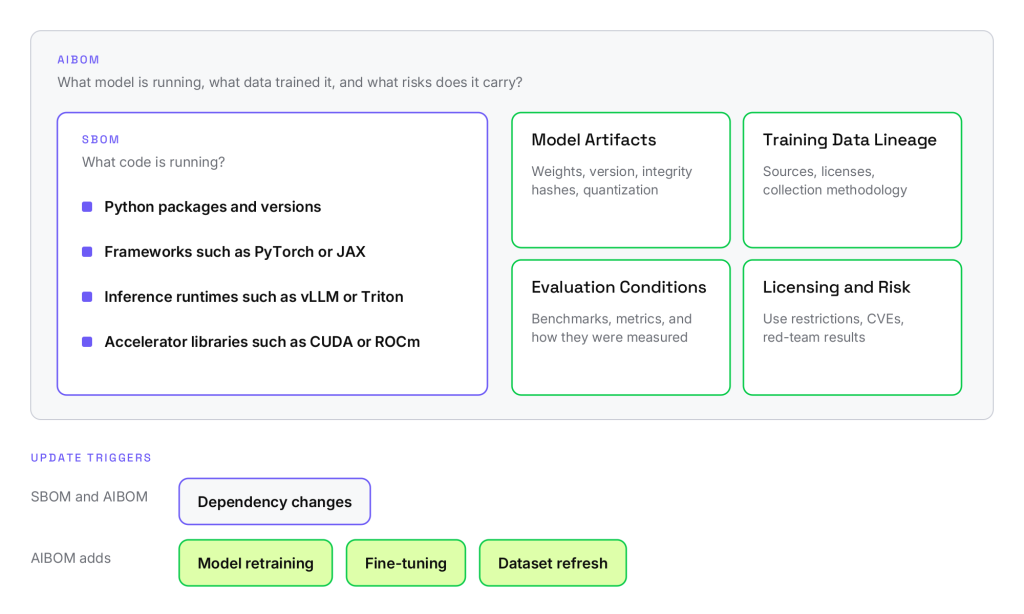
An SBOM documents software components and answers “what code is running in production?” An AIBOM, or AI SBOM as some teams call it, extends the concept to AI systems and answers “what model is running, what data trained it, and what risks does it carry?”
These two differences drive everything else:
Scope: SBOMs cover software dependencies. AIBOMs cover those dependencies plus model artifacts, training data lineage, and evaluation conditions. AI behavior depends on data and model weights as much as it depends on code, so an inventory limited to code describes part of what determines system behavior. A model with clean dependencies can still produce unacceptable outputs because of what it was trained on.
Update triggers: SBOMs update when software dependencies change. AIBOMs update on those same triggers, plus model retraining, fine-tuning, and dataset refreshes. Those additional triggers expand what counts as a meaningful change in the system, which makes manual maintenance untenable sooner for AIBOMs than for SBOMs.
AIBOMs and SBOMs work together, and modern AI systems need both. A team with mature SBOM workflows starts with an advantage: the tooling transfers directly, and so does the habit of treating inventory as a gate rather than a report. AIBOMs also can fit into an existing AI governance program instead of requiring a new one.
What an AIBOM captures
Multiple specifications now define what an AIBOM should contain, and the Software Package Data Exchange (SPDX) 3.0 AI Profile, the CycloneDX machine learning bill of materials (ML-BOM), and the Open Worldwide Application Security Project (OWASP) AIBOM Project cover the same core categories. Regardless of the schema you adopt, the six categories below remain valid. Each one guides a specific component-level risk decision.
1. Model metadata and provenance
Metadata captures the fields that identify the model: name, version, unique identifier, architecture, parameter count, integrity hashes, and quantization variants. Quantized variants deserve explicit treatment, because a 4-bit quantization behaves differently from the full-precision original and often carries different evaluation results.
Provenance covers the model creator, source repository, publication date, and model card reference. For fine-tuned models, provenance must capture the base model identifier and the fine-tuning methodology. Without the base model identifier, a vulnerability disclosed against a widely used foundation model cannot be traced to the derivative models running in your environment.
Record provenance at selection time. Reconstructing it later means trusting a repository page that may have changed since you pulled the weights.
2. Training data
Capture dataset names and sources, licensing terms, collection methodology, and known limitations or biases. SPDX 3.0 includes a dedicated Dataset Profile that complements the AI Profile for this purpose and documents dataset provenance and lineage as first-class objects.
Training data licensing can conflict with model licensing in ways that are not obvious. A permissive model license does not mean the training data permits commercial use. If you discover the conflict after deployment, you cannot simply swap in a drop-in alternative; you may be forced to re-architect the entire solution around a completely different framework.
For closed and partially open models, training data is the field that vendors are least willing or able to disclose. Record that gap explicitly. A model with undocumented training data carries a different risk profile than one with a published data summary, and your procurement process should be able to see the difference.
3. Embedded dependencies
Capture the frameworks the model depends on for inference with specific versions, along with inference runtimes, tokenizers, preprocessors, and hardware acceleration dependencies. In practice, this means PyTorch releases or JAX versions, serving stacks such as vLLM or Triton, and CUDA or ROCm requirements.
Embedded dependencies are where AIBOMs and SBOMs intersect. An AIBOM should reference or include the SBOM for the model’s runtime dependencies. CycloneDX handles this directly, because ML-BOM and SBOM share the same underlying schema, so one pipeline can produce the two records.
Treat the dependency list as a governance surface. Resolving inference dependencies from governed channels and recording what each environment installed will keep the AIBOM accurate and catch a vulnerable package before it reaches production. Anaconda’s article on governed packages and models in workflow steps shows one way to apply that policy at install time.
4. Licensing
Capture model license, commercial use permissions, attribution requirements, and usage restrictions imposed by the license terms. Model licenses range from standard open-source licenses such as Apache 2.0 and MIT to bespoke community licenses with restrictions tied to user counts, geographies, or use cases. The bespoke licenses are where enterprises get surprised, because they encode business constraints that license scanners built for software packages were not designed to evaluate.
Review licensing at the AIBOM stage. Post-deployment license remediation means replacing the model and revalidating everything built on top of it.
5. Performance and benchmarks
Capture results on evaluation datasets relevant to the model’s modality, along with task-specific metrics such as latency, throughput, and accuracy. Record the evaluation methodology and the conditions under which benchmarks were measured, because a benchmark number without its conditions cannot be compared with other results.
Record the benchmarks that were run and treat the set as versioned metadata rather than hard-coding a fixed benchmark list into your AIBOM policy. Benchmark suites are revised and retired, and a policy pinned to a specific suite goes stale when the suite does.
6. Security and risk profile
Capture known common vulnerabilities and exposures (CVE) in embedded dependencies, results from AI-specific security assessments, bias and fairness testing results, adversarial robustness testing, and a risk rating with recommended use cases or restrictions. The OWASP Top 10 for Large Language Model Applications and MITRE ATLAS provide vocabulary for classifying AI-specific findings, which matters when a security team that does not work in machine learning has to read the AIBOM.
Populate these fields from your existing testing practice, including adversarial methods that go beyond jailbreak tests, such as AI red teaming. An empty risk profile usually means no testing ran. Schedule testing so each model version reaches the AIBOM with results attached.

Why AIBOMs are becoming a necessity
Visibility is the lead driver for AIBOMs: you cannot audit what is inside your AI models without a structured record of it. Regulation reinforces the urgency, but the visibility gap exists independently of any compliance deadline. Two pressures are converging: regulatory frameworks that require AI documentation, and supply chain risks that have materialized in documented incidents.
Regulatory frameworks pushing AIBOM adoption
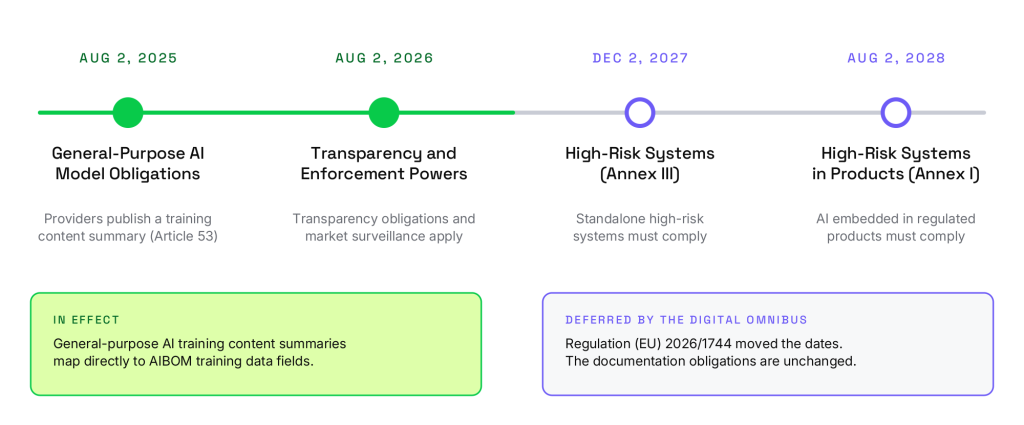
The European Union (EU) AI Act: Obligations for providers of general-purpose AI models are in effect, including the Article 53 requirement that providers publish a summary of training content covering data sources and top domain names. That requirement maps directly to AIBOM training data fields. Transparency obligations and market surveillance enforcement powers are also in effect. The Digital Omnibus, Regulation (EU) 2026/1744 is in force, and it deferred high-risk obligations to December 2, 2027 for standalone Annex III systems and August 2, 2028 for systems embedded in products, giving European standardization bodies time to publish the supporting standards.
The deferral does not reduce the work. The documentation obligations are unchanged, and a team that treats 2027 as its start date will be reconstructing lineage for models that have already been retrained many times. Anaconda’s overview of the state of AI regulation heading into 2027 covers how these frameworks interact.
NIST AI Risk Management Framework (AI RMF): The AI RMF provides voluntary guidance organized around four functions: govern, map, measure, and manage. The map and measure functions call for documentation practices that align closely with AIBOM fields, particularly context, provenance, and measured system characteristics.
ISO/IEC 42001: The International Organization for Standardization’s (ISO) AI management system (AIMS) standard defines requirements for organizations that provide or use AI-based products. Organizations can seek third-party certification against it, and its documentation requirements draw on the same information an AIBOM captures.
U.S. Federal policy: A U.S. President revoked Executive Order 14110 in January 2025 with Executive Order 14179 to remove barriers to American leadership in AI. Content that cites 14110 as a live AIBOM driver is out of date. Federal pressure now comes through procurement rather than through a single executive order: agency acquisition requirements, Federal Risk and Authorization Management Program (FedRAMP) authorization, and Department of Defense guidance layer AI documentation expectations onto existing compliance frameworks.
Industry-specific requirements: Healthcare organizations map AI documentation onto the Health Insurance Portability and Accountability Act (HIPAA) and Food and Drug Administration (FDA) guidance for AI-enabled medical devices. In financial services, US banking regulators replaced the long-standing SR 11-7 model risk guidance with SR 26-2 in April 2026, and the new guidance places generative AI and AI agents outside its scope. Banks remain accountable for those systems under their own governance programs, and an AIBOM gives that documentation a consistent structure. Anaconda’s analysis of who owns generative AI testing under SR 26-2 covers that gap in more detail.
Map each framework you answer to onto specific AIBOM fields, so one inventory supplies the evidence for each report.
AI supply chain risk is real and growing
AI supply chain risk has moved from research papers into documented incidents. The May 2026 Hugging Face incident is one case in a category that researchers continue to document. Four risk types map to a specific AIBOM field:
- Data poisoning: Compromised or maliciously crafted training data alters model behavior in ways that evade standard functional testing. Without training data documentation, you have no basis for detecting it.
- Model tampering: Attackers distribute modified weights under the guise of legitimate models. Integrity hashes recorded in an AIBOM make substitution detectable at load time rather than after an incident.
- Unverified embedded dependencies: AI models ship with required Python packages, and those packages carry known CVEs like any other dependency. Without dependency documentation at the model layer, those vulnerabilities run in production undetected, because the model is treated as a single opaque artifact rather than as a bundle of software.
- License risk: Model or training data licensing can conflict with intended use. The conflict often surfaces late, during a commercial expansion or an acquisition diligence process, when an AIBOM review would have caught it during selection.
AI systems are non-deterministic by design, while the infrastructure supporting them must be deterministic and auditable. That requirement gets harder to meet when agents select dependencies and trigger deployments on their own, as rapid changes threaten to bypass critical human gates. To keep humans effectively in the loop without slowing down innovation, we must make AIBOM generation automatic and machine-readable so our inventory keeps pace with the rate of change.
AIBOM standards
Multiple AIBOM specifications are in production use, with active tooling and translation between formats.
SPDX 3.0 AI Profile
SPDX is published as ISO/IEC 5962:2021, which gives it regulatory weight in procurement and federal contexts. SPDX 3.0, released in April 2024, introduced a profile architecture. Its AI Profile covers model provenance, architecture, training details, and model risks, and a complementary Dataset Profile covers training data with dedicated fields for source, licensing, and collection methodology.
SPDX 3.0 is progressing through ISO as a second edition replacing the 2021 standard. As of late 2026, it sits at the Draft International Standard enquiry stage, with the member ballot having closed in June 2026. If your procurement language references ISO standards, track that status.
CycloneDX ML-BOM
CycloneDX is an OWASP-backed standard ratified as ECMA-424. ML-BOM was introduced in CycloneDX v1.5 in June 2023 and has continued to evolve since. Its defining characteristic is that ML-BOM uses the same underlying schema as SBOM, which lets you produce model-layer and package-layer inventories from one tooling and reporting pipeline.
That property makes CycloneDX ML-BOM a practical choice for generation inside continuous integration and continuous delivery (CI/CD) pipelines. If your teams already produce CycloneDX SBOMs, the generation step extends an existing pipeline rather than adding a new one.
OWASP AIBOM Project
The OWASP AIBOM Project focuses on putting AIBOMs into practice through guidance and reference tooling rather than through a new schema. The project publishes an open-source AIBOM Generator that produces CycloneDX-format AIBOMs from Hugging Face model metadata, with a field checklist and completeness scoring that shows which fields are missing.
Completeness scoring turns “we have an AIBOM” into a measurable claim. It also shows the gap between models with rich published metadata and models whose publishers disclosed almost nothing.
If your teams already use Hugging Face models, start with the OWASP AIBOM Generator before building tooling of your own. The project also publishes guidance on AIBOM lifecycle management and the AI threat landscape that complements the schema work in SPDX and CycloneDX.
Choosing between standards
The standards are interoperable, and translation tools such as Protobom and BomCTL convert between SPDX and CycloneDX formats, which lowers the cost of choosing one over the other.
One workable split is to require the SPDX 3.0 AI Profile from external vendors for its regulatory weight, and to use CycloneDX ML-BOM for internal CI/CD generation, where tooling availability and SBOM integration matter more.
Choose one and iterate, rather than waiting for the standards to consolidate. Interoperability tooling makes schema migration manageable, and a migration costs far less than reconstructing 18 months of undocumented model lineage.
How to implement AIBOMs
Implementations fail when teams treat AIBOMs as a one-time documentation exercise. AIBOMs deliver value when they are continuously updated and wired into governance workflows, and the sequence below follows that principle.
1. Decide where AIBOMs are generated.
Start here, because this decision constrains the rest: whether AIBOMs are generated at the source, during model selection and deployment, or after the fact, through scanning and reconstruction.
At-the-source generation means AIBOMs are produced as part of model selection workflows, so teams consume models that already have AIBOMs attached. This approach scales because the AIBOM is a byproduct of standard work, rather than a separate task competing for engineering time. Curated model catalogs that ship an AIBOM with each model follow this pattern, as do CI/CD pipelines that generate CycloneDX ML-BOMs alongside SBOMs at build time.
After-the-fact generation is post-hoc AIBOM production through scanning tools or manual documentation. Open-source options such as the OWASP AIBOM Generator support this approach, as does Graph for Understanding Artifact Composition (GUAC), an aggregation project from the Open Source Security Foundation (OpenSSF). Several commercial scanning platforms do as well. Post-hoc generation requires ongoing engineering work and often produces incomplete documentation, because some metadata cannot be reconstructed from artifacts alone. Training data provenance for a model downloaded eight months ago is often unrecoverable.
Use at-the-source generation as the default for new AI workloads. Post-hoc tooling has a legitimate role for legacy models, third-party AI services you do not control, and the initial inventory phase when you need to document what is already running in production.
2. Choose a standard, or pick a tool that handles standards.
The choice among SPDX 3.0 AI Profile, CycloneDX ML-BOM, and the OWASP project’s tooling matters less than picking one and applying it consistently. Inconsistent AIBOMs across teams create a reconciliation problem that can be worse than the original visibility gap.
Use a platform or tool that handles schema generation, instead of building AIBOM tooling in house. Given the maturity of available options, custom AIBOM tooling rarely pays for itself, and a custom schema creates a translation burden whenever a regulator or customer asks for a standard format.
3. Integrate AIBOMs into governance workflows.
AIBOMs create value when they feed operational decisions. These four integration points carry that value:
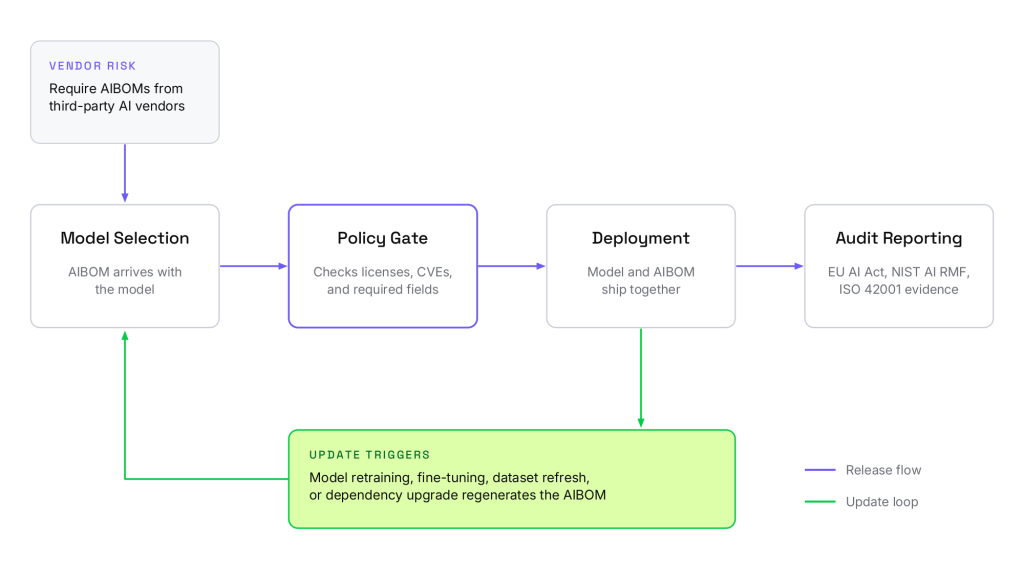
Model selection: Use AIBOM data to evaluate models before deployment. Block or flag models with incompatible licenses, high-risk security scoring, or undocumented training data. This is the cheapest place to catch problems, and it is why a structured model selection process and AIBOM generation belong in the same workflow.
Policy enforcement: Tie AIBOM data to deployment gates. Models that fail AIBOM-based policy checks, whether for license incompatibility, missing required fields, or CVE thresholds, cannot deploy without explicit override. Build the override path in from the start, because teams may route around a gate that has no exception process.
Audit reporting: Generate compliance documentation for the EU AI Act, NIST AI RMF, ISO 42001, or industry-specific frameworks directly from AIBOM data rather than maintaining parallel documentation. Parallel documentation creates drift that stays invisible until an auditor finds it.
Vendor risk assessment: Require AIBOMs from third-party AI vendors and add them to vendor risk workflows alongside SOC 2 reports, security questionnaires, and SBOMs. Asking for an AIBOM during procurement also tests the vendor’s own model governance, since a vendor that cannot produce one may not be tracking what is inside its models.
An AIBOM disconnected from these workflows produces paperwork without changing any decision. Start with the model selection gate, since it catches problems at the lowest cost, and add the others as coverage grows.
4. Plan for continuous updates.
AIBOMs need to update as the systems they document change. Models retrain and datasets refresh, and embedded dependencies receive security patches on their own schedules. A static AIBOM becomes inaccurate quickly, and an inaccurate one is worse than none because it creates false confidence.
Build update triggers tied to model version changes, dataset refreshes, and dependency upgrades, treating each as an AIBOM-impacting event. Tie the AIBOM review cycle to the model release cycle, so a model deployment produces or updates an AIBOM as part of the release process. Automate update generation wherever possible, because manual maintenance will not scale past a handful of models.
5. Combine AIBOMs with SBOMs for complete supply chain visibility.
SBOMs document the software running the model. AIBOMs document the model itself and its training data. Full AI supply chain visibility requires the two together.
Answering “what model is running, on what packages, with what vulnerabilities, under what licenses?” requires the two artifacts and the connection between them. When separate teams maintain them in separate systems, you end up with two partial inventories. Store them together, and link each AIBOM to the SBOM for the environment the model runs in.
Where Anaconda fits
You already have models, packages, agents, developer tools, and clouds. Turning them into an AI development factory, the repeatable system your enterprise uses to build, secure, and operate AI, takes a trusted foundation underneath. The AI dev factory is yours, and AIBOMs are part of the evidence that it is working.
Anaconda Platform supports an at-the-source approach to AIBOMs. Instead of scanning for AI components after they reach production, you govern the inputs your teams build with, and the evidence comes out of the same workflow.
Trust with AI Artifacts: Your teams select from 19,000+ vetted Python packages, curated AI models, and trusted MCP servers. Packages are built and verified from source with documented dependencies, and models are curated and evaluated against benchmarks. Provenance, dependencies, and vulnerabilities are tracked with SBOMs and AIBOMs, so the inventory begins at selection rather than after deployment.
Secure with AI security and guardrails: Continuous CVE monitoring across the package supply chain surfaces vulnerable packages before they reach production, and governed access policies let your administrators define the approved surface area that builders work within. Enkrypt AI by Anaconda red-teams models, agents, and MCP connections across more than 300 attack categories before release, so the security and risk profile fields carry test results.
Operate with AI orchestration: Workflow-level audit and reproducibility record what data, model version, and configuration produced each run, which provides the lineage fields an AIBOM needs as models retrain.
Builders keep using the models and tools they have chosen while enterprise policy follows their work, so the inventory stays current without a manual reporting step. Anaconda Platform works across the models, packages, developer tools, clouds, and infrastructure your teams already use, so AIBOM coverage extends across the AI dev factory you are building. Anaconda’s post on how to build your AI dev factory your way describes that approach in more detail.
To compare how governance platforms handle the software supply chain, model, application, and agent layers, see AI Governance Platforms: The 2026 Buyer’s Guide.
Build and scale an AI dev factory you can trust: Request a demo
Frequently asked questions
Who owns AIBOM generation within an enterprise: security, MLOps, data science, or compliance?
Ownership works best when it is split by function. MLOps or platform engineering owns generation, because AIBOMs are produced by the same pipelines that build and deploy models. Security owns the policy layer that defines which AIBOM findings block a deployment. Compliance consumes AIBOM data for audit reporting rather than maintaining separate documentation. Data science teams supply model-specific context such as evaluation methodology and known limitations. The pattern that fails is assigning sole ownership to compliance, which produces documentation disconnected from the systems it describes.
How do AIBOMs apply to AI agents and agentic AI systems?
Agentic systems expand the inventory without changing the concept. An agent’s AIBOM needs to cover the underlying models, the tools and APIs the agent can invoke, the prompt templates and system instructions that shape its behavior, and any retrieval sources it queries. Agents select dependencies and trigger actions at runtime rather than at build time, which makes automated, continuously updated AIBOMs a requirement.
Tool connections carry measurable exposure: in two months, Enkrypt AI, now part of Anaconda, scanned 268,000+ tools across 25,000 Model Context Protocol (MCP) servers and found 143,000+ vulnerabilities affecting 73% of those servers. SPDX 3.0 addresses part of this by treating AI agents and prompt templates as documentable components. Anaconda’s explainer on MCP security covers how to assess those connections.
What if we are using third-party AI APIs rather than self-hosted models?
You still need an inventory, but the fields you can populate change. For a hosted API, you can record the provider, model identifier, version or snapshot, API endpoint, data handling terms, and the provider’s published documentation. You cannot record training data provenance or integrity hashes, because the provider does not expose them. Record that gap explicitly rather than leaving the field blank, since an undocumented dependency on an opaque third-party model is a risk finding in itself. For hosted models, vendor risk assessment and contractual terms carry the weight that AIBOM fields carry for self-hosted ones, supported by the provider’s own transparency reporting.
How often should AIBOMs be updated?
Update AIBOMs when something changes. Any model version change, dataset refresh, or dependency upgrade is an AIBOM-impacting event and should trigger regeneration. In practice, this means tying AIBOM generation to your model release process, so each deployment produces a current AIBOM. Periodic review still has a role for detecting drift and for catching newly disclosed CVEs against dependencies that have not otherwise changed. Monthly is a reasonable cadence for that review, with more frequent review for models in regulated or high-risk use cases.
Can AIBOMs be generated for models we built ourselves rather than open-source models?
Yes, and internally trained models are the easiest case, because you control the inputs. You have the training data provenance, the preprocessing methodology, the training configuration, and the evaluation results, which are the fields that are hardest to obtain for third-party models. The practical requirement is capturing that metadata during training, instead of reconstructing it afterward. Instrument your training pipelines to emit AIBOM fields, and you get complete documentation as a byproduct. If you wait, the person who ran the training job may have moved on, and the configuration may never have been versioned.
How do AIBOMs interact with model cards and datasheets, which already document AI components?
Model cards and datasheets are human-readable documents that describe intended use and known limitations. AIBOMs are machine-readable inventories that feed automated policy decisions. They overlap in content and differ in function. An AIBOM should reference the model card rather than duplicate it, and a good model card supplies content that populates AIBOM fields. Keep the two together: the model card explains what the model is for, and the AIBOM gives your deployment gate the data to decide whether it can ship.