
Enterprises want AI at real scale, on their own terms; proprietary data and workflows turned into business-critical agents and applications, without losing control of security, cost, or choice.
But the AI stack most enterprises have already assembled is fragmented. Foundation models, open models, coding assistants, data platforms, cloud services, graphics processing units (GPUs), and a growing supply chain of packages and model components have all been adopted independently. What works in a proof of concept becomes hard to secure, govern, and reproduce once it has to run in production, and that gap widens as AI use grows.
The answer isn’t fewer tools, or a single closed platform. It’s a repeatable system that turns that mix into something trusted, dependable, and ready to scale: an AI Dev Factory.
What is an AI Dev Factory?
Across the industry, the factory metaphor is gaining traction as a way to describe how enterprises industrialize AI. The AI Dev Factory brings that idea into focus around the software development and delivery process for AI agents, applications, and systems.
In practice, the AI Dev Factory connects what the business needs with how teams build, test, deliver, and operate AI, linking that workflow to the models, tools, data platforms, and infrastructure underneath it. The result is a repeatable path from AI investment to applications and agents that deliver value you can measure in revenue, customer experience, productivity, or operational performance.
Your AI Dev Factory should reflect your business. Your goals might include revenue growth, better customer experiences, higher productivity, or improved operational performance. Those goals, together with your data, policies, infrastructure, and economics, determine what belongs in it. A trusted AI foundation applies security, governance, and guardrails consistently across the lifecycle, giving teams the freedom to choose the right technology for each workload, move faster from development to production, and control model and infrastructure costs.
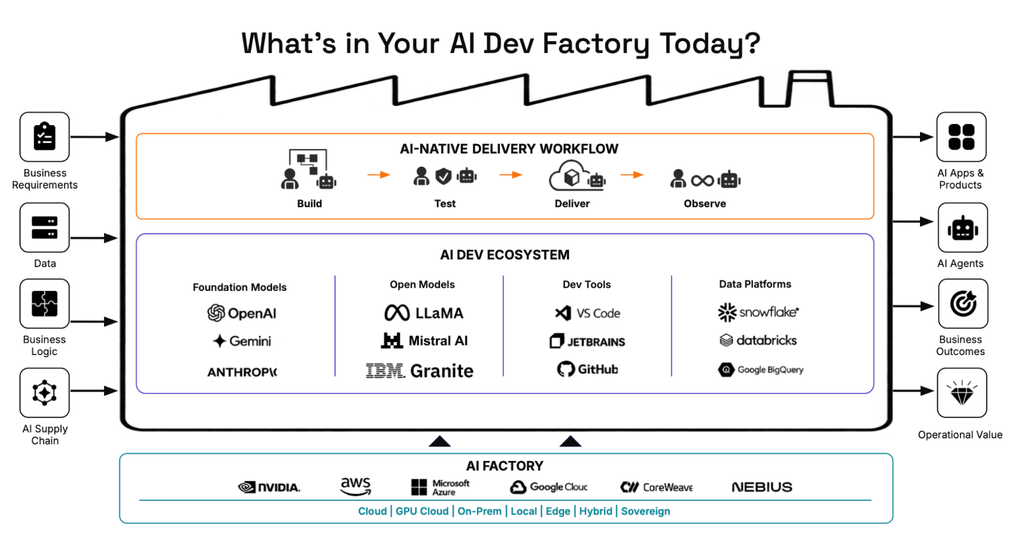
The factory starts with business needs
Business requirements define the problem to solve and the outcome to achieve. Enterprise data supplies the context. Business processes and logic connect AI systems to the work they support. Packages, models, and other components from the AI supply chain give teams the building blocks.
For example, an enterprise building a customer support agent needs more than a model. It needs clear service goals, access to relevant customer and product data, rules for handling requests, and a path to human escalation. Those requirements shape how teams build, test, deliver, and observe the agent.
Once the agent is in production, teams use operational feedback to improve it and measure progress against the original goals, such as faster resolution, higher customer satisfaction, and lower cost per interaction.
An AI Factory provides the foundation
NVIDIA describes the AI factory as “a specialized computing infrastructure designed to create value from data by managing the entire AI life cycle, from data ingestion to training, fine-tuning, and high-volume AI inference.”
This infrastructure and supporting software provide the foundation for AI workloads. Enterprises can run those workloads across public cloud, GPU cloud, on-premises systems, local devices, edge environments, and sovereign infrastructure, often combining these in hybrid architectures.
The AI Dev Factory connects the development and operational practices across that foundation. Enterprises using several infrastructure providers and deployment patterns at the same time make portability and operational consistency essential. Teams need to carry their applications, environments, and policies across deployment targets while maintaining security, visibility, and cost control.
Inside the AI-native delivery workflow
The AI-native delivery workflow connects four stages: build, test, deliver, and operate. Together, these stages turn business requirements and AI components into working systems that create operational value. Governance, control, traceability and efficiency span the entire workflow.
Build
Using notebooks, integrated development environments (IDEs), and AI-native development tools, teams combine Python packages, models, agents, data, and business logic into working AI systems. Reproducible environments give collaborators a consistent foundation across teams and projects. Enterprise policies guide which components, models, and tools enter the development process.
Test
AI testing covers functional behavior, security, and compliance. Teams evaluate model and agent performance, identify security weaknesses, check adherence to enterprise policies, and verify how systems access enterprise tools and data. These checks continue as applications, agents, and workflows change.
Deliver
Teams move AI applications, agents, and workflows into the production environments where the business needs them. A repeatable delivery process carries approved components and reproducible environments from development to production across infrastructure choices. Traceability across artifacts, versions, dependencies, and lineage gives teams a clear record of what entered production.
Operate
Teams run, manage, and scale AI applications, agents, and workflows in production, maintaining reliability, enforcing policies, and controlling resource use and cost. Continuous observation provides signals about behavior, performance, and drift. Teams use those signals to address issues, improve operations, and guide the next build and test cycle as AI systems evolve.
The AI development ecosystem is fragmented
The fragmentation deepens as the ecosystem beneath the workflow continues to expand. Developers, AI researchers, and enterprise teams can choose among open and proprietary models, work in familiar developer tools, and connect to data platforms. That breadth helps teams fit technology to each workload.
As teams adopt these technologies independently, fragmentation grows. Environments and approval processes differ. Models bring different cost, performance, security, and deployment characteristics. Packages and dependencies change over time. Governance can vary between development and production or fall away at the handoff.
Enterprises can preserve choice while bringing consistency to how teams work. They need a reliable way to approve components, reproduce environments, apply security controls, move work into production, and manage it throughout operation. Openness determines what teams can choose. Standardization makes those choices work together reliably.
Your factory, your way requires a trusted AI foundation
Your AI Dev Factory should preserve the freedom to select the models, tools, platforms, and infrastructure that match your requirements. That freedom has practical value. Teams can choose the right model for a task, keep sensitive workloads in controlled environments, use existing technology investments, and change providers as needs evolve.
Choice becomes sustainable when trust and control travel across the lifecycle. Builders need approved components and consistent workspaces. Security teams need a way to test AI before release and govern it during operation. Platform teams need repeatable workflows that can run across supported environments. Business leaders need visibility into risk, cost, and whether AI is producing the expected result.
Anaconda provides the trusted AI foundation that connects your AI-native delivery workflow with the ecosystem and infrastructure beneath it. It strengthens the AI Dev Factory you choose to build, bringing consistent governance, security, and operational control across your existing investments while preserving the freedom to evolve.

Four solution suites strengthen the factory
AI Artifacts governs the AI supply chain
AI development depends on packages, models, Model Context Protocols (MCPs), and their dependencies. AI Artifacts helps teams discover and use trusted, approved components according to enterprise policy. Software bills of materials, dependency information, and vulnerability intelligence give organizations visibility into what enters the factory and what needs attention as components change.
AI Workspaces accelerates development with choice and cost control
AI Workspaces is where builders get their work done, combining familiar tools, agentic development, and access to trusted packages and models. Teams can choose the right model for each task, streamline development, and control model costs. Consistent environments help builders move faster while enterprise policies guide access and use.
AI Security & Guardrails carries trust across the lifecycle
AI Security & Guardrails uses autonomous security agents to red-team models, agents, and MCP connections before release. Runtime controls govern access to enterprise tools and data and protect systems during operation. Continuous testing and runtime guardrails keep security connected to delivery as AI systems evolve.
AI Orchestration makes workflows repeatable
AI Orchestration helps teams turn projects into repeatable, traceable workflows that move from development to production across supported infrastructure. Teams can track lineage, models, resources, and cost as workloads run, and adapt deployment choices without rebuilding workflows for every environment.
Build the AI Dev Factory that fits your enterprise
Your models will change. New tools will enter the ecosystem. Infrastructure choices will shift as workloads, regulations, performance requirements, and economics evolve. The AI Dev Factory gives those changing parts a durable operating structure.
Start with the business outcomes your AI must produce. Define how teams will build, test, deliver, and operate the systems behind those outcomes. Preserve the freedom to choose the right technology for each workload, then apply consistent security, governance, and operational practices across those choices.
Anaconda helps you strengthen that system with trusted AI artifacts, productive workspaces, security and guardrails, and repeatable orchestration. You keep control of the factory. You keep the freedom to build it your way.
Learn more today about how Anaconda can help fortify your AI Dev Factory.