
Anaconda Acquires Outerbounds to Unify AI-Native Development

Today, Anaconda is announcing the acquisition of Outerbounds, the company behind Metaflow. This isn’t a typical acquisition. This is closing the gap that enterprises have been working around for the last three years. And that gap is between building AI and trusting AI in production. Here’s why. AI is not an incremental shift. It is […]
Introducing Anaconda Desktop

Today, we’re releasing Anaconda Desktop in public beta, a single application for AI development that brings model discovery, local inference, and conda environment management together for the first time. Anaconda Desktop is free to download. You can find a model and build with it locally, all from one place. It also runs on the same […]
What Open Source Projects Can Learn From the First b.o.s.s. town hall

A New Kind of Town Hall Open source software is everywhere. It powers scientific discovery, financial systems, climate models, and the AI tools reshaping every industry. But ask most people who built those tools whether they can tell you how many people depend on their work, and you’ll often get a shrug. That’s what the […]
What’s New in Anaconda Main for AI Development
If you’ve been supplementing main with conda-forge or PyPI to get your AI stack working, this post is for you. Over the past two quarters, Anaconda has significantly expanded main channel coverage for AI development—faster PyTorch releases, broader GPU support, and new packages that complete the AI workflow stack. Here’s what’s new and why it […]
AI in Banking: How Financial Institutions Are Scaling Intelligent Systems
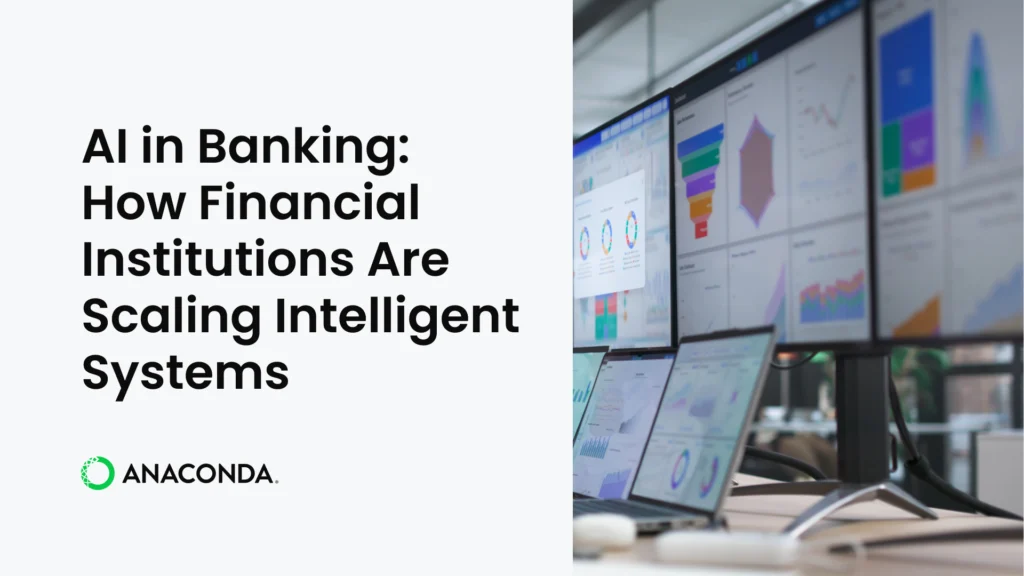
The banking industry has been a pioneer and proving ground for enterprise AI. Even before other sectors experimented with pilots, financial institutions moved AI from proof of concept to production at scale. This shift has happened over the past decade, as banking’s data-rich environment, regulatory requirements, and competitive pressures pushed the industry to adopt AI […]
The Python Packages You Didn’t Install Are Now Your Biggest Security Risk

It’s been a brutal two weeks for the open source supply chain. On March 19, the Trivy vulnerability scanner, the tool many teams rely on to detect supply chain attacks, was itself compromised (oh, the irony). Five days later, a cascading effect from the Trivy breach led directly to the compromise of LiteLLM, one of […]
Can You Answer These 7 Questions About Your AI?

On March 24, 2026, attackers reportedly slipped malicious code into two versions of LiteLLM—a Python library and API gateway that sits inside millions of enterprise AI stacks. Organizations that didn’t know LiteLLM was running in their environment had no way of knowing they were exposed. That last point is a recurring problem. Supply chain attacks […]
Dependency Hell in AI: Why ML Package Conflicts Are a Governance Problem
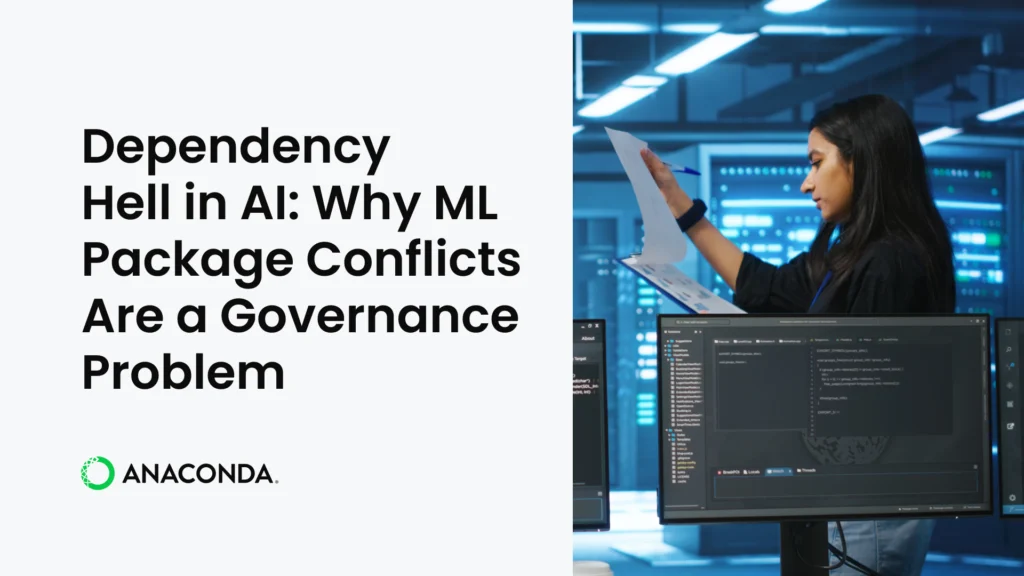
The Problem That Looks Like a Tuesday It usually starts with a help desk ticket or a Slack message that says something like: “The model we deployed last month is throwing errors in production.” An engineer digs in. The culprit is not the model itself. It is a transitive dependency—a package that another package requires—that […]
When the world begins to shift underneath your feet
By now you’ve probably seen the news: OpenAI has acquired Astral, the team behind uv, Ruff, and ty. In just a few years, Astral built tooling that fundamentally changed what it feels like to work with Python with uv alone seeing over 126 million downloads a month, a number that reflects both direct developer adoption […]
Why Can’t Your Organization Actually Execute Its AI Strategy?

Most executives would tell you their organization has an AI strategy. They’d also admit, if pressed, that it isn’t being enforced across the tools their teams use every day. It’s happening across the board. 70% of IT leaders say they have a centralized AI strategy, but only 34% can actually apply it to their enterprise […]