
Today, Anaconda is announcing the acquisition of Outerbounds, the company behind Metaflow. This isn’t a typical acquisition. This is closing the gap that enterprises have been working around for the last three years. And that gap is between building AI and trusting AI in production. Here’s why.
AI is not an incremental shift. It is redefining how software is built, what sits at the core, and how it operates in production. AI-native applications are fundamentally different from traditional software. The AI model becomes the core, and the code supporting it becomes the artifact built around it.
Two forces are reshaping how engineering teams work right now. The first is reach. Most modern applications depend heavily on open source, over 90% in many cases, and AI agents now contribute to more than 42% of committed code, with that share rising every quarter. The second is reliability. Adoption of AI in software workflows is widespread yet problems remain. AI-created code produces 1.7x more defects than human-written code, and 80% of dependencies suggested by AI coding assistants carry known risks. This leaves humans reviewing output, fixing intent, and directing rework, slowing down the efficiency AI provides.
The instinct is to treat this as a control problem. It isn’t. This only transfers the bottleneck and doesn’t resolve the problem. The root problem is that the systems and environments underneath that code are inconsistent, producing results that are unreliable, difficult to reproduce, and hard to trust.
Get Updates
Be the first to hear about product timelines and integration details as we bring Anaconda and Outerbounds together.
Anaconda + Outerbounds: The trusted foundation for AI-native development
Anaconda and Outerbounds have been working on the same underlying problem from different sides. Anaconda has focused on the foundation where AI development begins, whereas Outerbounds has focused on what it takes to run those systems reliably in production. Bringing the two together closes that gap, fixing what everything is built on, and allowing both humans and agents to build more securely.
Anaconda was built specifically for this problem, years before it became urgent. Our DNA covers the three layers where AI development actually breaks down:
- Data experimentation: Running controlled, reproducible experiments at scale so teams can iterate without rebuilding environments from scratch
- Trusted open source: Vetting and securing the packages and models developers depend on so every dependency entering a production environment is one that can be relied upon
- Advanced computing at scale: Running the most demanding AI and data workloads, from GPU-intensive training to high-throughput inference, across the infrastructure enterprises already operate, without requiring them to move to a new platform to get there.
Outerbounds closes the AI-native development loop. Built by the team that created Metaflow at Netflix to handle production AI at scale, it adds the orchestration layer above Anaconda’s foundation: workflow execution, artifact tracking, governed deployment, and observability across any infrastructure. Together, the two offerings cover the full AI-native development lifecycle without forced migration or new execution models to adopt.
Metaflow remains open source. That will not change. To every team building on Metaflow or Outerbounds today: Anaconda’s scale and experience means more resources behind the infrastructure you already rely on. The platform operates underneath the tools teams already use, so what works locally now has a governed, reproducible path all the way to production.
The three things enterprises have always needed, now in one solution
For years, enterprise AI teams have faced the same structural problem: the tools that make development fast are disconnected from the infrastructure that makes production reliable, and neither is natively governed.
Anaconda is built on three commitments, and every capability in this platform traces back to one of them.
- Trusted AI workflows at scale: a continuous governance layer from your first package install to production deployment.
- Developer velocity: teams keep working in the tools they already use. The platform runs underneath, not instead of them.
- Secure by default: policy enforcement, license governance, and CVE management travel with the workload from development through deployment.
Trusted AI workflows at scale
Anaconda has spent a decade earning trust at the foundation layer for more than 50 million users and 95% of the Fortune 500. The principle has always been the same: make sure enterprises can trust what they run. That trust has deepened over time, from package governance to full software supply chain security to AI model governance and enterprise-grade distribution.
Now, it extends all the way to production. Outerbounds brings Metaflow’s battle-tested orchestration into the same governance layer. Every model artifact, workflow execution, and deployed endpoint inherits the same trust model enterprises have relied on for Anaconda packages. For the first time, teams have a continuous governance layer from the first conda install to production deployment.
As Outerbounds founder Ville Tuulos puts it, “Anaconda has spent a decade making sure every package, model, and dependency that enters an enterprise environment is one that can be trusted. Putting those two things together creates something neither of us could build alone.” To build on that shared commitment, Anaconda and Outerbounds are co-organizing a Metaflow community meetup at DoorDash’s San Francisco headquarters alongside Netflix in May.
Unlocking developer velocity
Developers move fast when environments work and infrastructure stays out of the way. Outerbounds was built on exactly that principle.
One-click scheduling, automatic dependency resolution, and portable applications mean developers spend time building, not debugging pipelines. No new execution model. No migration request. Data scientists keep writing Python the way they already do. Workloads migrate. Workflows do not. Adding Outerbounds to Anaconda extends that principle across the full lifecycle, from local development to cloud-scale production, without asking teams to change how they work.
Secure by default
Governance that slows teams down gets worked around. Anaconda’s approach has always been to embed trust and verification directly into the workflow so governance becomes an accelerator, not a blocker. Outerbounds carries that same philosophy into production, and together, the two platforms extend it across a surface area no other vendor covers: both the software supply chain and the model supply chain.
Outerbounds’ bring-your-own-cloud architecture keeps all data in the customer’s environment. SOC 2 and HIPAA compliance, CVE enforcement, license governance, and security scanning travel with the workload from development through production. Security is part of how the platform operates, not a process bolted on at the end.
Why Anaconda? Why now?
For over a decade, Anaconda has built and nurtured the foundational Python ecosystem powering data science, machine learning, and AI across enterprises and regulated industries. The Anaconda Platform delivers the security and governance controls organizations need to ensure only trusted packages and approved models are used within their AI applications. With the 2025 launch of AI Catalyst, Anaconda extended those controls to a curated catalog of open-source AI models, giving organizations the ability to govern AI adoption at the model layer, not just the package layer.
Today, Anaconda is relied on by more than 50 million users, has been downloaded 21 billion times, and counts 95% of the Fortune 500 among its customers.
Bridging the gap between development and production
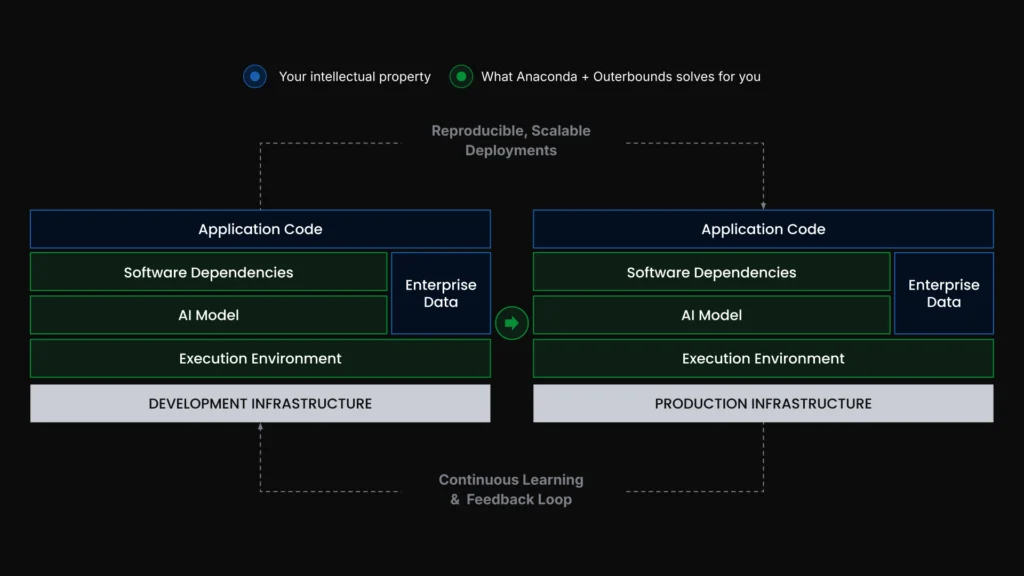
Until now, the development side and the production side of enterprise AI have lived in separate worlds. Anaconda has owned the development side: the environment, the packages, the models, the governance layer where developers work. Outerbounds has owned the production side: the orchestration, the compute, the deployment infrastructure where AI systems run. With this acquisition, Anaconda brings both sides together for the first time into a single, unified foundation.
What a new combined platform experience delivers today
The combined platform experience between Anaconda and Outerbounds is available today.
Developers can quickly and easily build with confidence using workstations that can be created from secure, pre-configured Anaconda images assembled to support some of the most common development use cases. Workstations are easily deployed in your compute infrastructure, and with the pre-configured Anaconda images and integrations with IDEs like VSCode, developers can start building securely, immediately.
Along the way, Anaconda and Outerbounds are making it easier than ever to connect to additional secure packages, as well as curated models from the Anaconda catalog. This new release introduces new step decorators, @anaconda_base and @anaconda_models, to easily connect to and pull in packages from Anaconda’s secure main channel and models from the curated model catalog. No additional steps are necessary to access the packages and models your applications need today.
We’ve also extended these powerful capabilities to our newly revamped Anaconda CLI, meeting builders where they already are. With commands like ana ob init and ana ob deploy, we’ve made it simple to configure, build, and deploy workflows from development to production, all from the command line.
For enterprises ready to accelerate AI development, click here to sign up for updates on product timelines and integration details as we bring these platforms together. We’re ready to help you deploy a managed platform for AI-native development.