
Python for Excel Analysts: Combining Tables
This is the final blog post in a series that teaches you how to work with tables of data using Python code. The subject of this post is a common operation used to prepare data for analysis—combining tables. As a Microsoft Excel analyst, you’ve likely used Excel functions like VLOOKUP() and XLOOKUP() to combine data tables. It’s the same […]
Changes to Anaconda’s Anonymous Usage Data Collection
Anaconda strives to continually improve the user experience for our customers and communities. We aim to be the premiere provider of secure access to thousands of Python repositories, packages, and libraries, while also supporting the open-source community that powers those packages. These dual goals are reflected in Anaconda’s products and in our open-source contributions. A […]
Anaconda Assistant Brings Generative AI to Cloud Notebooks
Anaconda is excited to announce the public release of Anaconda Assistant, an AI-powered Jupyter notebook extension designed to enhance the productivity of data scientists, developers, and researchers. Anaconda Assistant is now available to all users of Anaconda cloud notebooks. Powered by the same large language model behind ChatGPT, the Assistant provides an intuitive chat interface […]
Numba, Mojo, and Compilers for Numerical Computing
There have been a lot of articles written following Modular’s announcement of Mojo, a Python “successor” language that will bring high performance computing (especially for AI applications) to Python users. Here at Anaconda, we’ve been working on the problem of HPC and Python for over a decade now. As part of that work, we created […]
Is conda Free?
Our current Terms of Service policies can be reviewed here. Conda: An Imagined Conversation Fiona: Is conda free? Dave: Yes. Absolutely and always. F: Then why do some people say conda is not free? Where does this story come from? Conda Packages and the conda Ecosystem D: There is a distinction between the conda program that installs […]
Python for Excel Analysts: Data Cleaning and Wrangling
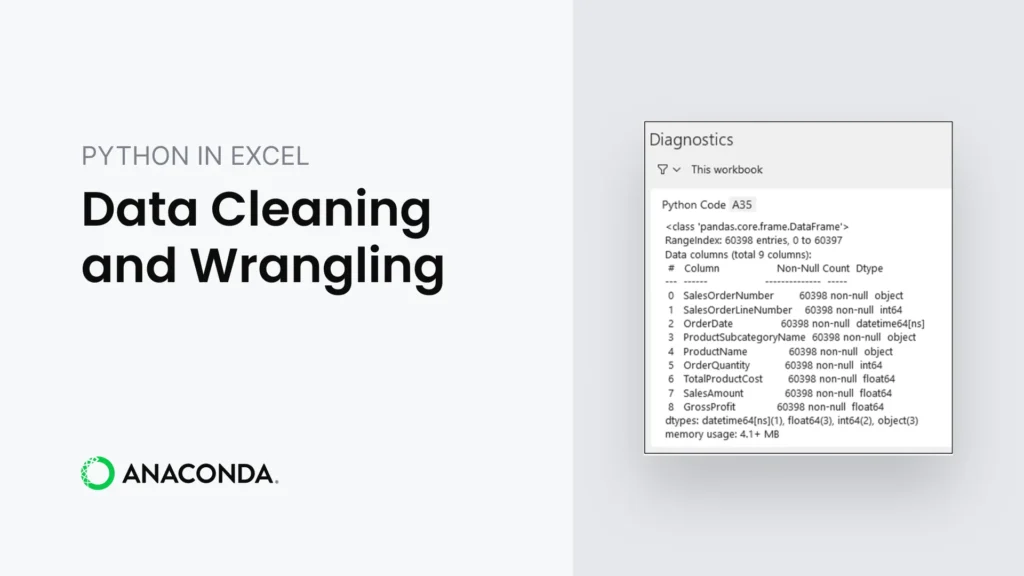
This is the fourth in a series of blog posts that teaches you how to work with tables of data using Python code. The subject of this post is one of the most critical operations in data analysis: cleaning and wrangling your data. In case you’re not familiar, here’s a definition from Wikipedia: “Data wrangling, sometimes […]
Introduction to Data Visualization with Python in Excel
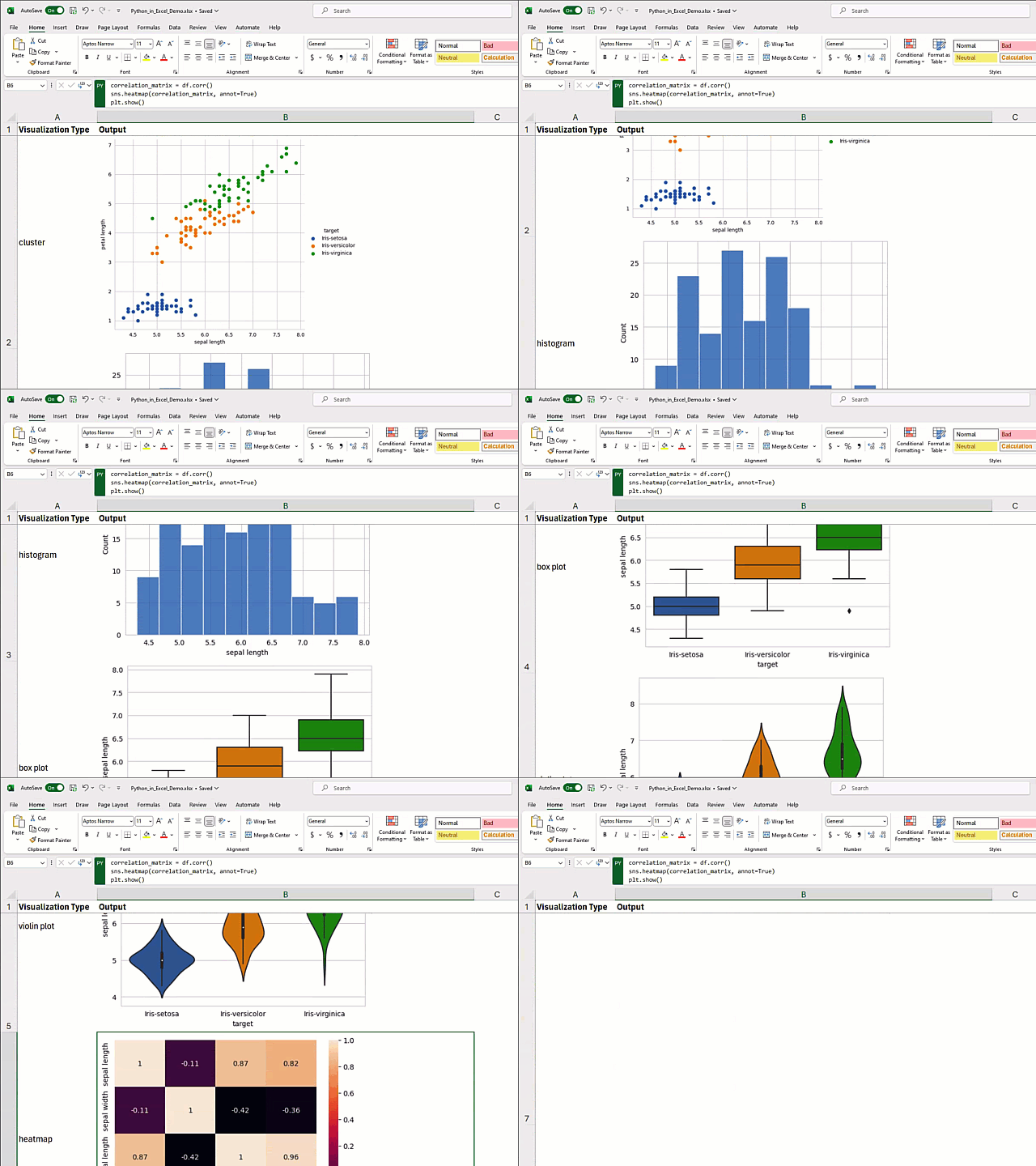
Integrating Python with Excel stands as a groundbreaking plug-in that acts as a bridge connecting two popular but previously separate ecosystems. Seamlessly integrating Python code within an Excel workbook empowers us to leverage Python’s extensive libraries for data analysis and visualization right within Excel, making it an invaluable tool for data enthusiasts and analysts. In […]
Introduction to Text Analysis with Python in Excel
Text analysis is an essential technique for extracting valuable insights from unstructured text data that serves as a fundamental component of natural language processing (NLP) applications and more. In this blog post, we will explore an exciting new way to perform text analysis using Python within the familiar environment of Microsoft Excel, made possible […]
What Are Python Packages in Excel?
https://www.youtube.com/watch?v=JskOwIuSECU [Transcript] You may come across the term “package” or “Python library” as you dive into the world of data analysis with Python. Packages—or Python libraries—are collections of code written to perform a specific task. Anaconda enables you to quickly access over 400 packages for use in Excel, and if you want to take your […]
Announcing Python in Excel: Next-Level Data Analysis for All

Now you can write Python code directly in Microsoft Excel’s grid—no Python installation required. Today, Anaconda and Microsoft announced a groundbreaking innovation: Python in Excel. This marks a transformation in how Excel users and Python practitioners approach their work. For Excel users, this opens a new world of data analysis potential previously limited to […]