
Small Language Models: The Efficient Future of AI
Large language models (LLMs) like GPT-4 from OpenAI and Claude Opus from Anthropic have captured headlines with their impressive capabilities, but they come with significant computational demands and deployment challenges. Training an LLM from scratch is out of reach for most organizations. But even if you fine-tune an open source LLM like Llama 3.1 405B, […]
Focusing Our Future: Changes to Anaconda’s R Channel Support
For over a decade, Anaconda has been committed to supporting data scientists across multiple programming languages. Today, we’re announcing an important change to how we prioritize our resources: Effective November 4, 2025, Anaconda will deprecate the R channel and discontinue active maintenance. This decision allows us to focus our engineering resources on delivering the best […]
Stop Buying AI Tools: Why Process Beats Technology Every Time
This article is excerpted from “AI Essentials for Tech Executives: A Practical Guide to Unlocking the Competitive Potential of AI” by Hamel Husain and Greg Ceccarelli, published by O’Reilly Media, Inc., 2025. Reproduced with permission. One of the first questions I ask tech leaders is how they plan to improve AI reliability, performance, or user […]
State of Data Science and AI: How Companies Are Moving Ahead (Or Not) in the AI Race
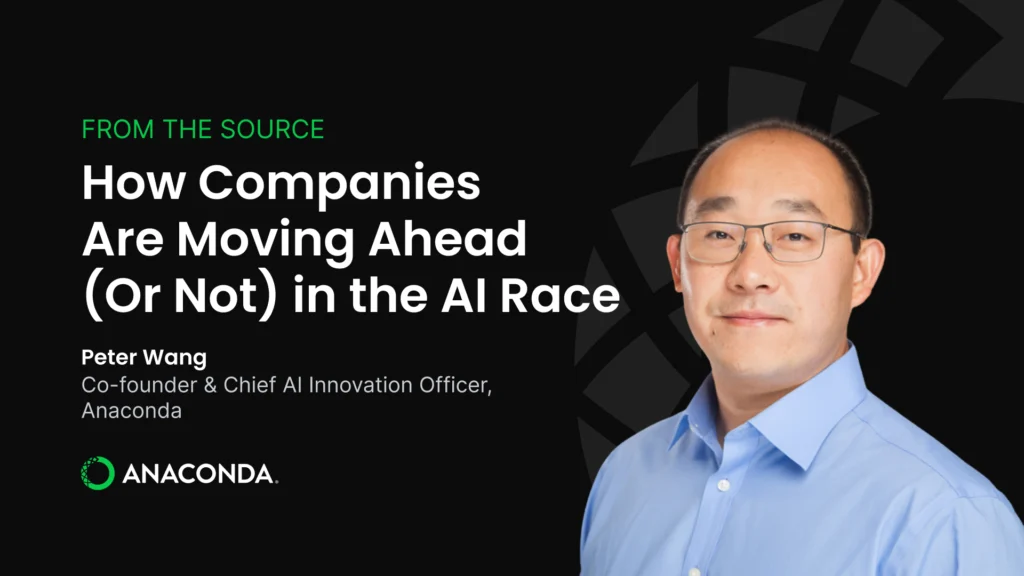
Fewer than one in four companies—only 22%—consider their AI deployment as strategic. That’s according to the respondents of our State of Data Science and AI survey. An unclear or absent strategy can limit how productive artificial intelligence (AI) initiatives become. However, we’re seeing progress toward those strategic approaches. In particular, there’s a varied mix of […]
Python 3.9 Reaches End-of-Life
As part of the official Python support cycle defined by the Python Software Foundation (PSF), Python 3.9 is reaching its scheduled end-of-life in October 2025. Following this upstream timeline, Anaconda will stop building new packages for Python 3.9 in our main channel of the Anaconda Distribution. Important: All existing Python 3.9 packages will remain available […]
Python on NVIDIA DGX Spark: First Impressions

There has been a lot of excitement and anticipation this year for the official release of the NVIDIA DGX Spark™. First announced at NVIDIA GTC 2025 in March, the DGX Spark is a small form factor desktop computer that I think will change the CUDA ecosystem dramatically, especially for data scientists and AI researchers. It’s […]
Five Python Data Visualization Examples to Transform Your Enterprise Data

Python has revolutionized data visualization by providing powerful, flexible tools that transform complex data sets into compelling visual narratives. Unlike traditional approaches limited to Excel spreadsheets or proprietary software like Tableau, Python offers unparalleled control over every aspect of data visualization—from basic bar charts and line graphs to sophisticated interactive dashboards and real-time data monitoring […]
Why Python is a Better Choice than R for Data Science and AI Workflows
NVIDIA becoming the world’s most valuable company and Python becoming the world’s most popular computing language are both due to the explosion of data science (DS), machine learning (ML), and artificial intelligence (AI) workflows in this Internet age. A few years ago, Python and R both seemed like strong contenders for these applications, as both […]
Making GenAI Work with Your Data: Implementation Strategies for Enterprise-Grade Generative AI Systems

As enterprises transition from pilot projects to production-grade generative AI systems, robust architecture becomes essential. They must consider a range of factors: choosing the right model, ensuring scalability, security, observability, and governance at every layer of the stack. Below, we share a direct excerpt from Generative AI in Action by Amit Bahree (Manning, 2024), outlining […]
Scaling GenAI in Production: Best Practices and Pitfalls
As organizations move from experimentation to production-grade GenAI systems, traditional MLOps alone isn’t enough. Below, we share a direct excerpt from Generative AI in Action by Amit Bahree (Manning, 2024), covering key practices for LLMOps, monitoring, and deployment checklists. The following text is excerpted with permission. LLMOps and MLOps Machine learning operations (MLOps) apply DevOps […]