
Python 3.14: What Data Scientists and Developers Need to Know
Python 3.14 is here, and the data science community is already buzzing experimenting with new features. As maintainers of one of the world’s largest scientific Python distributions, we at Anaconda want to help you prepare for this upcoming release and understand what it means for your data science workflows. What is the annual Python release […]
Evolving Anaconda From Python Foundation to Enterprise AI

Anaconda’s CPO on addressing enterprise AI with two suites: Anaconda Core for Python infrastructure and AI Catalyst for governed AI models.
How I Use Minimal Reproducible Examples to Accelerate Development
Diving straight in the codebase ❌ Building a tiny test case first ✅ Recently, in an internal meeting, we mentioned we wanted to add disk caching to reports generated so that when users make the same request, they can retrieve it fast, without waiting another 10–15 minutes for it to re-process. Philipp, the lead maintainer […]
No, AI Isn’t Replacing Developers. Here’s What’s Actually Happening

You’ve probably seen the headlines by now. Vibe coding tools that promise “anyone can build apps now.” Tech leaders claiming they’ll need fewer developers thanks to AI. The conclusion they’re drawing is pretty clear: software development is a dying field. I don’t buy it. And more importantly, that’s not what I’m seeing in the field. […]
9 Things to Know About Open-Source AI Models
New to open-source AI? Congrats! You’re in good company, and your timing couldn’t be better. The market is in hypergrowth. Enterprises now account for over two-thirds of open-source AI model end users, and large organizations (those with $20B+ revenue) lead in adoption. The shift is easy to justify: Open-source AI models can reduce data exposure […]
Which Packages Should I Install?
Choosing the right Python packages for your project can feel like navigating a maze with countless paths. Whether you’re building machine learning models, analyzing data, or developing web applications, selecting the optimal combination of packages is crucial for success. Yet many developers find themselves asking: “Which packages should I install for my specific needs?” This […]
How to Reclaim Disk Space with Conda Clean
When was the last time you checked how much disk space conda is using? If you’re like many developers, the answer is probably “never.” Conda just works, environments spin up when you need them, and you don’t really think about what’s happening behind the scenes. Or maybe you’ve noticed your conda installation has grown larger […]
Are There Good and Bad AI Models?

As local AI model deployments become more common, model safety is rightfully called into question. Is this model safe? Is it good? Is it bad? The answer is more nuanced than you might think. Anaconda has a lot of experience here, since we’ve been building and securing open-source artifacts for years. In some ways, generative AI […]
Model Curation: Breaking the Bottleneck in Enterprise AI Deployment
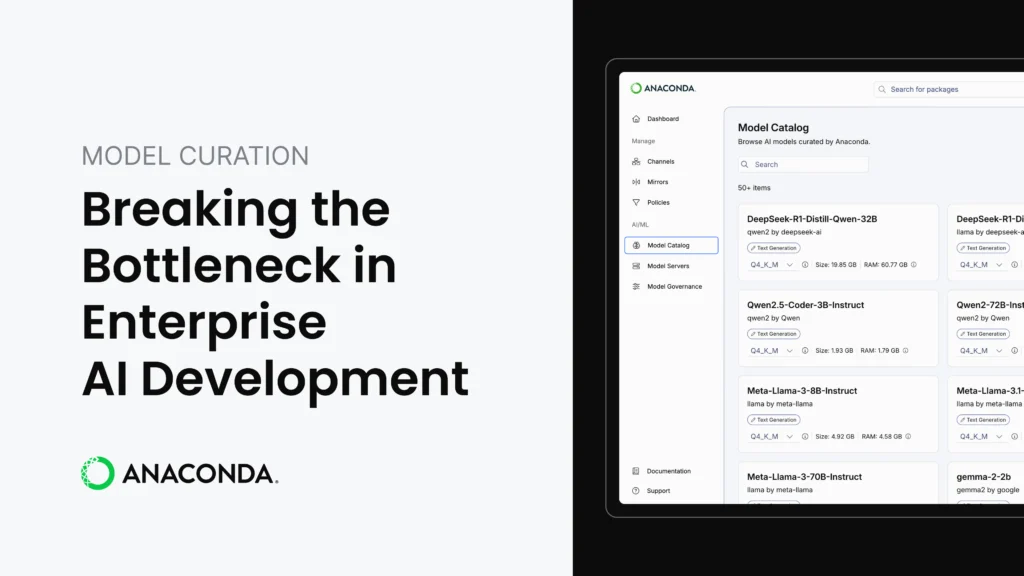
The pressure is on, and the assignment is clear: Build with AI, and do it faster than your competitors. But before you can build anything, you need to answer a fundamental question: Which AI models should power your applications? This is where most enterprises hit their first roadblock. Public repositories have more than 2 million […]
Building Actuarial Analytics with Snowflake and Anaconda
Data practitioners in enterprise environments regularly face workflows that require extracting, processing, calculating, ingesting, and analyzing data. These activities appear across different shapes and sizes in data science, data engineering, and machine learning (ML) engineering work. This blog illustrates a common real-world example from the insurance industry and provides a step-by-step solution. In this post, […]