
Enterprise AI has crossed a threshold. Individual AI tools have given way to integrated workflows: organizations embed artificial intelligence into the ways financial analysts model risk, manufacturers reduce downtime, customer support teams resolve issues end-to-end, and HR teams screen candidates at scale.
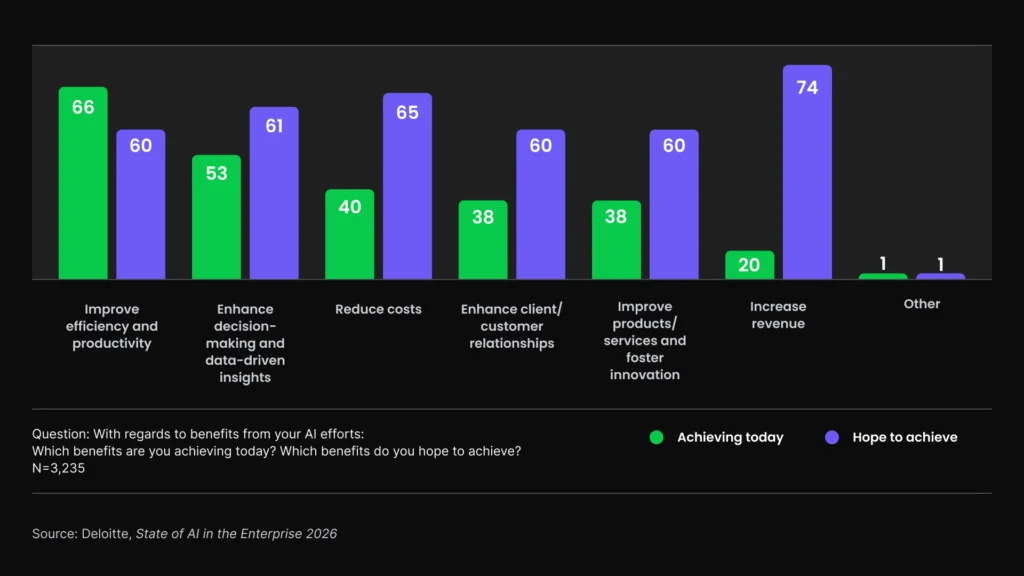
According to Deloitte’s State of AI in the Enterprise 2026 report, 66% of organizations report productivity gains from AI adoption, 58% have adopted some form of physical AI, and 85% of companies expect to customize agents to fit their business needs. AI use cases are now both industry-specific and function-specific.
Deloitte State of AI 2026 Survey: AI Benefits Organizations Are Achieving Today vs. Hope to Achieve
How to Identify AI Use Cases for Your Organization
It’s worth spending time to identify the right use cases for your organization. Consider that, according to an S&P Global Market Intelligence report, AI project failure rates are on the rise. In 2025, the average organization abandoned 46% of AI proofs of concept before they reached production, up from 17% in 2024. The most common reason for failure was selecting a use case before verifying that the underlying data, infrastructure, security, and governance requirements were in place to support it.
When you are ready to choose your use cases, consider these decision lenses:
- Task decomposition: Jobs are collections of tasks, and some tasks automate well, while others do not. Occupational researchers have long used this methodology using research from 2003 to assess automation potential: repetitive tasks with clear success criteria are strong candidates; tasks requiring contextual judgment, relationship management, or creative synthesis typically are not.
Before committing to any AI initiative, map the workflow into its component tasks and assess each independently. Think about how tasks are sequenced, grouped, and handed off between humans and machines. In February 2026, MIT Sloan School of Management researchers found that AI’s biggest impact comes from how these tasks are managed, to the point of reshaping workflows and redefining jobs.
- Cost-benefit framing: The total cost of automation includes licensing and compute, but also the adaptation effort required to connect AI systems to existing business processes, the cost of building error-detection mechanisms, and the reputational risk if errors reach customers or regulators.
Compare these costs with the fully-loaded cost of the current manual process. Use cases where the gap is large and measurable tend to produce durable cost savings. Check out Anaconda’s environmental maturity assessment to answer eight questions and get a detailed scorecard with specific risks and priority actions tailored to your organization’s maturity level. The scorecard will give you a better understanding of infrastructure investments that would make a positive difference in your results with AI.
- Pilot-first sequencing: High-stakes deployments, such as clinical decision-making support or loan underwriting, require organizational AI literacy that most enterprises have not yet built.
Prioritize low-stakes, high-velocity pilots to produce fast feedback loops and build the institutional knowledge needed before higher-stakes AI solutions follow. According to McKinsey’s 2025 State of AI report, only 21% of organizations have fundamentally redesigned workflows to support AI, and that workflow redesign is the factor most correlated with realizing financial outcomes from generative AI.
Note that these four common scaling blockers cut across all three lenses: unmanaged open-source dependencies, inconsistent development environments, lack of model reproducibility, and security vulnerabilities in the AI model supply chain. Your organization’s tech stack and data practices will affect your success in deploying AI across the enterprise.
Top Enterprise AI Use Cases By Industry
AI technology is reshaping how industries operate, removing bottlenecks from business operations that once required significant manual effort, time, and headcount. Across financial services, healthcare, manufacturing, customer service, and beyond, organizations are deploying AI to surface patterns in data faster than human analysts can, deliver personalized experiences and product recommendations at scale, and give decision-makers the real-time information they need to make informed decisions with confidence. The use cases below represent where AI deployment is most mature, most measurable, and most directly connected to business outcomes.
AI in Financial Services
Financial services firms operate in data-rich, regulation-dense environments. Banks and asset managers gather customer data, transaction signals, and account histories at a scale few other industries match, and regulatory requirements create strong incentives to deploy AI systems with rigorous governance.
- Financial analysis
AI-powered systems detect patterns across large, heterogeneous datasets that would take human analysts days to process. JPMorgan Chase has used AI models to review complex legal documents at a scale and speed that would require significant lawyer-hours manually. Blackrock has applied machine learning to portfolio construction and market signal detection, using algorithms that evaluate real-time data streams across asset classes. Financial services firms are now building agentic AI workflows that capture meeting outcomes, draft follow-up communications, and track action items across business processes. - Budget forecasting
AI-powered forecasting models evaluate market conditions, historical patterns, and real-time signals simultaneously to generate scenario-based projections. Microsoft has applied AI to its own finance operations for this purpose and to assist the organization as its revenue grows. The 2026 evolution is probability-weighted scenario planning: rather than a single forecast, AI models generate outcomes across multiple macroeconomic scenarios, enabling dynamic pricing decisions and giving finance teams a more defensible basis for capital allocation.
Fraud detection and risk management
Modern fraud detection combines anomaly detection, behavioral modeling, and natural language processing to flag suspicious activity in real time across millions of transactions. Banks, including Bradesco, have used AI to identify fraudulent patterns at transaction volumes that no human review process could match. Machine learning algorithms adapt continuously to new fraud tactics, improving detection accuracy while reducing false positives. Zempler Bank’s data science team deployed sophisticated fraud detection models that analyzed transaction patterns, behavioral signals, and device data in real time, resulting in a 90% reduction in fraud. An emerging capability is agentic auto-remediation: AI agents that not only detect anomalies in real time but initiate a defined response workflow, escalating to human review only when confidence thresholds are not met.
AI in Government
Government agencies face stricter constraints on privacy, transparency, and public accountability than most private-sector organizations. Successful deployments focus on AI use cases where explainability is built into the design from the start.
- Resource management
AI solutions optimize the allocation of public infrastructure resources, including energy distribution, traffic routing, and water management. Singapore and Barcelona have demonstrated smart city applications at scale. In the United States, municipal governments are applying predictive analytics to anticipate capacity constraints and allocate maintenance resources before failures occur, improving operational efficiency without removing human accountability from decisions. - Decision-making support
Government agencies use AI to simulate the downstream effects of proposed policies before implementation, running demographic, economic, and environmental models to surface unintended consequences. This human-in-the-loop decision augmentation model is standard in regulatory contexts where accountability requirements make fully autonomous AI decisions inappropriate. Federal agencies apply AI-driven data analysis to complex regulatory filings, surface relevant precedents, and synthesize large volumes of public comment data, compressing time-consuming analysis cycles without removing analyst judgment from the outcome.
AI in Healthcare
AI operating in real-world healthcare environments are under strict requirements for reproducibility, traceability, and data protection. Because AI in healthcare can assist providers in making decisions that affect patients’ health and lives, providers who use AI must understand its capabilities and limits. AI in healthcare can save lives and money. Researchers at McGill University discovered a drug candidate that cost $10 to replace a treatment that cost $10,000. As a result, infrastructure decisions in healthcare are as consequential as model selection.
- Predictive analytics
AI systems perform risk stratification across patient populations, combining vitals, lab results, family history, and social determinants of health to identify at-risk patients earlier in their care journey. Institutions including Cleveland Clinic applied predictive analytics to reduce preventable readmissions and improve resource allocation across facilities. Model reproducibility across data pipelines is a core operational requirement. Doncaster and Bassetlaw Teaching Hospitals NHS Foundation Trust built a data science function that could transform how the trust uses data to improve patient care and operational efficiency. They avoided 17M£ in potential penalties for non-compliance with government regulations. - Personalized treatment
AI systems analyze genetic information, medical history, and treatment response data to support personalized care planning. Cancer centers use AI-powered platforms to evaluate which treatment protocols are most likely to be effective for patients with specific tumor profiles and genetic markers, cross-referencing patient data against large volumes of medical literature in minutes. Advanced AI deployed in healthcare environments requires strict reproducibility, traceability, and secure package management to meet regulatory oversight requirements and protect patient data. - Medical diagnosis
Deep learning AI models analyze medical images including mammograms and lung scans with accuracy that matches or exceeds human specialists in defined diagnostic tasks. AI-powered tools flag findings for specialist review, compress the time between scan and diagnosis, and help radiologists manage their workload more effectively. The right framing is augmentation: AI manages high-volume screening so specialists concentrate on the cases that require the deepest clinical judgment. Administrative automation compounds the ROI case: AI assistants generate clinical notes, discharge summaries, and billing codes from patient interactions and medical records, reducing clinician burnout and accelerating reimbursement cycles.
AI in Customer Service
Customer service AI has evolved from rule-based chatbots that route inquiries to AI agents that can resolve them end-to-end: rebooking flights, processing returns, updating account information, and handling multi-step transactions across integrated systems. Production-grade conversational AI requires governed APIs, secure system integrations, and monitoring controls that flag outputs falling outside expected confidence thresholds.
- AI chatbots and conversational agents
The 2026 baseline customer expectation is resolution over routing. Modern AI agents and virtual assistants handle complex customer interactions across multiple languages, a practical necessity for global enterprises. These AI-powered systems can provide high-quality 24/7 customer support at a cost structure that scales with volume rather than headcount, improving customer satisfaction while reducing operational costs. AI conversational support company Crisp found that a human agent handles a routine query at $20 to $25, while a chatbot handles the same query at $0.50 to $0.70. AI agents complete multi-step workflows that previously required human handoffs across multiple systems, delivering better customer experiences with lower handling time. - Customer churn prediction
Machine learning models analyze behavioral patterns across customer data, including purchase history, customer interactions, and engagement metrics to identify at-risk customers before they act. Churn prediction outputs feed directly into personalized outreach workflows, triggering the right message through the right channel at the right time. The integration between prediction and response can turn a passive analytics capability into an active revenue-retention tool.
AI in Manufacturing
Manufacturing environments generate rich operational data and have clear ROI metrics. We mentioned earlier that Deloitte’s research found 58% of organizations have adopted some form of physical AI, with 80% expected to within two years. Factories are among the most active deployment environments, where multimodal AI models monitor safety conditions and detect equipment anomalies from sensor and visual data simultaneously. Automotive manufacturers are among the furthest along, applying AI across the full production lifecycle from prototyping to quality assurance.
- Advanced process automation
Predictive maintenance uses sensor data, maintenance histories, and production schedules to forecast equipment failures before they occur, reducing unplanned downtime and optimizing maintenance timing. Siemens has applied predictive maintenance at industrial scale. AI agents now also support new product development, helping engineering teams evaluate trade-offs between cost, time-to-market, and material constraints simultaneously. BlueScope, a Siemens customer, reported preventing 2,000 hours of downtime using the industrial automation company’s predictive maintenance technology. - Quality control
Computer vision AI systems inspect products at production speed with accuracy that matches or exceeds human inspection. AI identifies defects that require human review, allowing inspectors to concentrate on exceptions rather than routine screening. Defect detection at scale is the differentiator compared with manual inspection, particularly on high-volume production lines where human fatigue introduces variability. For example, Tesla deployed AI-powered vision systems to inspect Tesla vehicles post-assembly. The systems catch micro-defects like paint irregularities and panel gaps. The system detects defects 50% faster than manual checks. - Supply chain optimization
AI-driven supply chain management applies machine learning to demand forecasting, inventory optimization, pricing decisions, and supplier risk monitoring. These AI solutions reduce waste and build resilience against disruption by continuously ingesting data from across the supply chain and updating forecasts in real time. Version-controlled AI models ensure forecasts remain consistent across planning, execution, and compliance workflows.
AI in Technology
Technology companies use AI to build their products and streamline their internal operations. The use cases are not always as spectacular as you might expect in the tech sector. For example, global aerospace leader Moog applied AI to reduce analysis time by 75%, cutting it from weeks to hours, while eliminating errors in critical safety assessments.
- AI-generated training datasets
Synthetic data generation is now a mature practice. Meta uses AI-generated datasets to improve model performance across computer vision and large language models (LLMs), and they’ve made synthetic datasets available to the public. The 2026 buyer-relevant angle is privacy-preserving training: synthetic datasets that reflect the statistical properties of real data enable model training without exposing sensitive individual records, which matters in regulated environments where training on real customer data creates compliance exposure. - Programming tools and code assistance
The 2026 reality is agentic coding, not single-suggestion autocomplete. Tools like GitHub Copilot and Amazon Q Developer handle multi-step coding tasks: generating code, writing tests, reviewing pull requests, and flagging potential cybersecurity issues within a single workflow. AI-generated code review is gaining traction, surfacing potential bugs and security vulnerabilities during review rather than after deployment. It’s important to note that enterprise AI adoption of these tools requires secure package sources, vulnerability scanning, and policy controls to prevent insecure dependencies from entering production systems.
AI for Enterprise-Wide Operations
Several AI applications span industries and are becoming standard components of enterprise AI programs regardless of sector.
- Agentic AI and workflow automation
AI assistants used to answer questions. Now, AI agent teams orchestrate multi-step business processes autonomously. A supply chain AI agent can monitor inventory levels, trigger a reorder when thresholds are met, pass the transaction to a compliance agent for approval validation, and route the confirmed order to the finance agent for processing. Each agent handles a narrow task; the orchestration layer coordinates them toward a business outcome with minimal human intervention. Keep in mind: safe enterprise deployment requires policy controls, model validation, comprehensive logging, and human override mechanisms at each decision point. - Knowledge management and RAG
Retrieval-augmented generation (RAG) provides large language models with enterprise-specific document and data context, grounding outputs in verified source material rather than model memory alone. RAG AI use cases include internal documentation Q&A, contract analysis, and support ticket synthesis. Governance requirements include access controls, traceable source attribution, and regular audits to keep LLM outputs tied to current, verified enterprise data. Check out our blog on how to create a RAG chatbot. - Content generation and marketing
Generative AI has made personalized content creation at scale operationally practical. Marketing teams use AI-driven tools to generate campaign variants like A/B test assets across copy, image and video formats in a single workflow. The measurable outcomes are time-to-market compression and cost per asset, not general productivity narratives. - HR and employee experience
AI solutions screen resumes and match candidates to open roles, applying machine learning to skills-and-experience matching. Amazon uses ML to recommend roles to candidates based on interests and qualifications. When deploying similar AI solutions, it’s important to build bias detection and human review into the workflow. AI assistants also can handle employee self-service requests around benefits, policies, and onboarding, reducing time-consuming administrative workload while improving response time.
The Benefits of Enterprise AI
Deloitte’s 2026 research finds 66% of organizations cite productivity and efficiency improvements as the top outcome of AI adoption. AI-powered tools handle data entry, data analysis, pattern recognition, and repetitive tasks at scale, freeing teams to concentrate on work that requires judgment and strategic context. Cost savings follow from eliminating manual business processes: duplicate data entry, document review, and repetitive customer support interactions all carry measurable costs that AI reduces, with the realistic offset timeframe at 12 to 24 months for well-scoped use cases with clear baselines.
AI also compresses the cycle time for hypothesis testing and prototyping. Teams evaluate pricing strategies, product configurations, and marketing approaches against modeled outcomes before committing to full deployment, shortening the product and business lifecycle. Decision-making accelerates in parallel: AI systems synthesize real-time data across sources that human analysts could not monitor simultaneously, compressing days-long analysis cycles into minutes. Loan underwriting cycles, insurance claims processing, and executive briefing preparation are documented examples. The value is less about doing new things and more about doing existing things faster, with outputs reliable and explainable enough to act on.
Implementing AI with Anaconda
Every enterprise AI use case runs on a foundation of Python packages, data science libraries, and AI models. Earlier, we noted four scaling blockers that cut across every use case: unmanaged open-source dependencies, inconsistent development environments, lack of model reproducibility, and security vulnerabilities in the AI model supply chain. These are infrastructure problems, and they have infrastructure solutions.
Anaconda’s platform provides centralized, curated access to thousands of open-source Python packages, automated CVE scanning and filtering, and advanced dependency resolution for secure deployment across cloud, self-hosted, and on-premises environments. Centralized package management addresses unmanaged dependencies. Environment replication tools enforce consistency across development, staging, and production. Automated CVE scanning closes the supply chain security gap.
And conda’s architecture, which underpins Anaconda’s production Python, solves the binary dependency challenge that causes reproducibility failures at scale. It is the package management and environment layer that gives you the power to govern your existing ML infrastructure and future-proof your Python projects, whether your teams are building predictive maintenance models or fraud detection algorithms.
Anaconda is trusted by more than 50 million users and used across 95% of Fortune 100 companies. Whether the AI use cases that matter most to your organization are industry-specific or horizontal, the foundational tooling layer is the same.
FAQs
Which industries are adopting enterprise AI fastest?
Financial services and technology lead AI adoption, driven by data availability, regulatory incentives, and existing quantitative infrastructure. Healthcare adoption is accelerating in regulated environments where reproducibility and compliance requirements are met. According to Deloitte’s State of AI in the Enterprise 2026 report, physical AI adoption is expanding fastest in manufacturing and industrial sectors, with 58% of organizations already deploying and 80% expecting to within two years.
What is agentic AI, and how does it differ from traditional AI?
Traditional AI systems are task-specific: a machine learning model classifies images, generates text, or detects anomalies. Agentic AI coordinates multiple specialized AI agents to autonomously execute multi-step workflows and make cross-system decisions to pursue a defined business objective. A traditional AI might flag a fraudulent transaction; an agentic system can flag it, initiate a hold, notify the compliance team, and route the case for human review, all without manual handoffs. Keep in mind, safe enterprise deployment requires policy controls, model validation, logging, and human override mechanisms at each decision point.
How do enterprises measure ROI on AI investments?
Some of the most reliable ROI metrics are productivity gains (time saved on defined tasks), cost savings from headcount redeployment away from repetitive tasks, revenue uplift from personalization and churn reduction, and risk reduction from fraud detection and error prevention. Deloitte’s State of AI in the Enterprise 2026 report finds 66% of organizations report productivity gains as the primary measured outcome. Organizations that establish clear baselines before deployment are better positioned to demonstrate returns within a defined timeframe.
What are the biggest barriers to enterprise AI adoption?
Data quality and accessibility, security and compliance requirements, foundational tooling readiness, and skill gaps are the most consistently cited barriers. S&P Global Market Intelligence research found the average organization abandons 46% of AI proofs-of-concept before production, with cost, data privacy, and security risks cited as the top obstacles.
Organizations that address infrastructure gaps during the pilot phase, rather than after, scale their AI initiatives more successfully.