
Natural language processing (NLP)—the field of computer science focused on enabling machines to understand and work with human language—underpins much of the generative AI ecosystem, from large language models to translation assistants to customer service chatbots. It’s the fastest-growing and most widely used data science and machine learning application, according to Databricks’ State of AI report, and the number of Python libraries supporting NLP have grown in scale and sophistication to match. For teams evaluating their options, that abundance of choice can make it difficult to decide where to start.
We’ve written this guide to help you make sense of it all. Whether you’re a data scientist starting your first natural language processing project, a machine learning (ML) engineer evaluating tools for a production pipeline, or a team lead trying to standardize your stack, you’ll find a practical breakdown of the 11 most widely used Python NLP libraries, covering key features, pros and cons, ideal use cases, and pricing.
Python NLP Libraries Compared: Features, Trade-offs, and Use Cases
1. Hugging Face Transformers
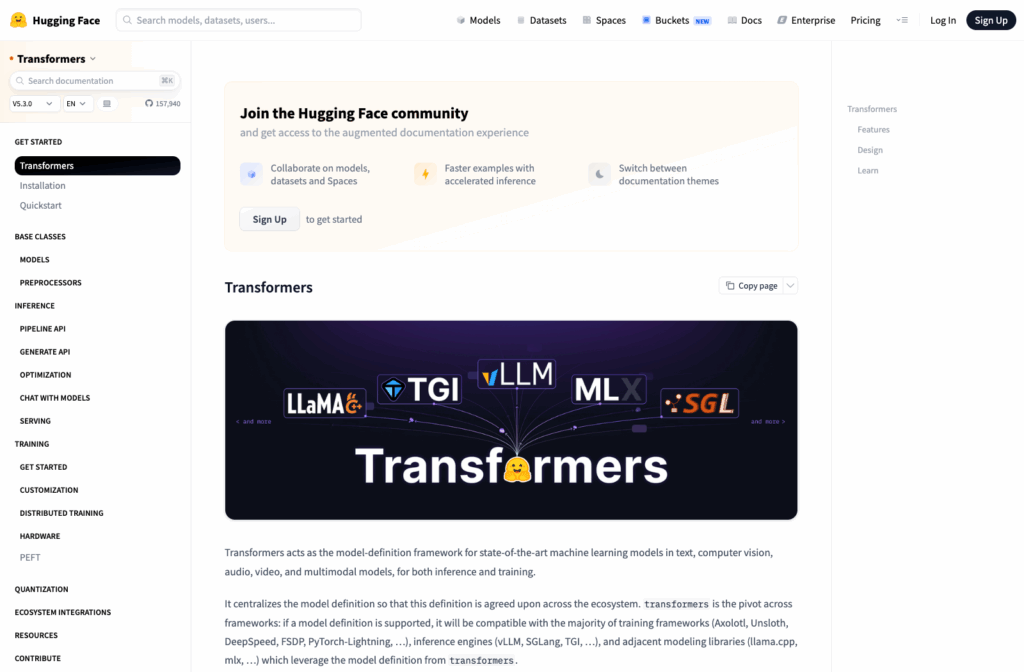
Hugging Face Transformers is the industry standard for modern NLP development. The open-source library provides a unified API for working with thousands of pre-trained transformer models, including BERT, GPT, RoBERTa, T5, LLaMA, and more, with capabilities ranging from text classification and translation to question answering and text generation. For most teams building with LLMs today, Hugging Face Transformers is the default starting point.
Key features:
- Access to millions of models through the Hugging Face Hub
- Unified API across PyTorch, TensorFlow, and JAX backends
- Built-in support for fine-tuning on custom datasets using the Trainer API
- Pipelines for rapid deployment of various NLP tasks with just a few lines of code
Pros: Unmatched breadth of pre-trained models; strong community and frequent updates; excellent support for both research and production workflows; easy to install via conda.
Cons: Large model downloads can strain storage and compute resources; production deployment typically requires GPU infrastructure for practical throughput; model-specific dependencies and CUDA-aligned packages can complicate environment reproducibility.
Who uses it: Data scientists and artificial intelligence (AI) developers across virtually every industry. It is the go-to library for teams building generative AI (GenAI) applications and chatbots, fine-tuning LLMs, or staying current with the latest NLP research. For teams evaluating a library to anchor a modern natural language processing stack—particularly one involving LLMs or generative AI—Hugging Face Transformers is a natural starting point.
Pricing: The Transformers library is free and open source under the Apache 2.0 license. The Hugging Face Hub offers a free tier with optional paid plans for private model hosting and additional compute.
2. spaCy
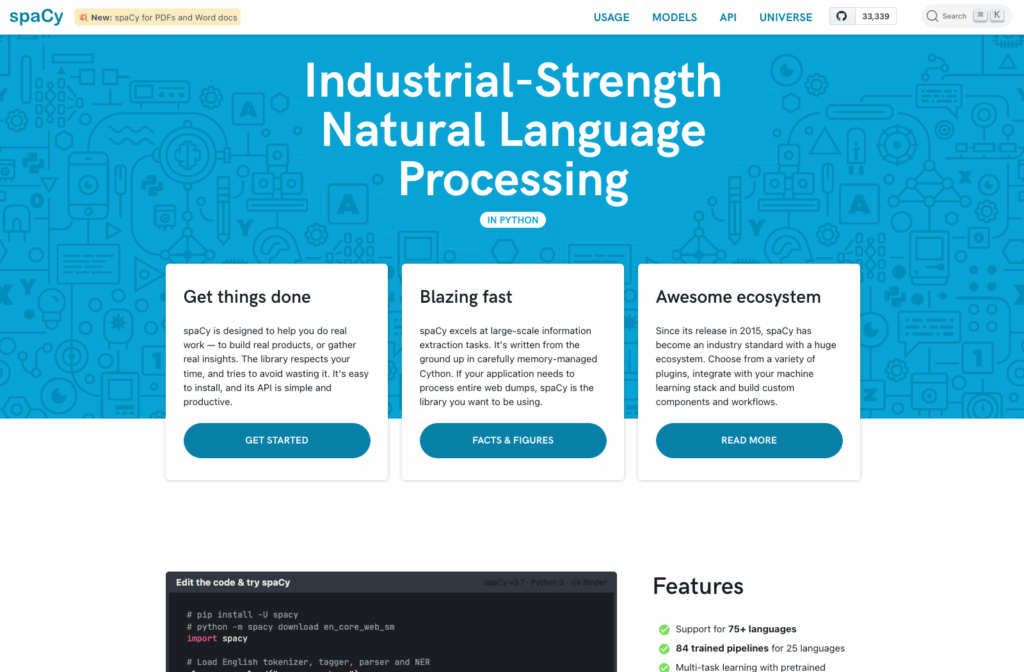
spaCy is an industrial-strength NLP library built for production use. Developed by Explosion AI, it was designed from the ground up to be fast, opinionated, and easy to integrate into real-world pipelines. Rather than attempting to cover every possible natural language processing algorithm, spaCy ships with highly optimized implementations of the tasks that matter most in production environments.
Key features:
- Tokenization, sentence segmentation, part-of-speech tagging (POS tagging), named entity recognition (NER), and syntax and dependency parsing
- Support for 70+ languages, with fully trained pipelines available for 25
- Custom and trainable components for building production workflows
- Built-in visualization of dependency trees and named entities via the displaCy tool
- Native integration with deep learning frameworks via spaCy-transformers
Pros: Extremely fast processing speeds; clean and well-maintained API; production-ready architecture; excellent documentation; active community support.
Cons: Less suited to research contexts that require rapid experimentation across multiple model architectures; fewer pre-trained models than Hugging Face Transformers.
Who uses it: Engineering teams building production NLP systems in industries such as finance, legal tech, and healthcare. spaCy is the right choice when reliability and throughput matter more than maximum flexibility.
Pricing: Free and open source under the MIT license.
3. Natural Language Toolkit (NLTK)
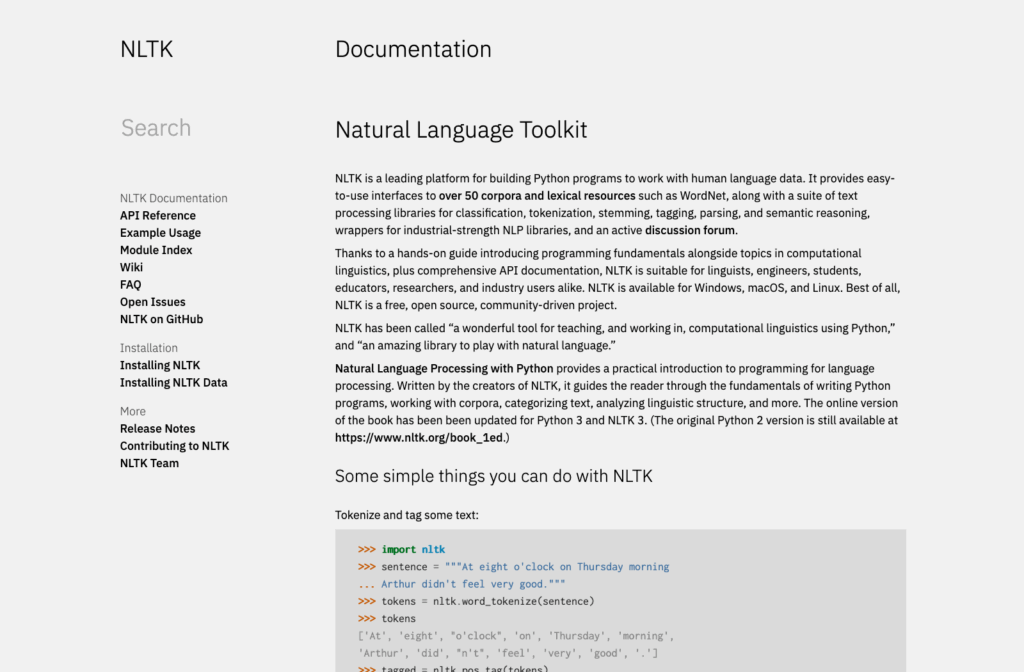
NLTK is one of the oldest NLP libraries in the Python ecosystem. Developed at the University of Pennsylvania, it has become a foundational resource for learning human language processing concepts and accessing a wide range of linguistic data. NLTK provides access to over 50 corpora and lexical resources, including WordNet, and includes implementations of a broad range of text processing algorithms.
Key features:
- Tokenization, stemming, lemmatization, tagging, parsing, and syntax analysis
- Access to a large collection of corpora and pre-built datasets
- Built-in text classification and sentiment analysis utilities
- Thorough documentation and tutorials oriented toward learning and exploration
Pros: Excellent breadth of features; ideal for education and prototyping; rich access to linguistic resources; strong community and long track record.
Cons: Slower than modern alternatives; not optimized for production deployment; designed for an era before deep learning, so some tooling reflects older approaches.
Who uses it: Academic researchers, students learning natural language processing fundamentals, and data scientists who need access to diverse linguistic datasets or are prototyping ideas before committing to a production stack. Teams often pair NLTK with scikit-learn for downstream classification as well. NLTK is a strong starting point, but it’s rarely the final answer for teams building at scale.
Pricing: Free and open source under the Apache 2.0 license.
4. Gensim
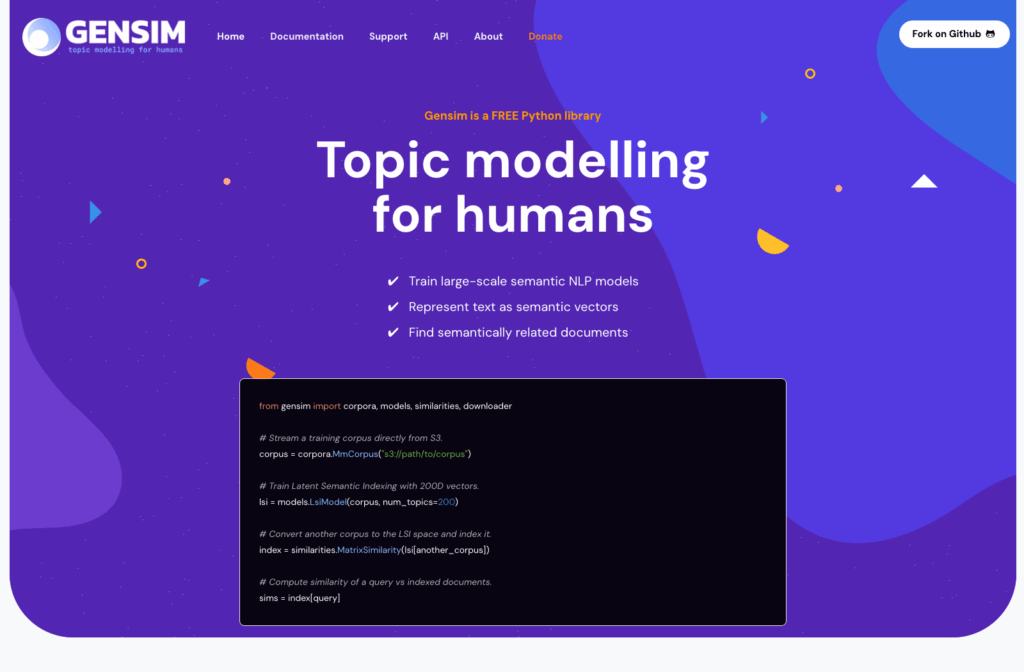
Gensim is a Python library purpose-built for unsupervised topic modeling and document similarity analysis. While many NLP libraries aim to be comprehensive, Gensim focuses on doing a specific set of things extremely well: representing documents as semantic vectors and word vectors, indexing them for similarity retrieval, and discovering relationships between them efficiently at scale.
Key features:
- Word2Vec, FastText, and Doc2Vec implementations for training word vectors and document embeddings
- Latent Dirichlet Allocation (LDA) for topic modeling
- Efficient streaming and memory-mapped data handling for large corpora
- Built-in utilities for loading pre-trained embeddings from sources such as Google News and Wikipedia
Pros: Widely used for topic modeling and semantic similarity; highly efficient with large datasets; built-in support for performance optimization via NumPy and BLAS libraries; clean and well-documented API.
Cons: Narrower in scope than general-purpose NLP libraries; not the right tool for tasks like NER, dependency parsing, or sequence classification; teams whose work centers on topic modeling should also evaluate transformer-based alternatives like BERTopic, which offer stronger semantic coherence on many modern datasets.
Who uses it: Data scientists working on recommendation systems, content clustering, search relevance, and research requiring word embeddings to surface thematic structure across large document collections. If your project centers on understanding what documents are about rather than annotating their linguistic structure, Gensim is worth serious consideration.
Pricing: Free and open source under the GNU Lesser General Public License (LGPL) license.
5. Stanza
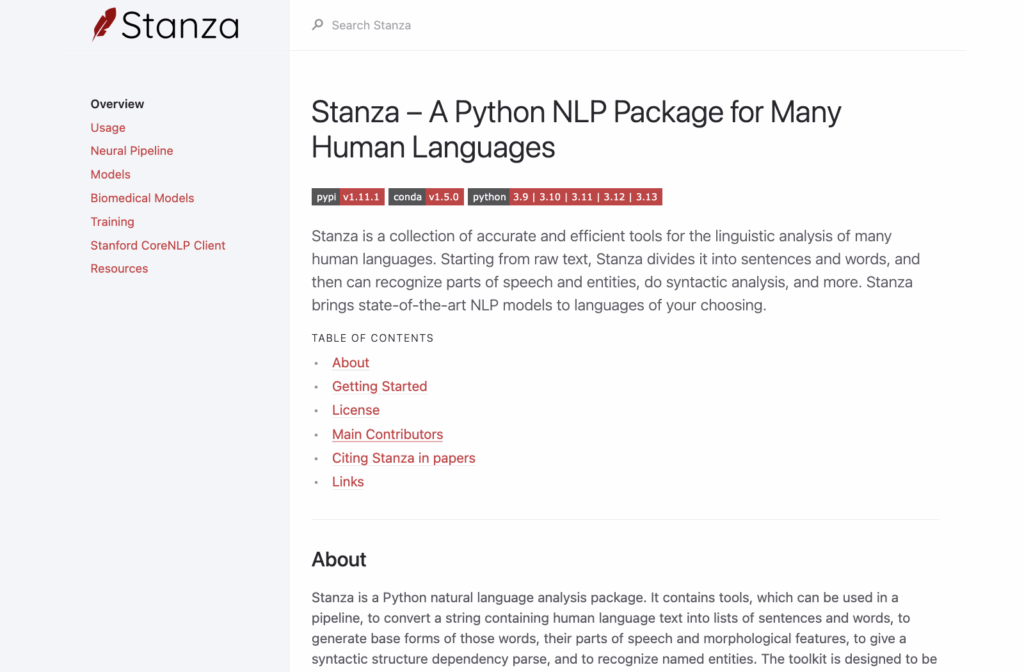
Stanza is the Stanford NLP Group‘s official Python NLP library—a deep learning-based toolkit that includes a built-in client for accessing Stanford CoreNLP’s extended functionality. Where CoreNLP required a Java runtime and a client-server setup to work with Python, Stanza is pure Python from the ground up, and Stanford recommends it as the preferred way to use CoreNLP in Python.
Built on PyTorch, Stanza features a fully neural, language-agnostic pipeline that delivers high accuracy across a wide range of text analysis tasks. It was designed to work consistently across languages rather than optimizing for English and treating everything else as an afterthought, which makes it a strong choice for teams working with multilingual text at research or production scale.
Key features:
- Tokenization, lemmatization, part-of-speech tagging, named entity recognition (NER), and dependency parsing
- Pretrained models for 80 human languages, trained on Universal Dependencies treebanks and other multilingual corpora
- Fully neural pipeline built on PyTorch, enabling efficient training on custom annotated data
- Native Python interface to Stanford CoreNLP for extended functionality, including coreference resolution and relation extraction
Pros: Strong multilingual coverage; high accuracy across languages due to neural network architecture; clean Python API; backed by Stanford NLP Group’s ongoing research; well-documented with active maintenance.
Cons: Heavier compute requirements than rule-based alternatives; model downloads can be large for teams working across many languages; most production deployment examples and integrations in the ecosystem are built around spaCy or Hugging Face.
Who uses it: Researchers and data scientists working on multilingual natural language processing tasks, particularly in academic, government, and enterprise settings where linguistic depth and cross-language consistency matter. Stanza is also a natural fit for teams transitioning away from Stanford CoreNLP who want to stay within the Stanford NLP ecosystem without the Java dependency.
Pricing: Free and open source under the Apache 2.0 license.
6. Flair
Flair is an NLP library originally developed at Zalando Research and now maintained at Humboldt University of Berlin. Its central contribution to the field is contextual string embeddings—a character-level approach that captures the meaning of a word based on its surrounding context, rather than assigning it a fixed vector, which results in higher accuracy on sequence labeling tasks than fixed embedding methods. This approach makes Flair particularly strong for sequence labeling tasks, like named entity recognition and part-of-speech tagging.
Key features:
- State-of-the-art models for NER, part-of-speech tagging, sentiment analysis, and text classification
- Contextual string embeddings that represent words differently based on surrounding context
- Unified interface for stacking and combining multiple embedding types, including GloVe, BERT, ELMo, and Flair’s own embeddings
- Dedicated biomedical NER support via the HunFlair model family, including entity linking to standardized knowledge bases
Pros: High accuracy on sequence labeling tasks; flexible embedding architecture makes it easy to experiment; strong research pedigree with active academic development; models hosted on the Hugging Face Hub for easy access.
Cons: Slower than spaCy for production workloads; smaller community and ecosystem than Hugging Face Transformers or spaCy; less suited to general-purpose natural language processing pipelines that go beyond sequence labeling and classification.
Who uses it: Data scientists and NLP researchers who need high-accuracy sequence labeling (particularly for NER) and want the flexibility to combine multiple embedding strategies without writing custom integration code. Flair is especially well-suited to domain-specific applications like biomedical text analysis, where its HunFlair models offer specialized out-of-the-box support that general-purpose libraries don’t provide.
Pricing: Free and open source under the MIT license.
7. SentenceTransformers
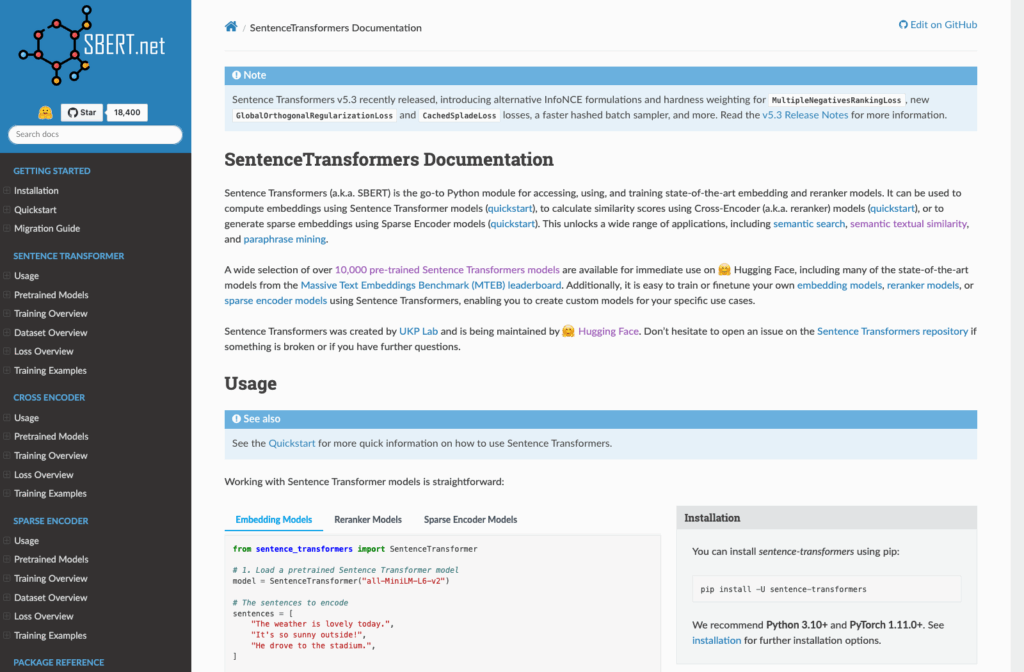
SentenceTransformers is built for sentence-level tasks, like semantic search and document similarity. Originally developed by the UKP Lab at TU Darmstadt and now maintained by Hugging Face, it has become the go-to library for teams building semantic search, clustering, and retrieval-augmented generation (RAG) pipelines.
Key features:
- Sentence and document embeddings optimized for semantic similarity, clustering, and information retrieval
- Over 10,000 pretrained models spanning 100+ languages available on the Hugging Face Hub
- Support for fine-tuning custom embedding models on domain-specific data
- Built-in utilities for semantic search, paraphrase mining, and similarity scoring
Pros: Purpose-built for sentence-level word embeddings, delivering stronger results than general-purpose transformer models on semantic similarity benchmarks; deep integration with the Hugging Face ecosystem; extensive pretrained model selection; straightforward API.
Cons: Narrower in scope than Hugging Face Transformers (if your project goes beyond embeddings and retrieval, you will likely need additional libraries); embedding quality depends heavily on choosing the right pretrained model for your use case.
Who uses it: Data scientists and engineers building semantic search engines, recommendation systems, duplicate detection pipelines, and RAG applications. SentenceTransformers is increasingly the default choice for the embedding layer in any workflow that requires comparing or retrieving text by meaning rather than keyword match.
Pricing: Free and open source under the Apache 2.0 license.
8. TextBlob
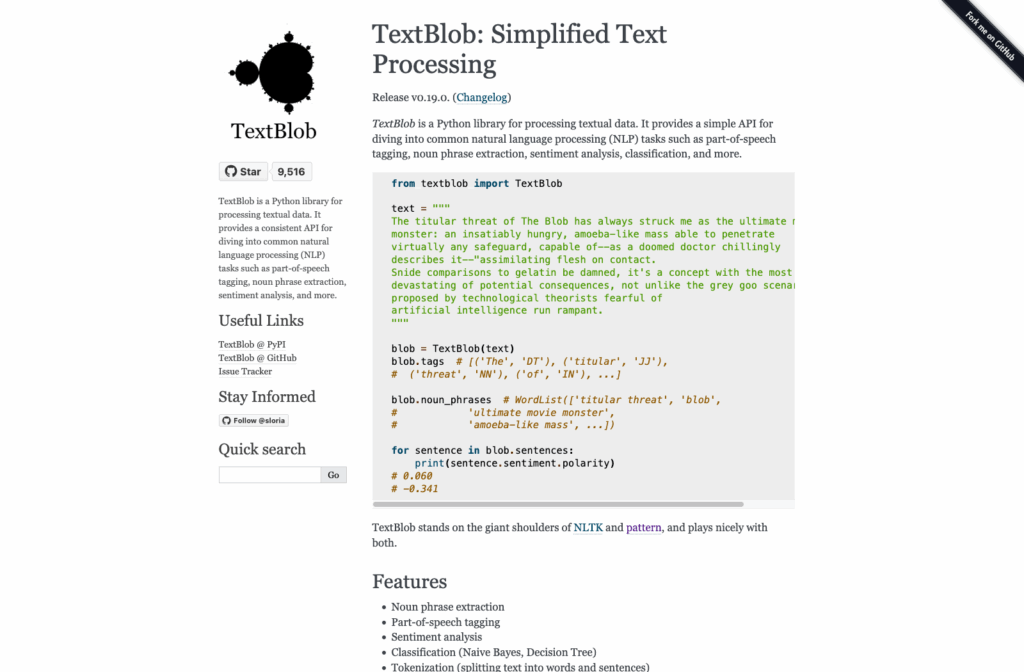
TextBlob is a beginner-friendly NLP library built on top of NLTK and Pattern. It offers a clean, readable API that abstracts away much of the complexity of standard NLP tasks, making it an excellent entry point for developers who are new to text processing and want to produce results quickly without a steep learning curve.
Key features:
- Sentiment analysis with polarity and subjectivity scores
- Part-of-speech tagging, noun phrase extraction, and tokenization
- Simple text classification using a Naive Bayes classifier
Pros: Very user-friendly; clean and readable API; good documentation for beginners; fast for prototyping and exploratory analysis.
Cons: Not suitable for production-scale workloads; limited model accuracy compared to modern deep learning alternatives.
Who uses it: Python developers and data analysts who are getting started with natural language processing, as well as teams that need to add lightweight text data processing to a project without significant overhead. TextBlob is a useful prototyping tool, but most teams will eventually graduate to spaCy or Hugging Face as their needs grow.
Pricing: Free and open source under the MIT license.
9. VADER
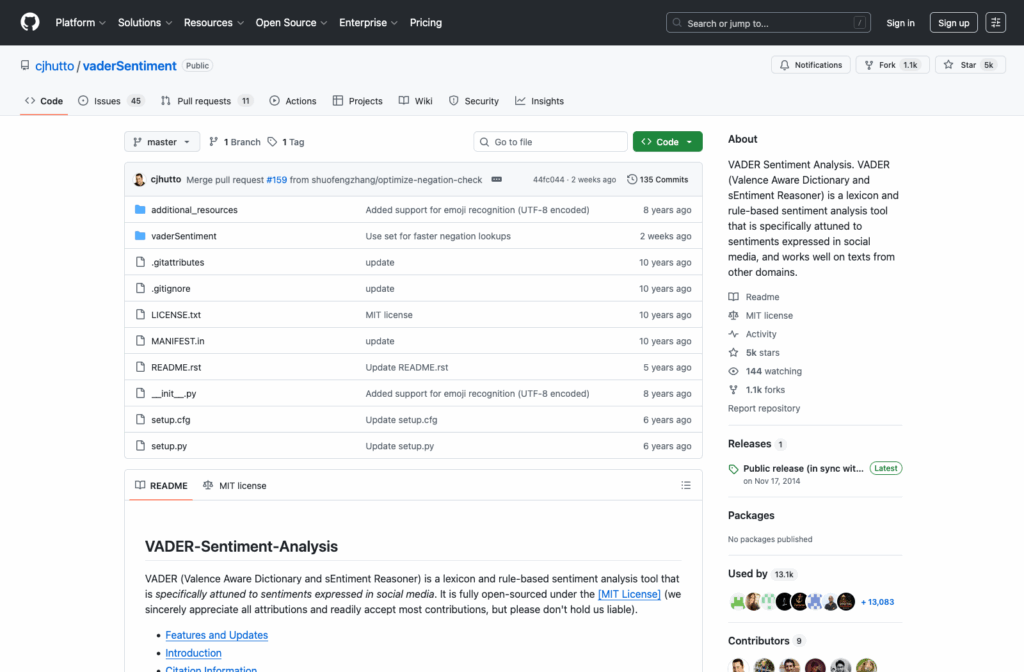
VADER (Valence Aware Dictionary and sEntiment Reasoner) is a lexicon and rule-based sentiment analysis tool developed by C.J. Hutto and Eric Gilbert, originally presented at ICWSM 2014. Unlike most libraries in this guide, VADER requires no model training. Instead, it scores sentiment using a hand-validated lexicon of words, phrases, emoticons, and social media conventions, which makes it fast and easy to use out of the box.
Key features:
- Sentiment scoring across four dimensions: positive, negative, neutral, and a normalized compound score between -1 and +1
- Built-in awareness of degree modifiers, capitalization, punctuation emphasis, and slang
- Native support for emoticons and social media conventions that confuse most other sentiment tools
- Available as a standalone package (
vaderSentiment) and built into NLTK
Pros: No training data or model setup required; extremely fast; results are interpretable and easy to explain to non-technical stakeholders; well-validated against human raters; widely cited in academic research.
Cons: Designed primarily for English-language short-form text; struggles with sarcasm, irony, and complex negations; less accurate than fine-tuned transformer-based models on formal or domain-specific text. The standalone repository is no longer under active development, though the library remains stable and widely used.
Who uses it: Data scientists and researchers who need fast, training-free sentiment scoring on social media posts, customer reviews, or other informal text. VADER is particularly common in academic research, rapid prototyping, and use cases where explainability matters more than state-of-the-art accuracy.
Pricing: Free and open source under the MIT license.
10. Textacy
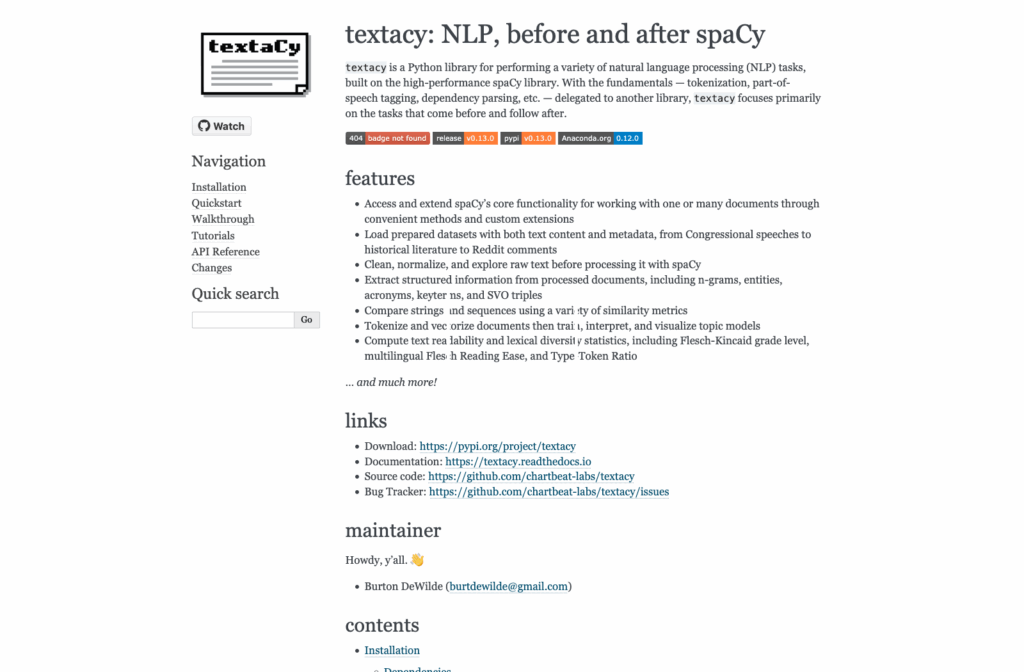
Textacy is a Python NLP library built on top of spaCy. Where spaCy handles core linguistic annotations, Textacy handles everything around them, such as cleaning and normalizing raw text and extracting higher-level structured information from spaCy’s output.
Key features:
- Text preprocessing and normalization utilities, including tools for handling unicode, accented characters, URLs, and other common data cleaning tasks
- Structured information extraction from spaCy-processed documents, including n-grams, entities, acronyms, key terms, and subject-verb-object triples
- Topic modeling support via NMF and LSA, built on top of document-term matrices
- Built-in access to prepared datasets — including Congressional speeches, historical literature, and Reddit comments — for experimentation and research
Pros: Fills gaps in spaCy’s functionality rather than duplicating it; includes preprocessing utilities covering common edge cases such as unicode normalization, URL handling, and accented characters; useful for teams who are already invested in a spaCy-based workflow and need more than spaCy provides out of the box.
Cons: Tightly coupled to spaCy, so it’s not useful outside of a spaCy workflow; the most recent PyPI release was in 2023 and the project shows limited maintenance activity, which is worth monitoring if spaCy compatibility becomes an issue.
Who uses it: Data scientists and NLP engineers who are building on top of spaCy and need robust preprocessing or structured extraction capabilities without writing custom code. It’s particularly well-suited to research workflows and text-heavy analytical pipelines where cleaning and information extraction are as important as the linguistic annotations themselves.
Pricing: Free and open source under the Apache 2.0 license.
11. PyNLPl (Pineapple)
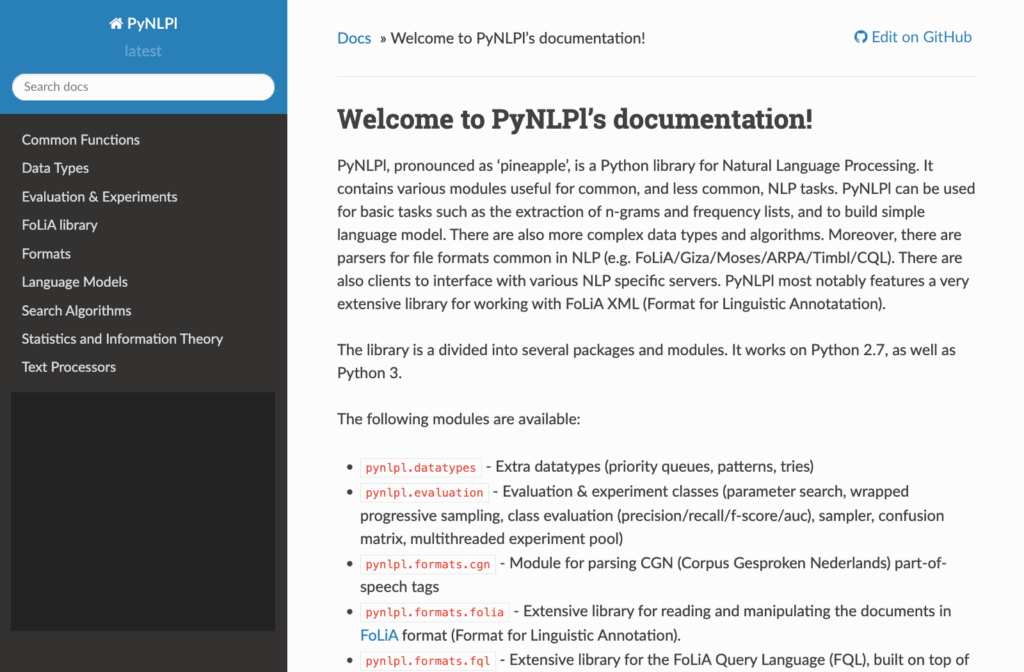
PyNLPl, pronounced “pineapple,” is a Python library for natural language processing developed at the Centre for Language and Speech Technology in the Netherlands. It’s designed around the FoLiA XML format—a rich annotation standard for linguistic data—and is best suited for research tasks that involve complex, structured text annotations.
Key features:
- Support for reading, writing, and manipulating FoLiA XML documents
- Tools for language modeling, n-gram extraction, and frequency analysis
- Modules for common NLP preprocessing tasks such as tokenization and feature extraction
- Lightweight design that integrates easily into custom research pipelines
Pros: Excellent for research workflows involving rich linguistic annotations; flexible and easy to extend; minimal footprint.
Cons: Smaller community and fewer learning resources than mainstream libraries; not designed for general-purpose production natural language processing; best suited to teams already working with FoLiA-formatted data.
Who uses it: Computational linguists and NLP researchers working on annotated corpus analysis, particularly in academic settings. PyNLPl is a specialized tool, and most teams building applied natural language processing products will not need it.
Pricing: Free and open source under the LGPL.
Start Your NLP Development Today
Selecting the right NLP library is one of the most consequential early decisions in any text-based project. The good news is that the Python ecosystem gives you strong options for NLP applications at every level of complexity, from TextBlob for quick prototypes to Hugging Face Transformers for production-scale generative artificial intelligence. The key is matching the tool to your team’s expertise, your project’s requirements, and the infrastructure you have available to support it.
Once you’ve made your selection, managing packages and environments cleanly becomes just as important as the code itself. Anaconda Core gives you a reliable, enterprise-ready foundation for Python development, with trusted package management and a curated open-source ecosystem that makes it straightforward to install and maintain NLP libraries across your team. For teams building more advanced machine learning and AI workflows that need to move from experimentation into production, Anaconda’s AI Catalyst provides the governance, collaboration, and deployment capabilities to get there faster.
Ready to move from library selection to production? See how AI Catalyst gives enterprise teams the governance and deployment infrastructure to get there.