
This article outlines ten stages of operational maturity for deploying ML/AI systems to production. Which stage are you at?
Every production-oriented ML/AI team grapples with the same challenge: how to work with data, code, and models effectively so that projects are readily deployable to production.
The challenge is not new. If you ignore the data and models part, software engineers have been facing and addressing the challenge for decades. Best practices and processes for doing this effectively are often found under the moniker Continuous Delivery (CD) which is concisely defined at continuousdelivery.com:
Continuous Delivery is the ability to get changes of all types—including new features, configuration changes, bug fixes and experiments—into production, or into the hands of users, safely and quickly in a sustainable way.
Certainly, this sounds like a desirable goal for ML/AI systems as well.
Why is Continuous Delivery for ML/AI hard(er)?
Since the challenge is not new and many valid solutions exist targeting traditional software projects, is there a reason to treat ML/AI systems any differently? Consider these three core challenges that are endemic in ML, AI, and data projects:
- Development and debugging cycles are more tedious due to computational requirements of models and data processing. Specialized hardware like GPUs pose extra challenges for dependency management, cause tricky cross-platform issues, and create gaps between development and production environments.
- Data introduces entropy – systems that deal with constantly changing data are less predictable, and hence inherently harder to make reproducible and debuggable than traditional software that has smaller surface area against the outside world.
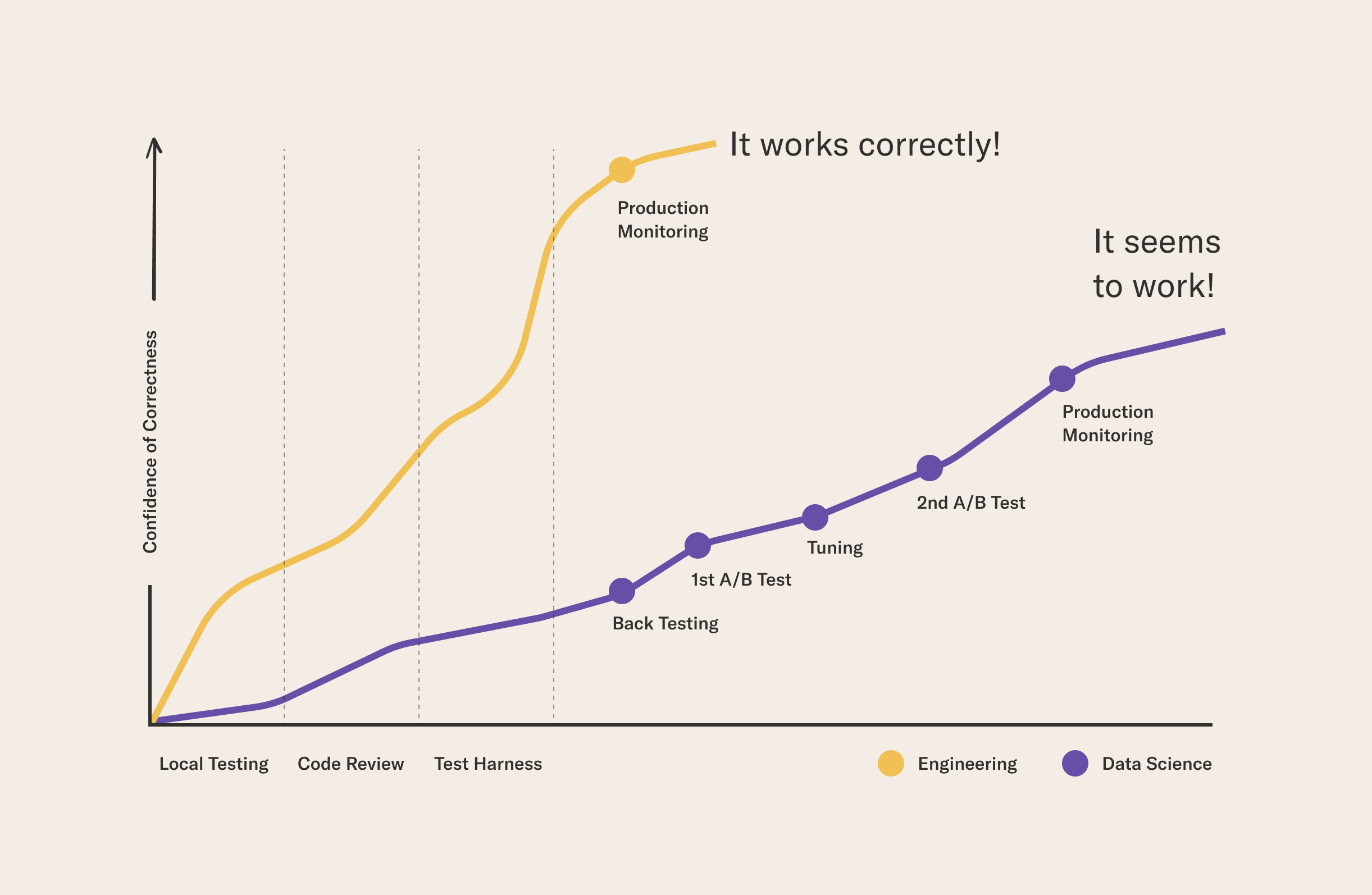
- It is hard to ascertain that ML/AI systems work correctly. A key tenet of continuous delivery is to follow a process, such as rigorous testing and manual reviews, to ensure that changes don’t cause breakage. In the case of ML/AI, ensuring correctness often happens empirically over time after the deployment, not before:
Continuous Delivery with Outerbounds
Instead of ignoring the special needs of ML/AI and shoehorning projects into existing patterns, we are paving the path for continuous delivery in the Outerbounds platform, specifically addressing the needs of ML, AI, and data projects.
We have observed problems, solutions, and best practices for CD at hundreds of advanced ML/AI organizations that we have worked with. It is clear that every organization is different – there isn’t a cookie-cutter approach that works as such for all – but the following four building blocks seem foundational in all successful CD implementations:
- Embrace GitOps: As a baseline, you should follow all the existing GitOps best practices from pull requests to automated testing. When it comes to CD for ML/AI, this is necessary but not sufficient.
- Scalable compute built-in, from prototype to production: To address the compute requirements, we provide compute-optimized cloud workstations, coupled with a scalable, multi-cloud compute backend out of the box – as well as solutions for dependency management and specialized hardware like GPUs and other accelerators.
- First-class support for data, artifacts, and change management: To tame the entropy, Outerbounds provides various tools that help dealing with real-world data securely, as well as managing state and change with minimal overhead.
- Isolated, flexible, secure environments: Since one can’t ascertain the quality and correctness of every model and deployment in advance, we make it possible create isolated environments and deployments which allow you to experiment safely and test new approaches without interfering with production. This helps with compliance too in scenarios where production deployments are under high scrutiny, or projects must be kept isolated from each other.
To illustrate how these four features work together to enable continuous delivery, we walk through ten stages that represent typical evolution of an ML/AI organization as their approach to CD matures over time. At every stage we show a few pertinent features of Outerbounds, but you can place yourself on the maturity spectrum regardless of the tools that you have been using this far – the needs are universal.
Stage 1: Local development
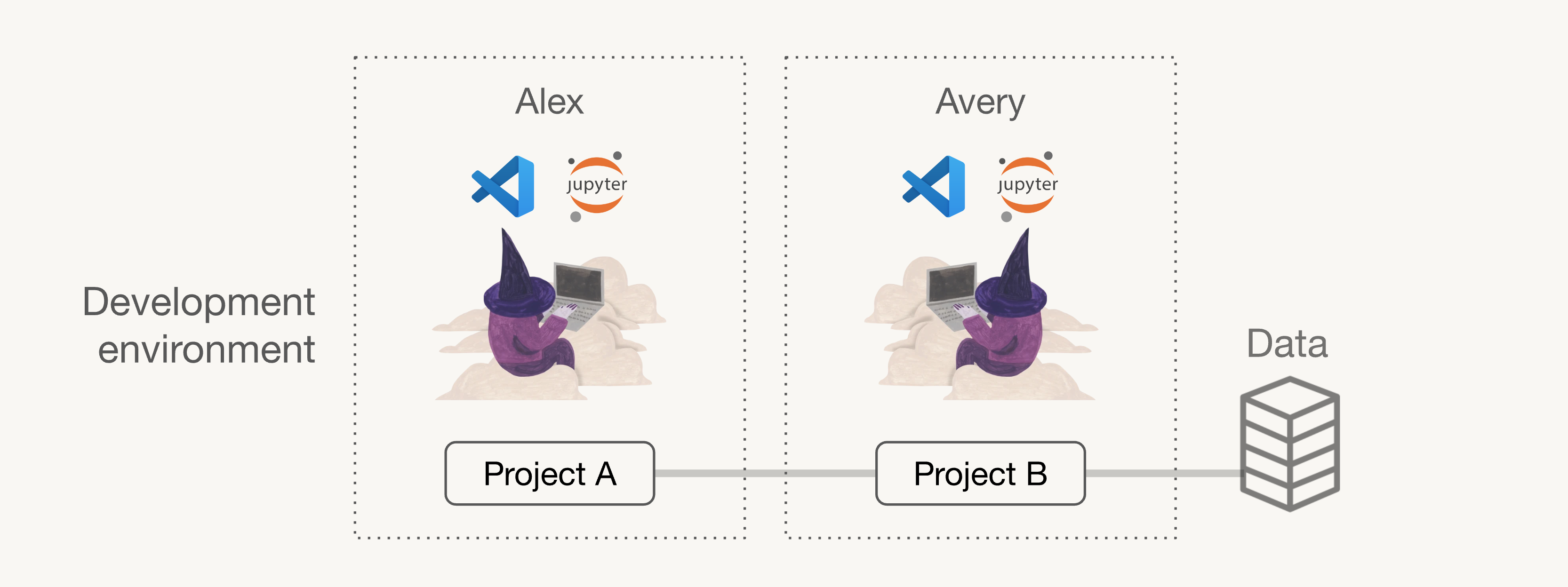
This is a familiar baseline in many ML/AI projects. You have a few developers, like Alex and Avery below, hacking code locally on their laptops or maybe cloud-based notebooks like Google Colab or Amazon Sagemaker Studio, accessing data from a common data store:
Move beyond notebooks
Notebooks are convenient for exploratory data analysis and as a quick scratchpad for code snippets. When it comes to developing production-ready code, it is beneficial to use a full-fledged IDE like VSCode, which allows you to develop modular, idiomatic Python projects – including Metaflow flows – while following GitOps best practices.
The change from notebook-oriented development is not drastic, as VSCode supports notebooks side-by-side with regular code, as shown here with Outerbounds cloud workstations:
Stage 2: Experiment tracking and versioning models and data
The Stage 1 resembles a typical setup in traditional software engineering: Developers hack code on their laptops, checking in code to Git periodically to keep track of changes. In projects involving ML, AI, and data improvements happen not only through changes in the code but also in changing data, models, and configuration. Keeping track of these changes and their impact becomes critical.
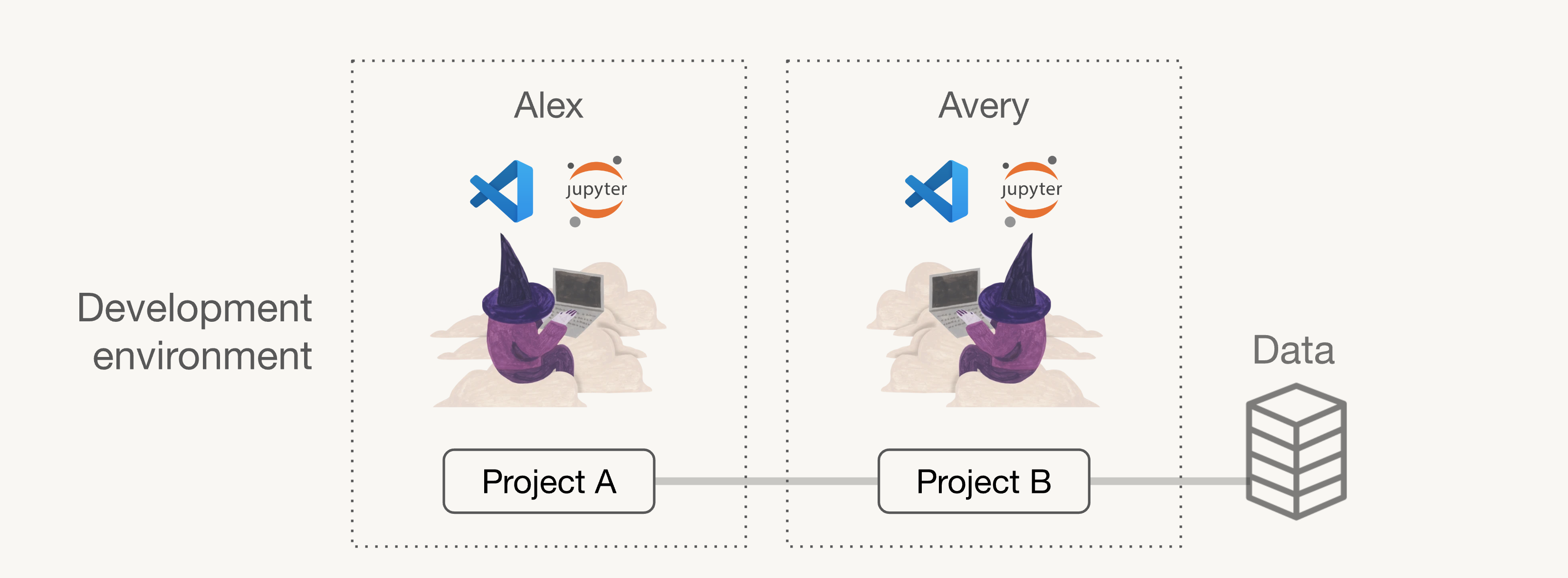
Many tools and services, such as MLFlow, Weights and Biases, and Comet, have emerged to address this need, often categorized as experiment tracking. They provide a layer of metadata that keeps track of models, metrics, and other artifacts produced as Alex and Avery develop their projects:
Keeping track of everything automatically
Since keeping track of code, data, models – as well as the state of systems in general – is such a fundamental part of ML/AI projects, it is beneficial to consider it as an integral part of the systems we build, not as a separate add-on.
Metaflow takes this approach by recording, persisting, and versioning the full state of the workflow automatically, so you can observe any part of your system, not just models or specific pieces of data, consistently across experimentation and production, as shown in this quick example:
As shown in the video, you can also present the data tracked through custom, real-time visualizations which are easily viewable in the UI.
Stage 3: Easy scalable compute
It is not too hard to get to the Stage 2 with off-the-shelf tooling: Alex and Avery have a productive development environment which allows them to keep track of changes and see improvements over time.
What happens if Alex needs to load a dataframe that doesn’t fit in the memory of their workstation, or Avery wants to fine-tune a set of LLMs on beefy GPUs? In scenarios like this, which are very common in ML/AI projects, developers need access to scalable compute resources outside their personal development environment – the more quickly and frictionlessly the better.
In the past, ML developers and data scientists were often required to learn a new paradigm, rewrite their code, and move to a different set of libraries – say, to move from Python to Spark – to test things at scale, severely slowing down development cycles and creating a massive gap in the delivery process.
Harness all cloud compute with minimal overhead
With Outerbounds, developers can request cloud resources without changing anything in their code – just work with your existing Python code, scaling it vertically, horizontally, or even leveraging distributed training. Here, we train a separate model for 249 countries in parallel, and show results of a previous fine-tuning run on GPUs:
Stage 4: Worry-free collaboration
Developers working concurrently can inadvertently interfere with each other’s work. For instance, consider two experiments running in parallel, both writing results to the same file or a database table.
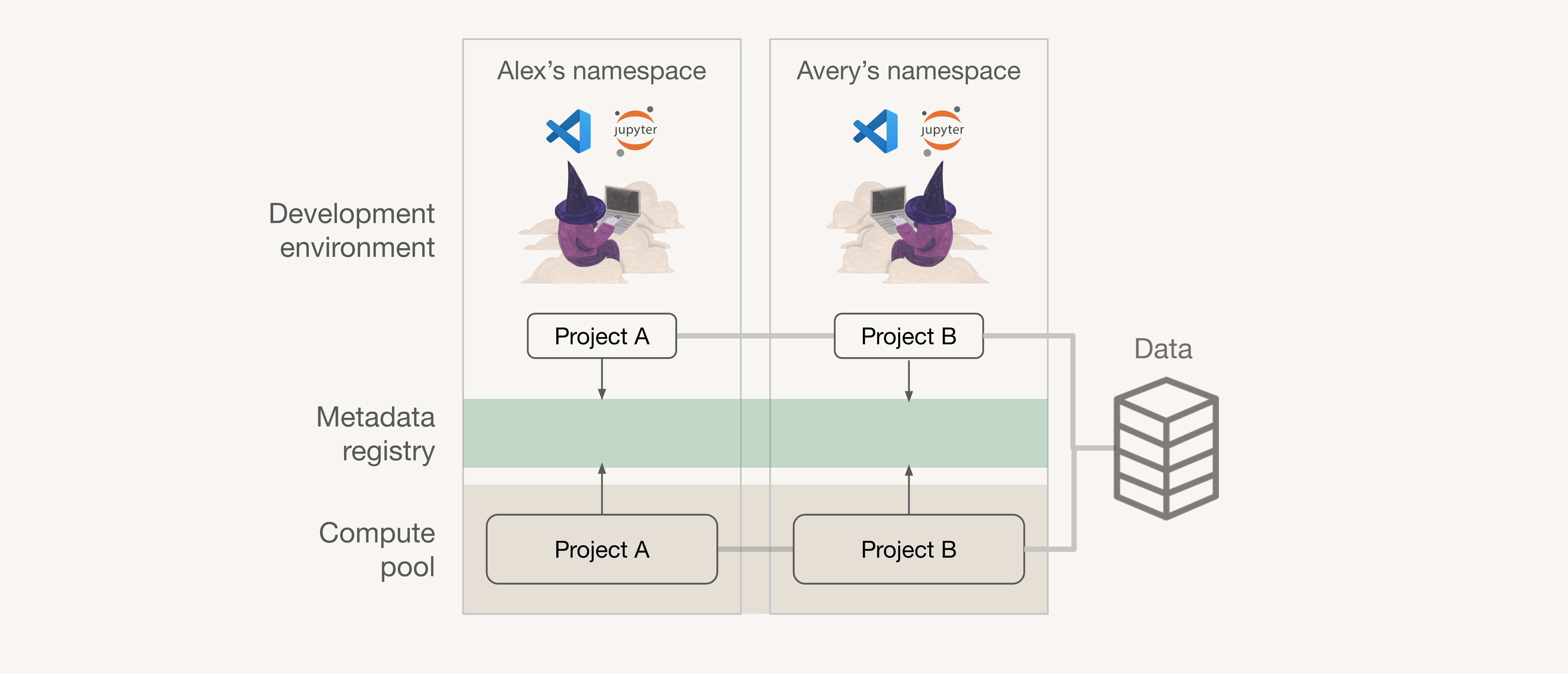
The challenge is amplified by shared compute pools, as workloads execute outside the confines of personal workstations. It is hard to achieve repeatable, worry-free continuous delivery, if there’s a chance of developers stepping on each other’s toes. Preferably, all developers would stay on their own swimlane by default – without fear of interference – while making it easy to collaborate whenever opportunities arise.
Keep work organized by default
Metaflow organizes all data, code, and models automatically under namespaces. A developer can safely develop their code as if no other developers existed, but accessing a colleague’s results is just a matter of switching the namespace:
Besides namespaces, Metaflow allows you to organize results with user-defined tags which make it possible to define various human-in-the-loop processes, for instance, to approve models before deployment.
Stage 5: Stable, consistent execution environments
The stages 1-4 ensure that developers are able to develop and test their projects, even at scale, and collaborate effectively. This establishes a robust foundation for development of production-grade ML/AI projects.
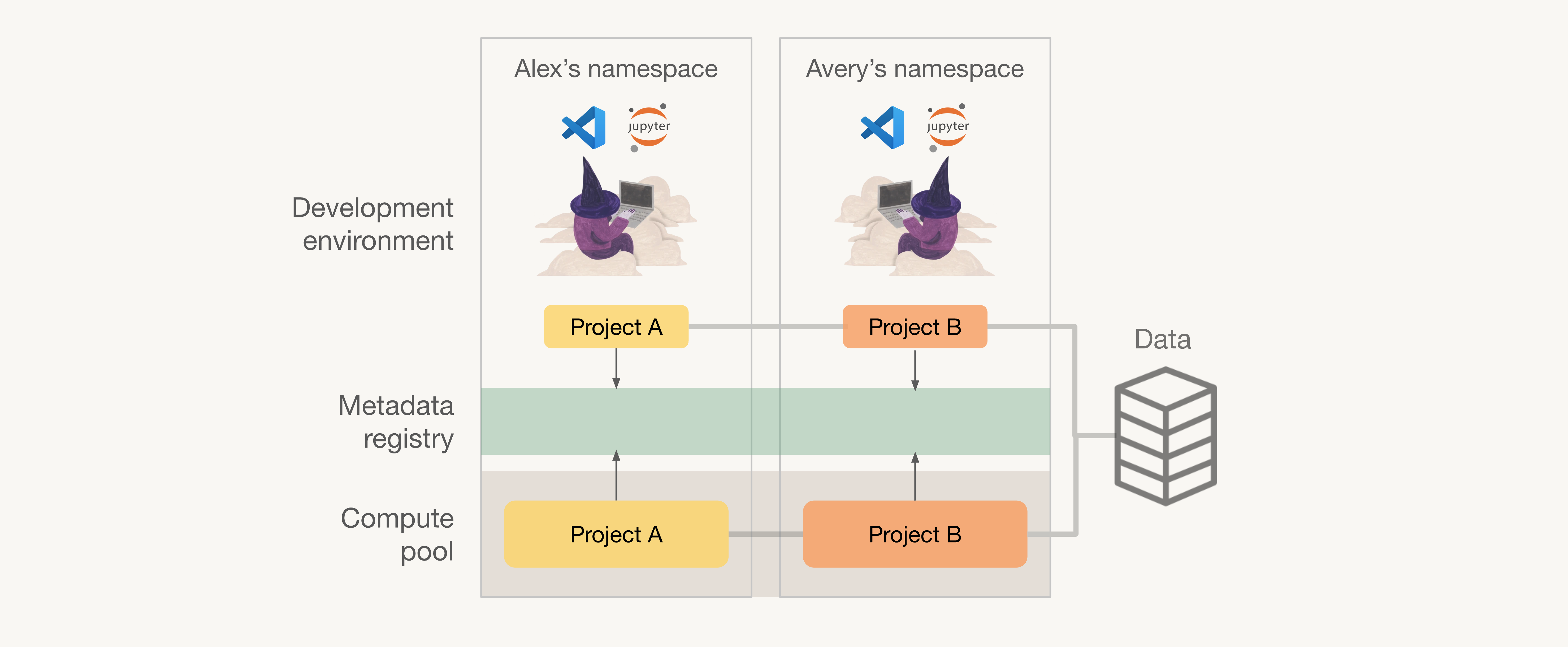
An absolute requirement for production deployments are stable execution environments, that is, careful management of all software dependencies that are required to execute the code. Problems arise if there’s a mismatch between the development and production environments. Preferably, one would use exactly the same environment from prototyping to production.
A popular solution is to use container (Docker) images. This is a perfectly valid solution but it brings up additional challenges:
- Are data scientists and other developers supposed to maintain their own images? This is a non-trivial challenge by itself.
- How to handle change management for images, say, Alex wants to update the version of
torch(the yellow boxes in the image) but Avery wants to keep an older version (the orange boxes)? - What should be included in the image? Certainly it is not convenient to bake a new image every time the code or configuration changes.
- How to manage the whole software supply chain, ensuring that images don’t contain security vulnerabilities?
Multi-layered approach to dependency management
To enable stable, consistent environments between development and production, without hindering the speed of iteration, Metaflow provides built-in support for dependency management. This video shows Metaflow’s three main mechanisms for defining stable environments for cloud execution:
Starting from the simplest pattern,
- Metaflow packages the user code automatically, including any custom modules and packages.
- It provides
@pypiand@condadecorators which can be used to include 3rd party dependencies safely, without having to manage container images manually. - Finally, to enable arbitrarily advanced cases, Metaflow allows you to use custom images – just specify
@kubernetes(image=).
With stages 1-5 in place, it is possible to deploy projects to stable production environments. In the case of Outerbounds, this can happen with a single command:
python myflow.py argo-workflows createwhich deploys the workflow for automated, highly-available execution.
Stage 6: Deployments via CI/CD
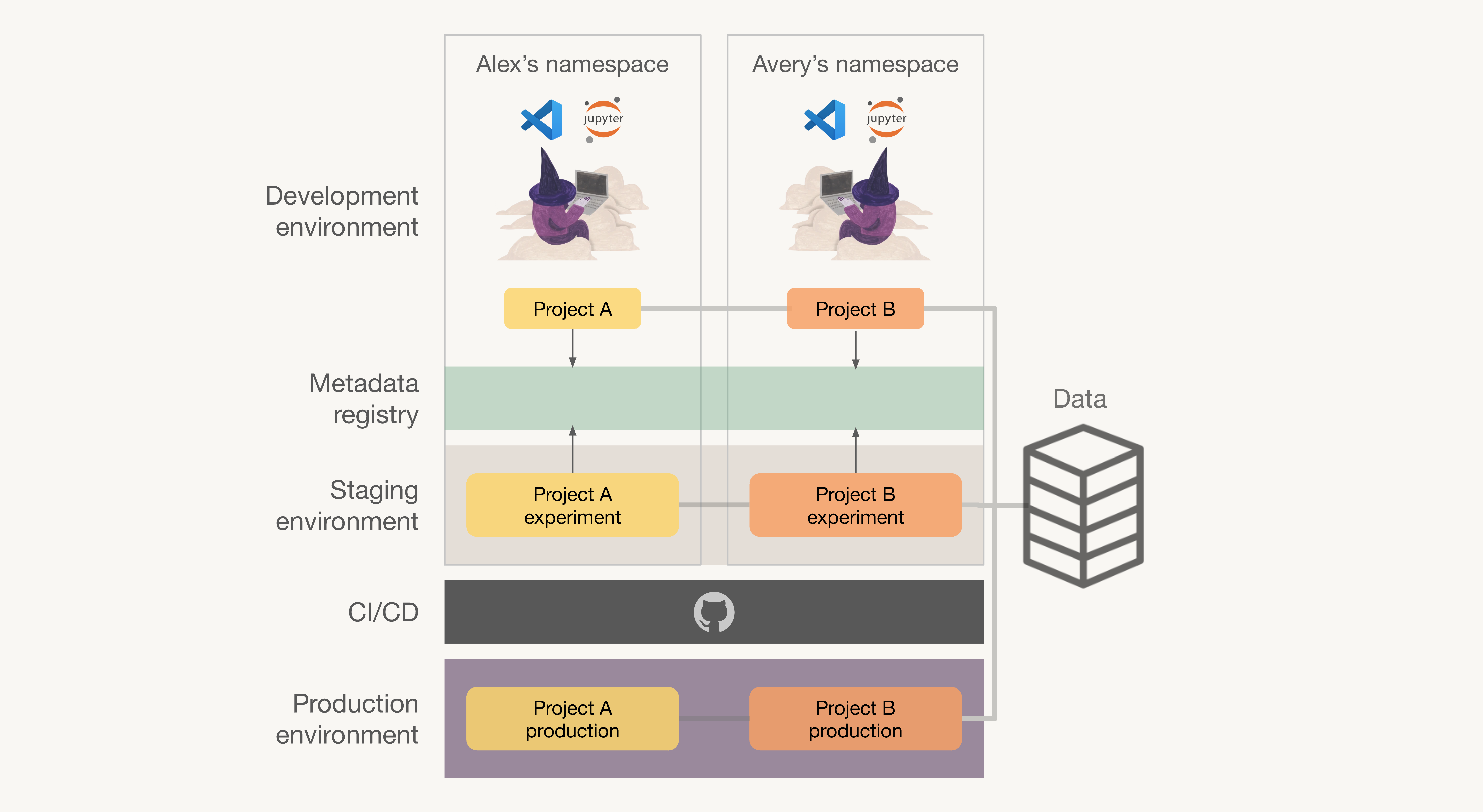
While one-click deployments are convenient, many organizations prefer to follow a more rigorous GitOps process where production deployments are done through a CI/CD system, such as GitHub Actions.
Using a CI/CD system provides a number of benefits over Stage 5:
- You can define arbitrary gates and policies, such as code reviews or automated tests, which must be passed before a deployment can commence.
- Only the CI/CD system needs to access the production environment directly, making it more secure and protected from inadvertent actions.
- You get a clear audit trail of deployments in the CI/CD system.
Seamless and secure integration with CI/CD systems
This illustration outlines a typical path from development environment to production on Outerbounds, when including a CI/CD system like GitHub Actions:
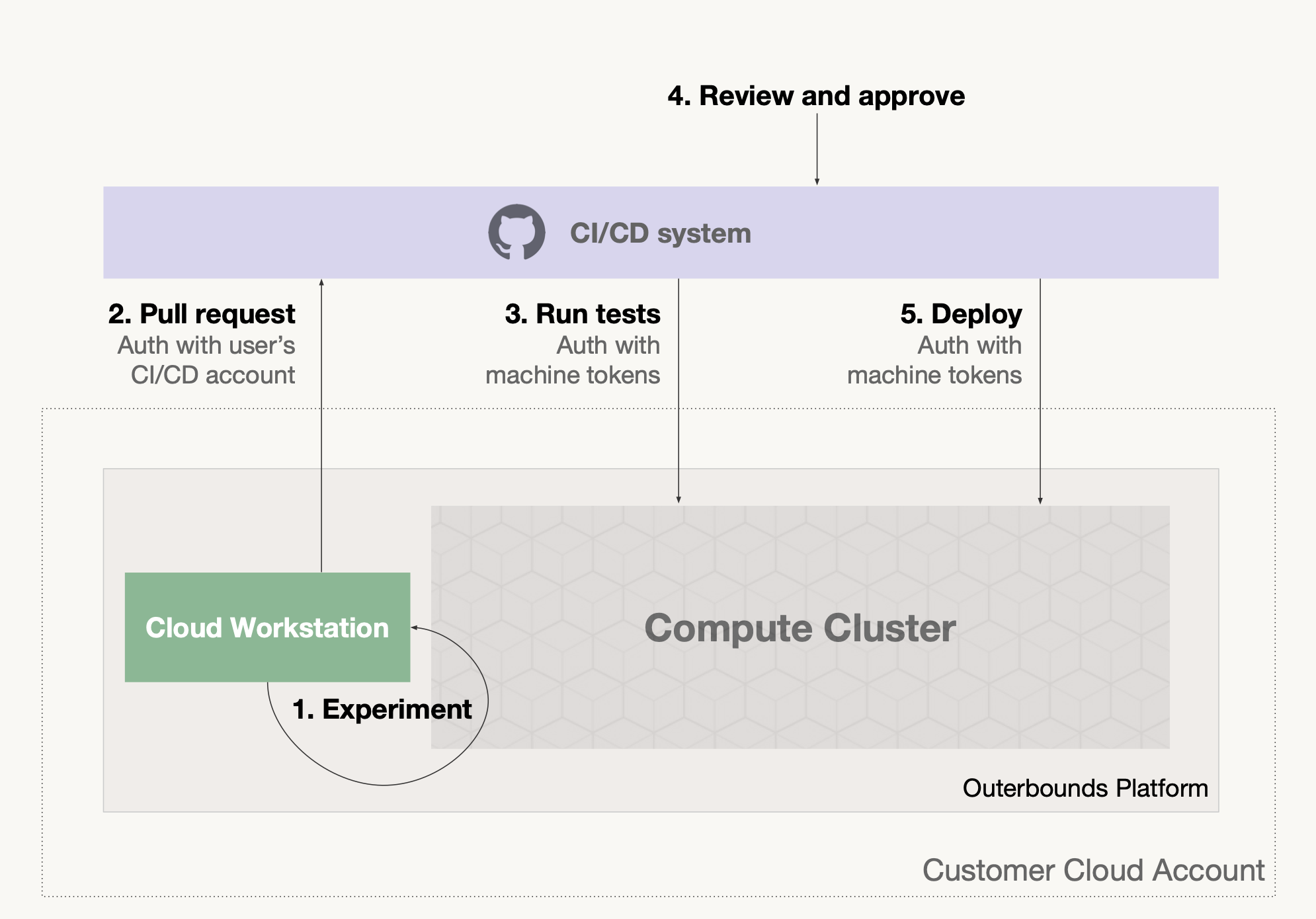
Crucially, the arrows 4 and 5, test execution and deployments, require GitHub Actions to communicate with the platform which is enabled via secure machine tokens. The beginning of this video shows how to set up GitHub Actions for Outerbounds, and the rest of the video goes through the path illustrated above:
At this stage, you are able to
- Experiment locally, running code at scale if needed.
- Commit changes to GitHub, which triggers a test execution.
- If the test execution passes, the flow is deployed to production.
Thanks to namespaces, tests and production don’t interfere with each other.
Stage 7: Environment-specific policies
Stage 6 is getting close to the continuous delivery nirvana. For small teams with a handful of projects it may be a perfectly sufficient setup.
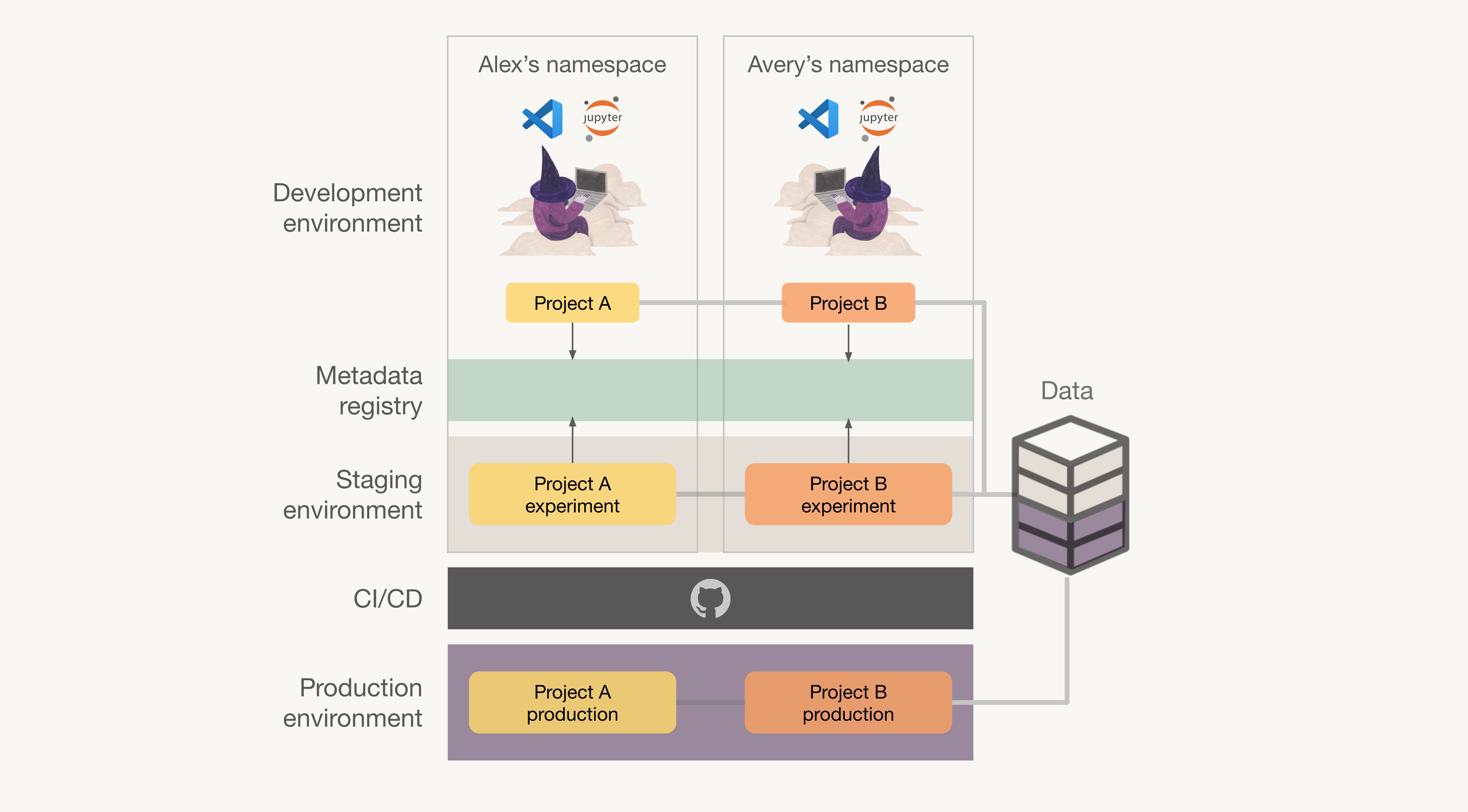
However, if your use cases are business or security-critical, the setup may be lacking, as experiments, tests, and production executions exist in the same environment with the same set of permissions. In particular, for data governance reasons you may need to limit access to production data only to production systems and let experiments access only test data. Or, you may want to limit the compute resources available to experimentation.
Defining custom policies
Outerbounds provides a core feature called a perimeter which allows you to create separate environments, such as staging and production, each with a different set of policies and permissions, like IAM permissions, container policies, and compute resources policies shown here:
Through this mechanism, you can grant access to production tables, say in a Snowflake database, only to production perimeters, and let staging access other tables. Or, you can require that all container images used in production must come from a trusted registry.
When it comes to battling against entropy, an effective approach is to compartmentalize different projects and variants in isolated environments, limiting the blast radius of surprising changes in code, data, and models.
Stage 8: Isolated, parallel deployments
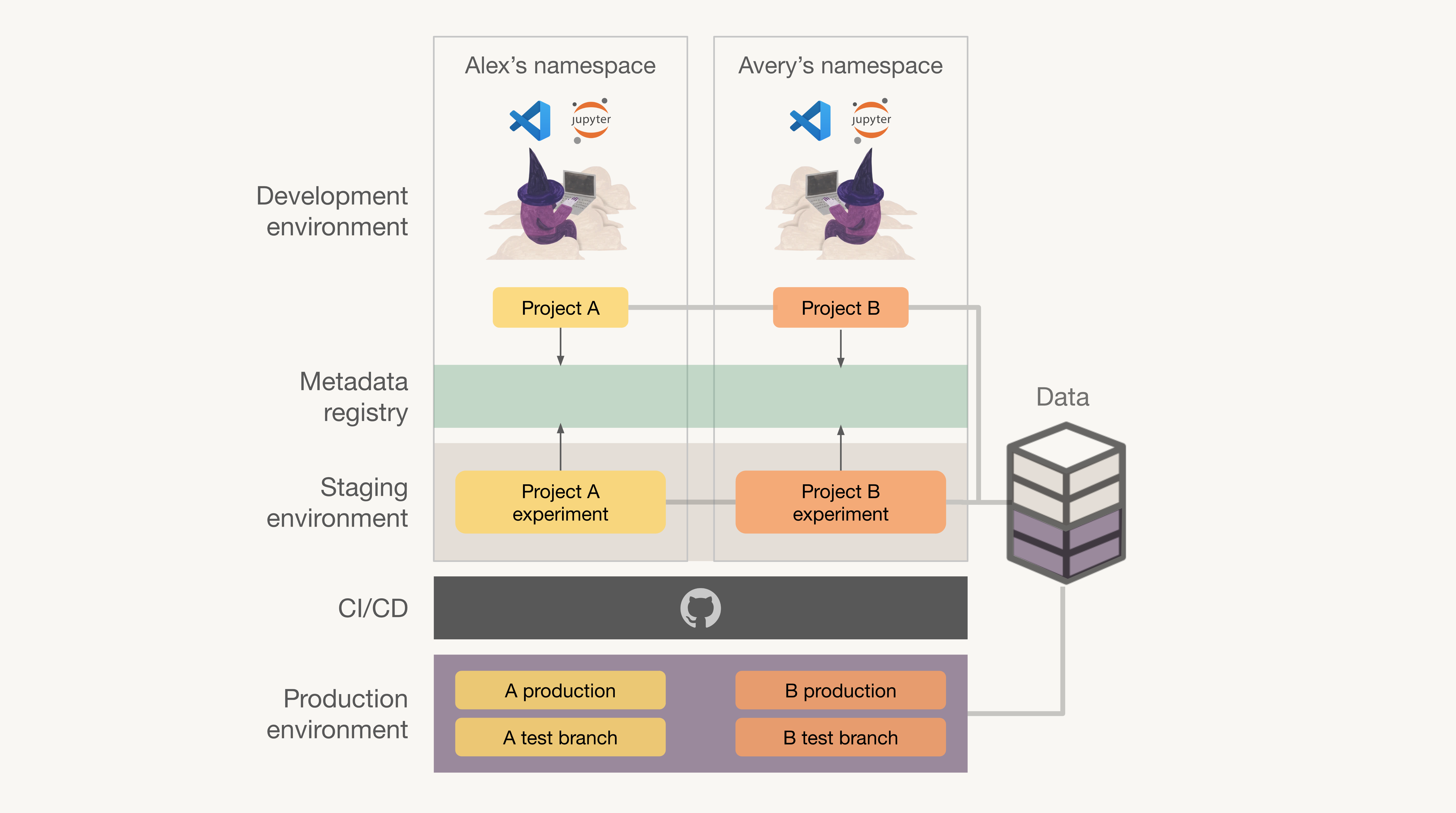
A killer feature in many mature continuous delivery platforms, like Vercel that targets web applications, is the ability to create multiple parallel deployments, say, one for each pull request. This allows the developer to eyeball changes in a real environment before promoting their branch to production.
As we mentioned in the beginning, ascertaining the quality of ML/AI branches is less straightforward – you can’t just eyeball the results quickly. Instead, you may have to leave the branch running side-by-side with the current production, A/B testing the new version against the existing production version over time.
Deploying branches
Metaflow has a specific construct, the @project decorator, to support concurrent, isolated deployments. In this video, we demonstrate two variants of a flow, daikon and cucumber, deployed to production as parallel pull requests.
Again, thanks to namespaces, the branches don’t interfere with each other. Remarkably, namespaces extend to event-triggering so you can deploy even complex sequences of flows to run in parallel, reacting to external events in real time. The deployments operate in the same production environment, potentially consuming the same live data, but they are safely isolated from the main production branch, similar to, say, Vercel’s branched deployments.
After a while, you can pull results from the test branch in a notebook and compare them to production, judging whether it is prudent to promote the new version to production.
Stage 9: Isolated, secure environments
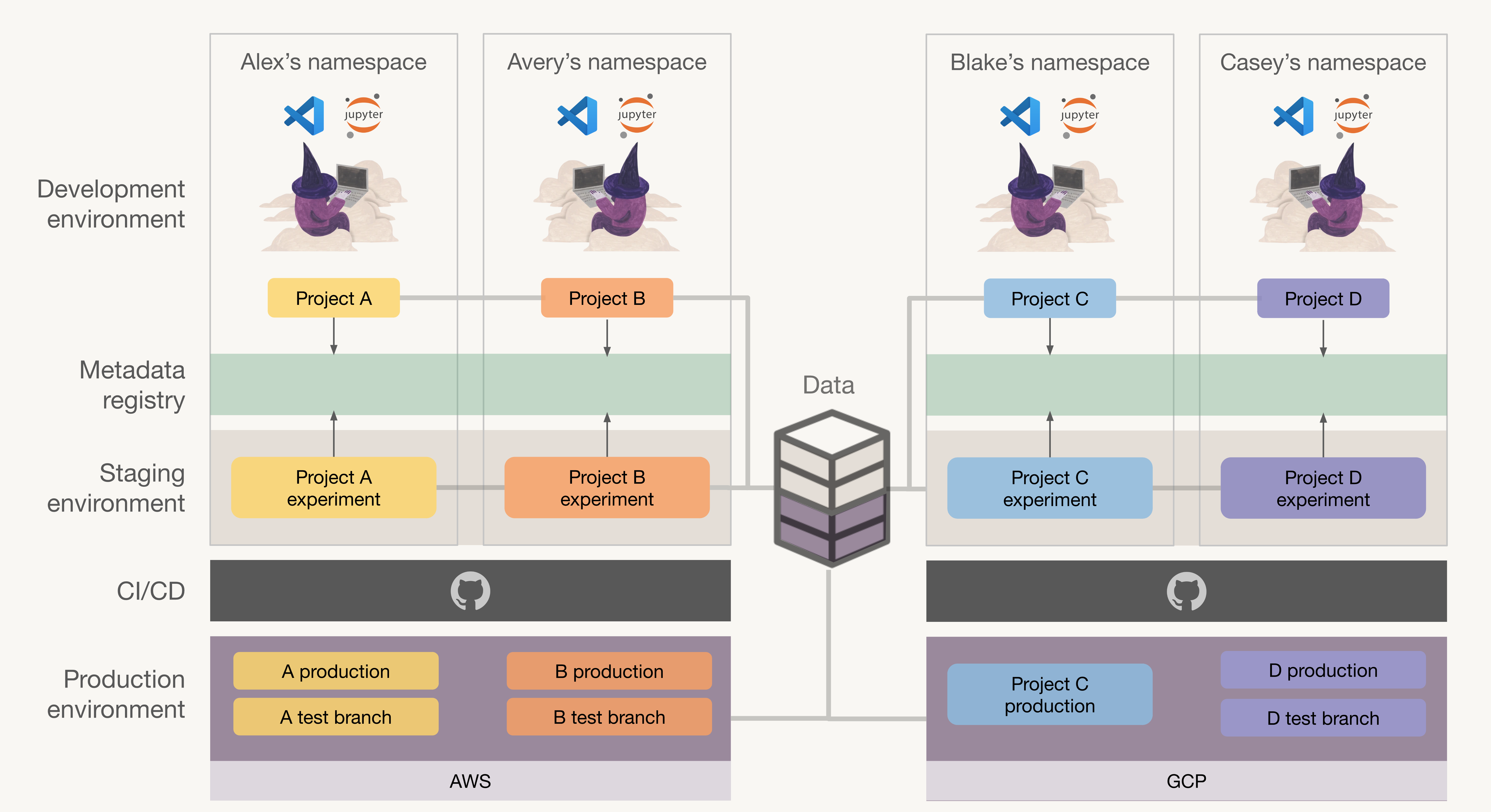
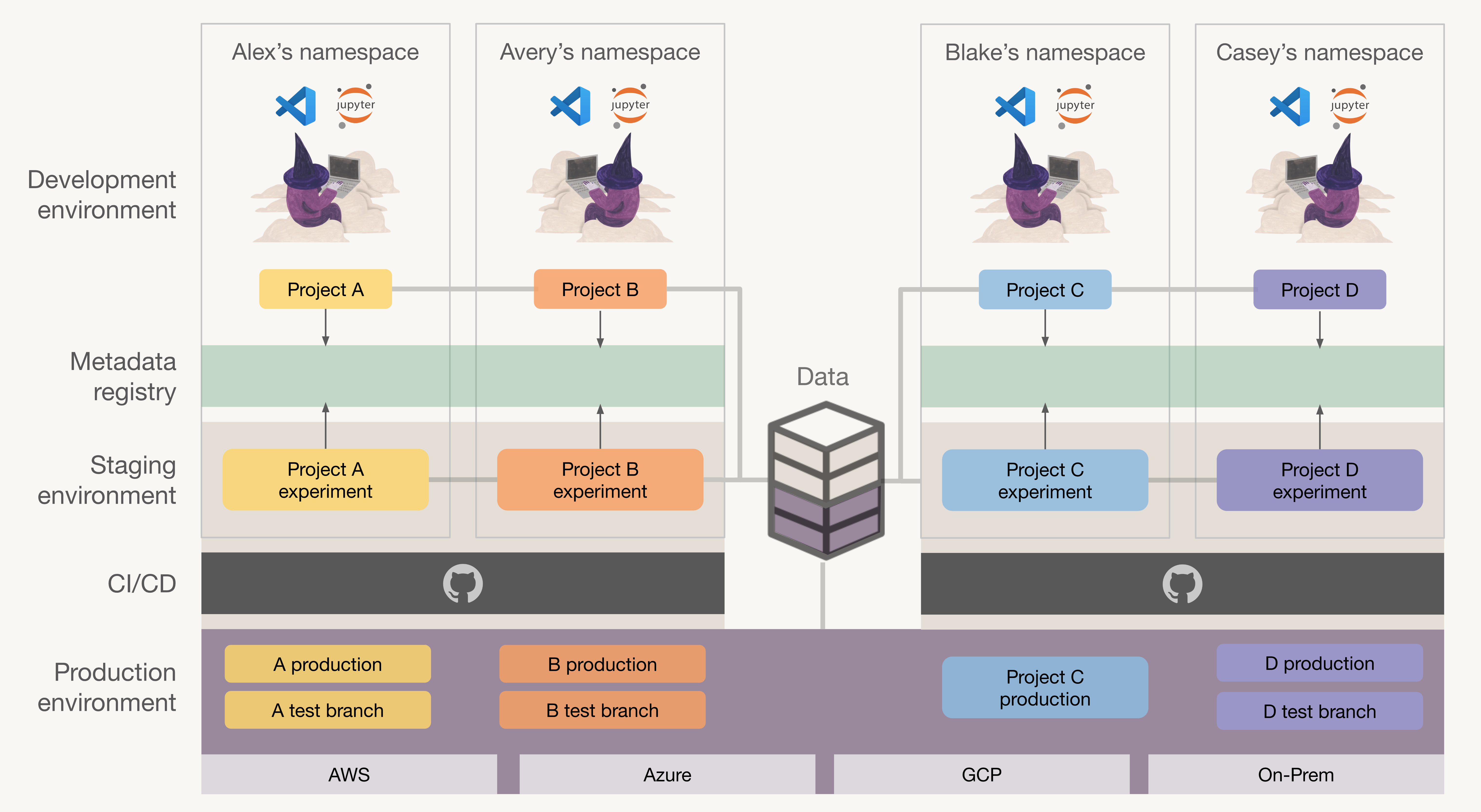
In a large organization, it is not only Alex and Avery working on ML/AI but they have potentially hundreds of colleagues, spread across various lines of business. Each team is responsible for their own products and services, and hence they need their own isolated staging and production environments. In other words, the organization needs multiple copies of Stage 8, each with their own set up and policies.
The organization may be distributed over multiple jurisdictions, so often it is critical that the environments are securely isolated from each other. To complicate things further, the teams may require different technical resources.
For instance, in the illustration below, Blake and Casey may need the latest TPU accelerators from the Google Cloud for their compute vision project, whereas Alex and Avery use the company’s main AWS account.
Managing multiple environments
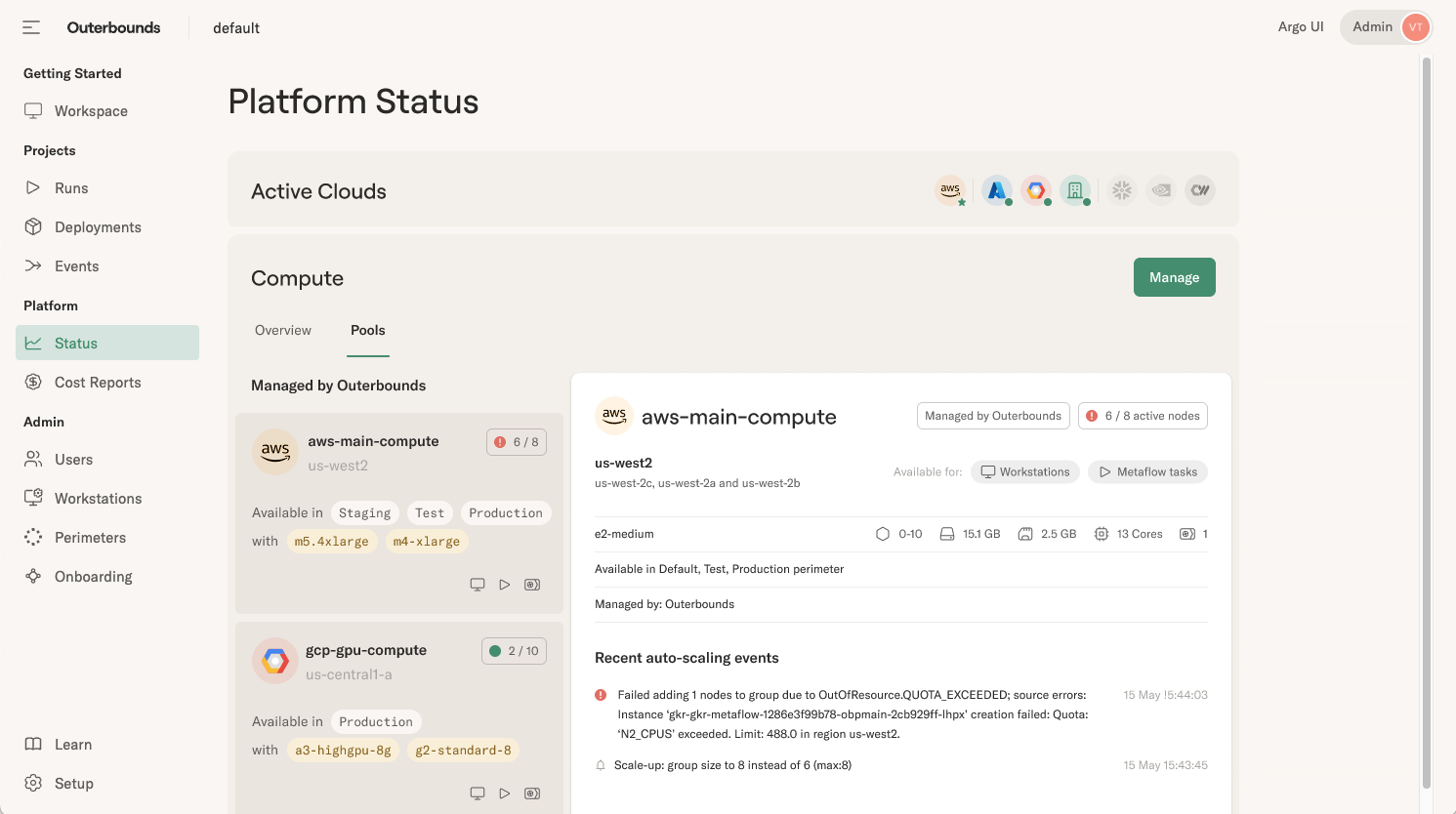
Outerbounds allows you to create any number of securely isolated environments, perimeters, which may target any number of compute pools that may be spread across multiple clouds, and even on-prem resources.
Each team can set up their own policies, CI/CD integrations, and processes, matching their bespoke requirements, as if they had an independent platform of their own.
Stage 10: Secure environments over unified compute
Finally, what sets a trailblazing tech company like Netflix, Google, or Meta apart from other large organizations? Similar to any large organization, they have myriads of teams and products with diverse needs.
They operate massive-scale shared platforms, compute in particular, on top of which each line of business can build solutions and workflows matching their requirements. This affords them benefits of scale, including higher utilization of compute resources in contrast to siloed deployments. As a result, the cost of compute is decreased and more resources can be made available to every team.
More deployments, lower costs
We have heard teams balking at the idea of continuous training of ML models due to cost concerns. With proper continuous delivery in place, you may have not only one production pipeline running continuously but any number of variants as well, maximizing the speed of innovation, and increasing the confidence in correctness.
Crucially, this doesn’t have to break the bank. Outerbounds offers full visibility to cloud costs, across all environments, with many levers to maximize resource utilization and minimize cost, as shown in this sneak peek of the cost reporting UI:
With these ten stages in place, you can start delivering changes of all types— new features, configuration changes, bug fixes and experiments—into production, or into the hands of users, safely and quickly in a sustainable way.
Start delivering today
If continuous delivery of ML/AI projects sounds intriguing, take Outerbounds for a test drive!
Deploying the platform doesn’t require any cloud expertise, but if your engineers want to go over the technical details (including our SOC2 compliance), or discuss integration to your existing CI/CD processes, we are happy to help.
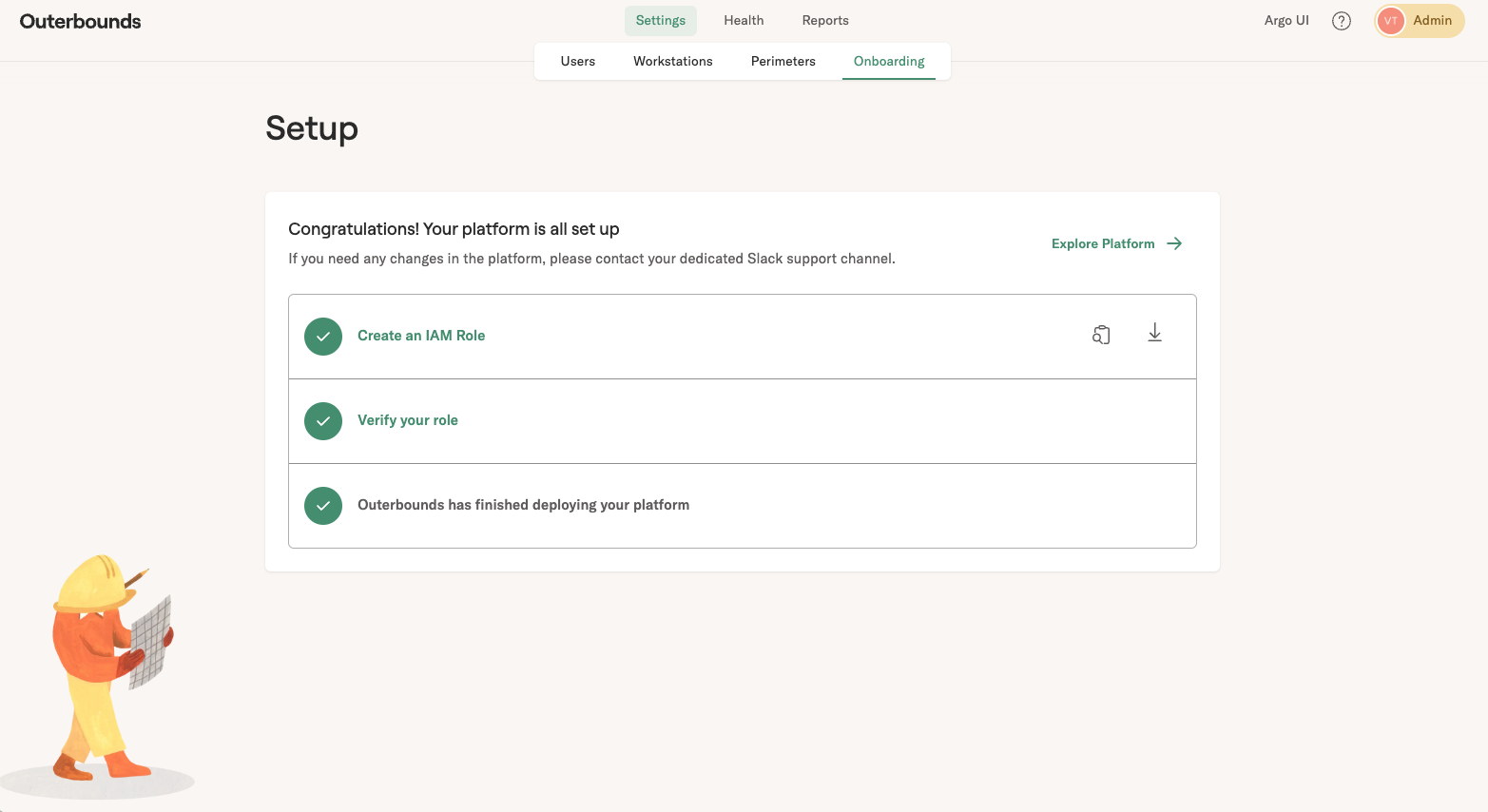
Once the platform has been deployed, we provide hands-on onboarding sessions, ensuring that developers will become productive on the platform and can start delivering projects quickly and confidently. Or, in the words of Thanasis Noulas from The Trade Republic, an Outerbounds customer:
A big advantage of Metaflow and Outerbounds is that we started rolling out much more complex models. We used to have simple manually-built heuristics. In six weeks, a team that hadn’t used Metaflow before was able to build an ML-based model, A/B test its performance, which handily beat the old simple approach, and roll it out to production.