Enabling environment management
In order to utilize the Environments feature, you must first complete the required setup steps.Installing required plugins
Environment logging and scanning requires a few plugins in your(base) environment that expand the functionality of conda. These are provided by the anaconda-env-manager metapackage.
Plugins provided by the anaconda-env-manager metapackage
anaconda login automatically prompts you to install anaconda-env-manager after authentication. After installation, your environments are automatically registered with your organization as they are created.
To verify the required plugins are installed, run:
anaconda-env-manager, you’re all set and can start logging your environments. If not, install it manually:
Registering your organization
If you installedanaconda-env-manager via anaconda login, your organization was registered automatically. If you installed manually or need to register with a different organization, follow these steps:
- Open Anaconda Prompt (Terminal on macOS/Linux).
-
Authenticate to Anaconda by running the following command:
Complete the login process in the browser window that opens.
-
After successfully logging in, return to the command line and register your environments with your organization:
If you belong to more than one organization, use the arrow keys to select the organization you want to register your environments with.
Logging environments
Existing environments can be manually logged by running:Viewing logged environments
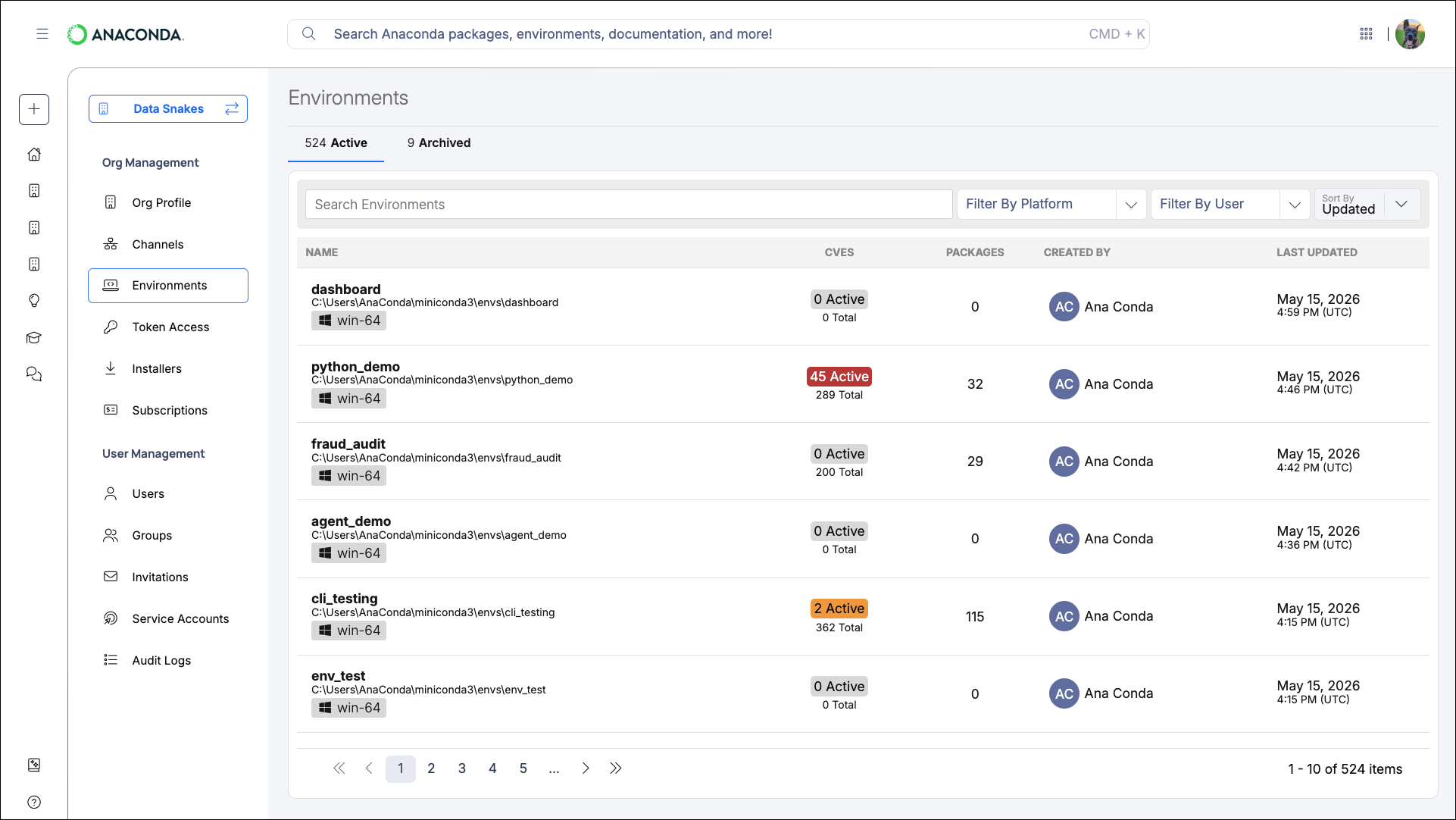
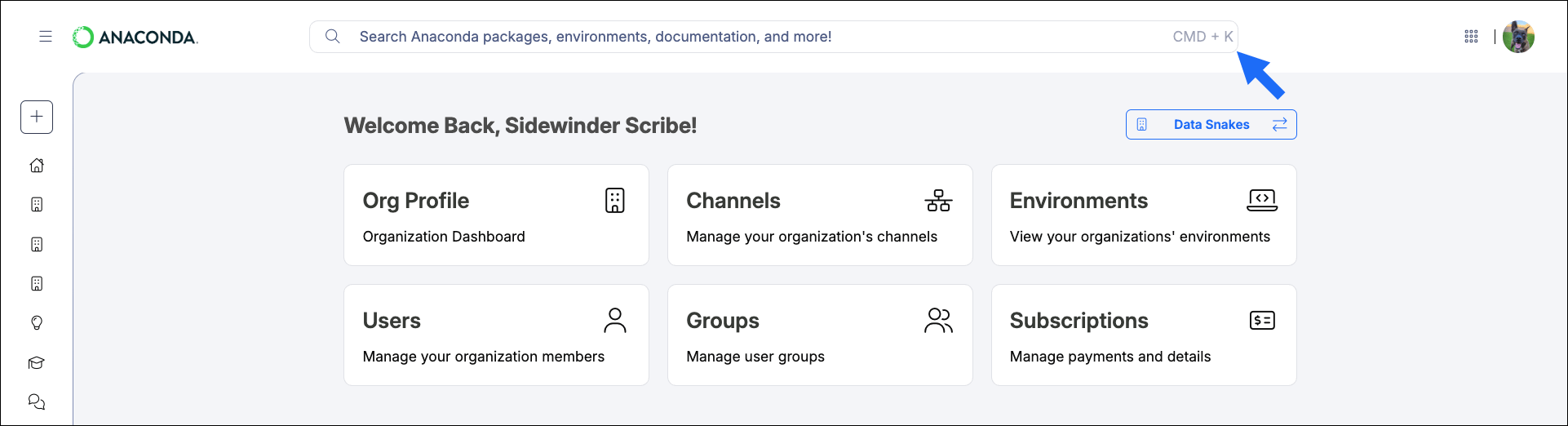
Environments you’ve logged to your organization can be viewed at any time from the Environments page. Under Org Management, select Environments.
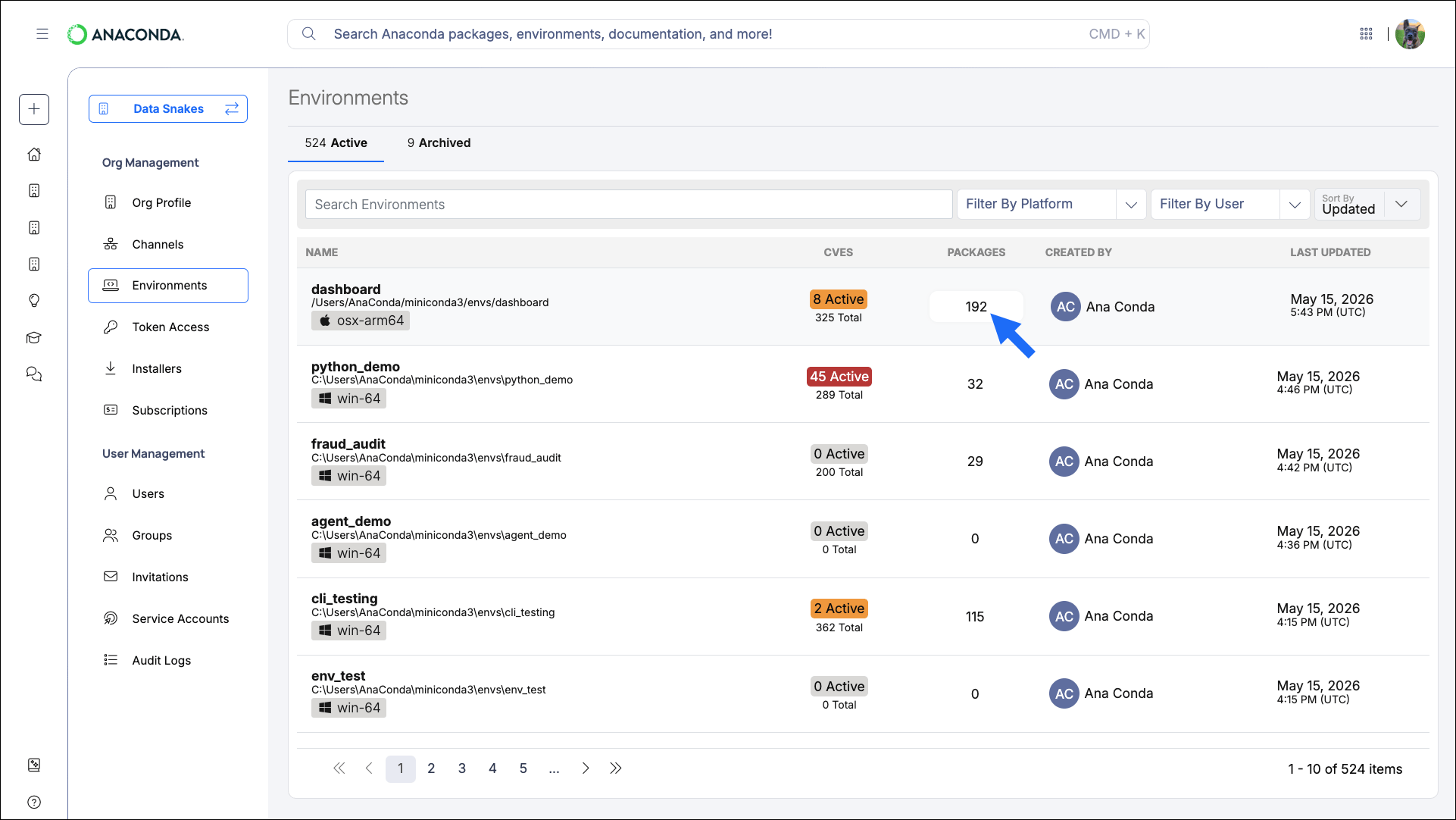
- Environment names and locations
- The number of packages in the environments
- The number of CVEs associated with the packages in the environments, as well as how many have an Active status
- The last time the environments were updated
Searching and filtering
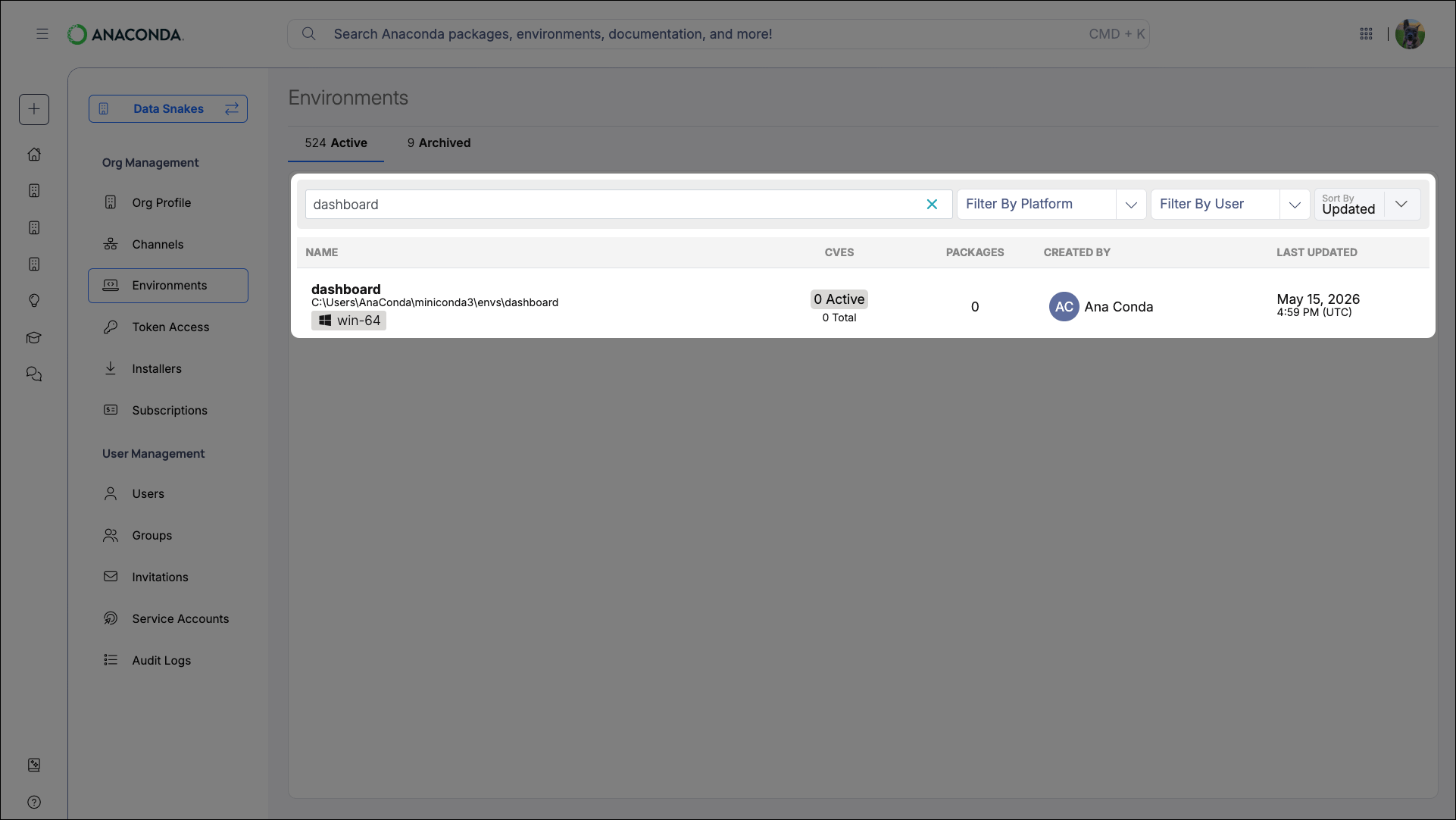
Use the search box at the top of the table to find your environments by name or path. You can also filter by platform.As a user, you can only view the environments that you’ve logged to your organization.

To find all environments affected by a specific vulnerability, search by CVE ID using the unified search at the top of the page. The results include every environment in your organization that contains packages associated with that CVE.
Exploring logged environments
Browse your logged environments to gain insights into the packages that they contain. You can see which packages are present in the environment as well as any CVEs associated with them.Viewing environment packages
The environment’s Packages page shows you which packages are in an environment and what they were sourced from.- Under Org Management, select Environments.
-
Select the package count displayed under the PACKAGES column.
Use the navigation controls at the bottom to browse the environment’s packages.
Viewing environment CVEs
- Viewing environment CVEs
- Viewing package CVEs
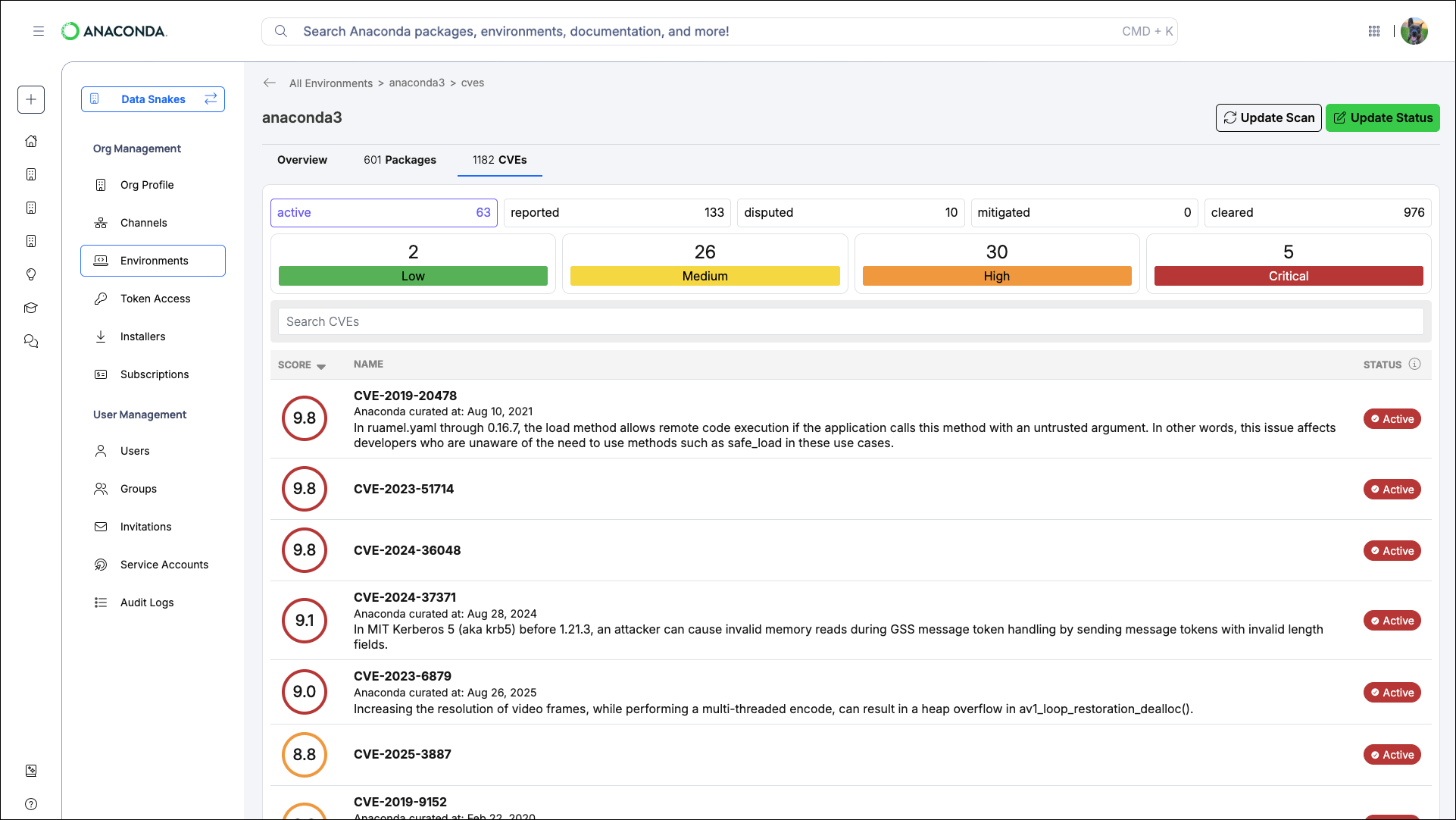
The CVEs tab shows all CVEs associated with the environment. Each entry includes the CVE name, CVSS score, Anaconda curation date, a description of the vulnerability, and its current status.
- Under Org Management, select Environments.
-
Select the CVE count displayed under the CVES column.
Use the filters at the top of the page to locate critical CVEs efficiently. Select a CVE from the list to view its details.
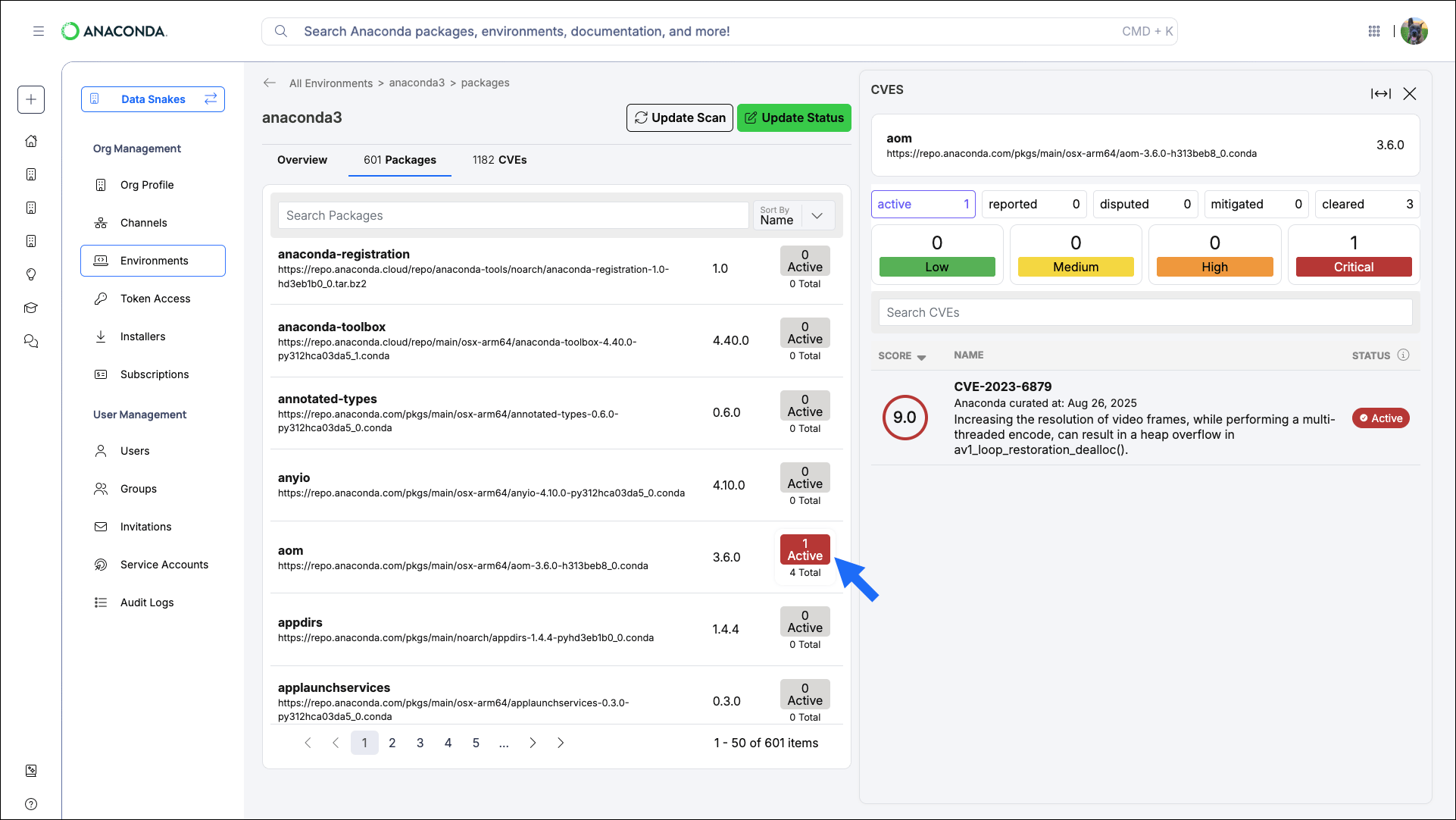
The active filter is automatically applied to the CVE panel’s displayed results.
Scanning environments
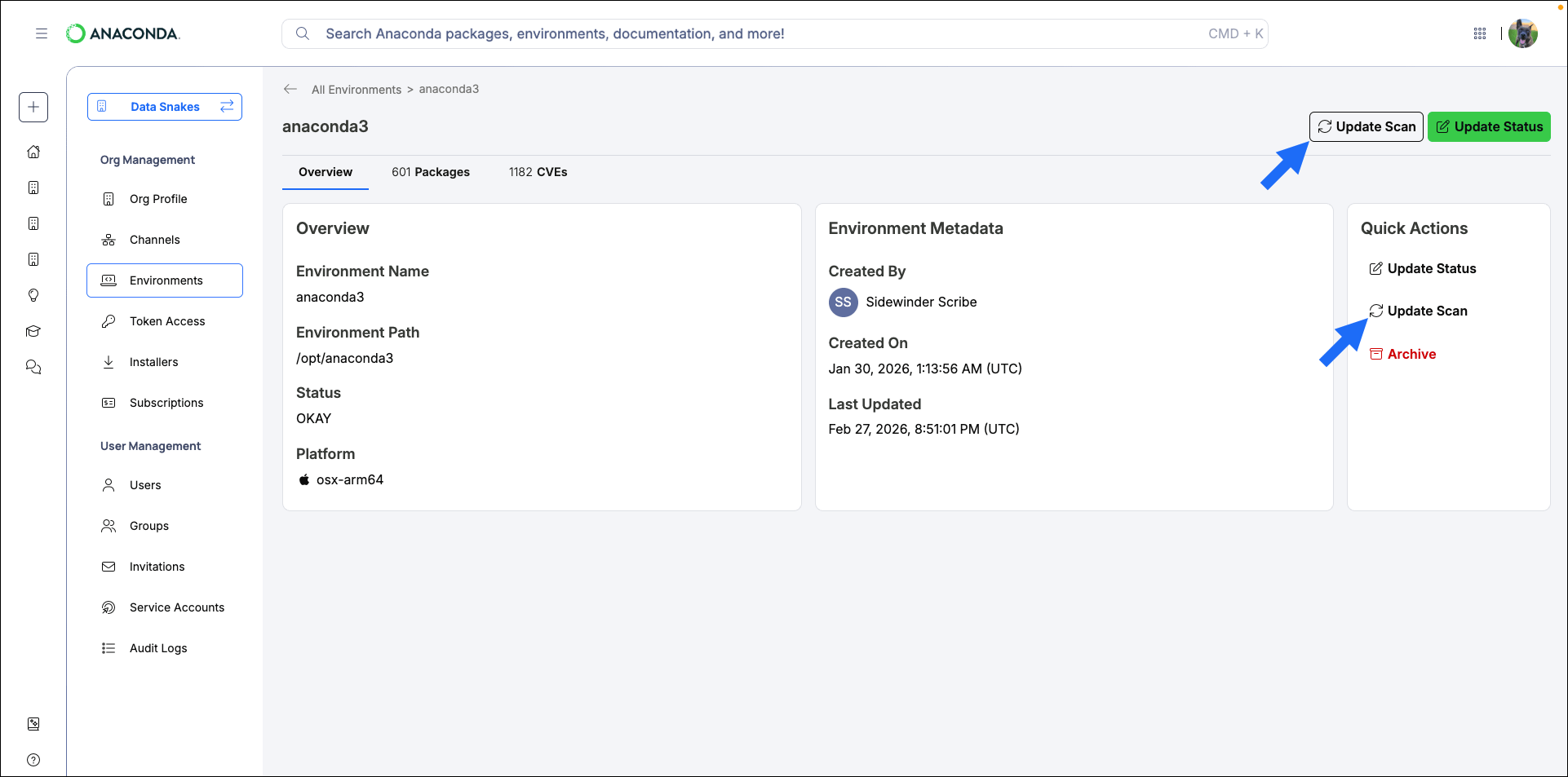
Scanning an environment checks the most recently saved conda environment log for CVEs associated with the packages it contains.Environments are automatically scanned when created, but not when they are logged or when the log updates. To ensure an accurate assessment of an environment’s current CVE state, perform a scan before you explore it in Anaconda.com. You can also scan environments locally to identify potential issues immediately.
- Scanning locally
- Scanning from your organization
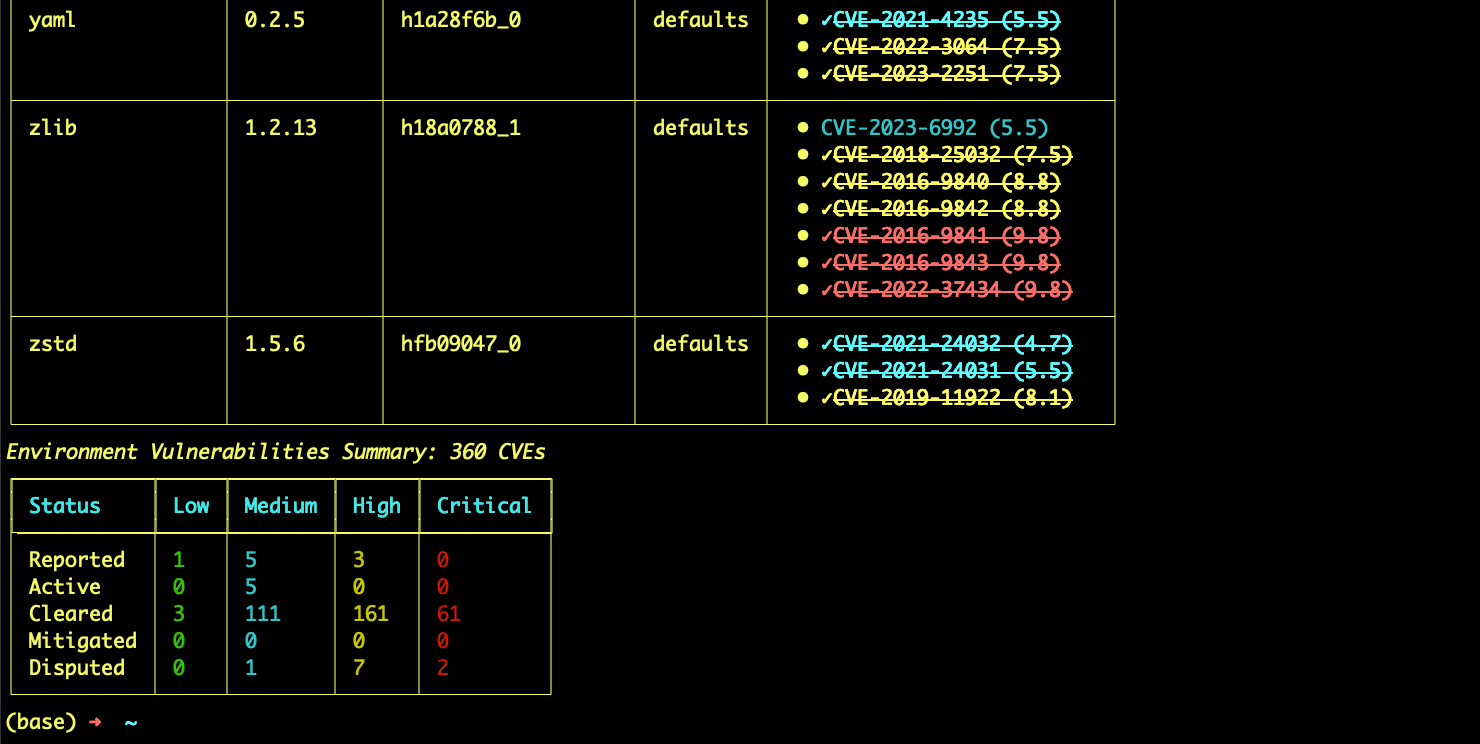
Use To scan an environment for a specific CVE:The audit scan returns a list of environment packages, and displays the following information for each package:
Scan results are color coded to help you identify the CVE severity, and a checkmark is displayed beside a CVE name to indicate that it has undergone Anaconda curation. CVEs that are stricken through have a status of cleared and are safe to use in your environment.
anaconda-audit to scan a local environment.To scan an environment, open Anaconda Prompt (Terminal on macOS/Linux) and run the following command:This command uses the default conda environment path prefix. If you have environments in non-default locations, you can use the
--prefix flag to specify the path to the environment. For example:- Windows
- macOS/Linux
Open Anaconda Prompt and run the following command:
- Version number
- Build number
- Source channel
- CVE curation status
- CVSS score
- CVE status