> ## Documentation Index
> Fetch the complete documentation index at: https://anaconda.com/docs/llms.txt
> Use this file to discover all available pages before exploring further.
# Python version support
export const DefinitionDescription = ({children}) => {children};
export const DefinitionTerm = ({children}) => {children};
export const DefinitionList = ({children}) => {children}
;
export const GCell = ({children, className}) =>
{children}
;
export const GTH = ({children, className}) =>
{children}
;
export const GRow = ({children}) => {children}
;
export const GBody = ({children}) => {children}
;
export const GHead = ({children}) => {children}
;
export const GTable = ({children, className, cols}) =>
{children}
;
Anaconda currently follows the official release cycle of the Python Software Foundation (PSF). Support for each Python version ends when the PSF ends security updates, typically five years after initial release.
### Currently supported Python versions
Anaconda is ending support for Python 3.10 in October 2026.
Python Version
Release Date
End of Support
Python 3.14
October 2025
October 2030
Python 3.13
October 2024
October 2029
Python 3.12
October 2023
October 2028
Python 3.11
October 2022
October 2027
Python 3.10
October 2021
October 2026
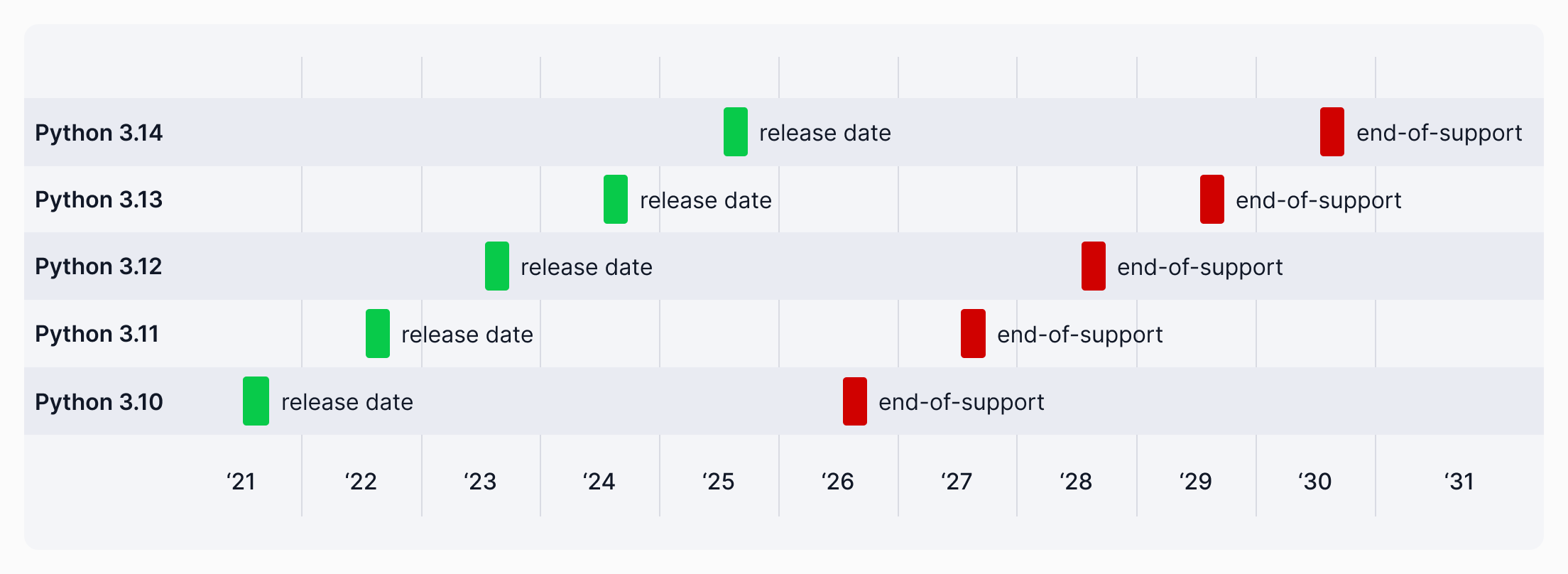 For the complete Python release schedule, see the [Python Software Foundation's Status of Versions](https://devguide.python.org/versions/) page.
## What End of Support means
After the End of Support Date:
* All Python interpreter packages for the Python version will remain available in the `main` channel.
* Packages built to work with the Python version (also known as Python 3.X “variants”) will remain available in the `main` channel.
* No additional patch releases for Python 3.X, including security fix releases, will be provided by the PSF or Anaconda.
* Anaconda will stop building and distributing new Python 3.X variant packages.
## Why Anaconda matches upstream support timelines
No Security Updates
The PSF ceases providing security patches for Python versions after the End of Support date. Without upstream security fixes, we cannot ensure continued safety of the interpreter.
Upstream Package Ecosystem
Most major Python packages will officially or semi-officially drop support for Python versions following their end of life. This means we cannot guarantee compatibility or stability for packages built against unsupported Python versions going forward.
## When Anaconda publishes new Python versions
When the PSF releases a new Python version, the Python community maintainers gradually add support for the new Python version across the packages they maintain. Anaconda monitors these upstream releases and iteratively builds the full set of supported packages on the `main` channel to be compatible with the new Python version. Once the PSF makes an official release of a new version of Python, Anaconda typically publishes the new version of the Python interpreter to the `main` channel within two weeks, the first set of packages within the first month, and compatible versions of the majority of the remaining packages within four months.
***
If you have any questions or need assistance with Python version transitions, reach out to us in our [forums](https://forum.anaconda.com/), through our [support team](https://support.anaconda.com/), or through your account representative.
For the complete Python release schedule, see the [Python Software Foundation's Status of Versions](https://devguide.python.org/versions/) page.
## What End of Support means
After the End of Support Date:
* All Python interpreter packages for the Python version will remain available in the `main` channel.
* Packages built to work with the Python version (also known as Python 3.X “variants”) will remain available in the `main` channel.
* No additional patch releases for Python 3.X, including security fix releases, will be provided by the PSF or Anaconda.
* Anaconda will stop building and distributing new Python 3.X variant packages.
## Why Anaconda matches upstream support timelines
No Security Updates
The PSF ceases providing security patches for Python versions after the End of Support date. Without upstream security fixes, we cannot ensure continued safety of the interpreter.
Upstream Package Ecosystem
Most major Python packages will officially or semi-officially drop support for Python versions following their end of life. This means we cannot guarantee compatibility or stability for packages built against unsupported Python versions going forward.
## When Anaconda publishes new Python versions
When the PSF releases a new Python version, the Python community maintainers gradually add support for the new Python version across the packages they maintain. Anaconda monitors these upstream releases and iteratively builds the full set of supported packages on the `main` channel to be compatible with the new Python version. Once the PSF makes an official release of a new version of Python, Anaconda typically publishes the new version of the Python interpreter to the `main` channel within two weeks, the first set of packages within the first month, and compatible versions of the majority of the remaining packages within four months.
***
If you have any questions or need assistance with Python version transitions, reach out to us in our [forums](https://forum.anaconda.com/), through our [support team](https://support.anaconda.com/), or through your account representative.