> ## Documentation Index
> Fetch the complete documentation index at: https://anaconda.com/docs/llms.txt
> Use this file to discover all available pages before exploring further.
# Mirrors
export const Danger = ({children}) => {
return ;
};
Package Security Manager (On-prem) enables you to create a local copy of a repository so users can access *approved* software components from a centralized on-premise or cloud location.
Mirrors are contained within channels in Package Security Manager. Therefore, you must have a channel established before you can create a mirror. Anaconda recommends channels contain only one mirror each to prevent conflicts between package sources and mirror filters. For more information on channels, see [Channels and subchannels](../user/channel).
Allowlist the following URLs before attempting to mirror:
* [https://repo.anaconda.com/](https://repo.anaconda.com/)
* [https://repo.anaconda.cloud/](https://repo.anaconda.cloud/)
* [https://anaconda.org/](https://anaconda.org/)
* [https://anaconda.com/](https://anaconda.com/)
* [https://api.anaconda.cloud/](https://api.anaconda.cloud/)
* [https://conda.anaconda.org/](https://conda.anaconda.org/)
* [https://pypi.org/](https://pypi.org/)
* [https://files.pythonhosted.org/](https://files.pythonhosted.org/)
* [https://cran.r-project.org/](https://cran.r-project.org/) *(optional - for CRAN R users)*
## Mirror filters
Adding filters to your mirrors ensures that you only mirror the packages that you need in your channel. This ensures that everyone on your team is not only using the same packages, but also the same version of those packages for the same operating system architecture. You can also filter by license and common vulnerability and exposure (CVE) score/status to ensure that you are meeting your organization’s software security requirements. For more information about CVEs, see [Common Vulnerabilities and Exposures (CVEs)](./cve).
Filters can also be applied to channels, and can be applied in both standard
and air-gapped environments.
The mirror filter should not contain configurations that will conflict with
the channel filter. If you attempt to mirror packages of a type not allowed by
the channel filter, no packages will be mirrored.
## Creating a mirror
Mirroring via the graphical user interface (GUI) is the most common method for mirror creation.
When creating a mirror, Anaconda recommends that you freeze the channel, create your mirror, allow it to complete, then unfreeze the channel. For more information on freezing and unfreezing a channel, see [Freezing/Unfreezing Channels](../user/channel#freezing-a-channel).
**To create a mirror:**
1. Log in to Package Security Manager as an administrator.
2. Select a channel you want to contain your mirror.
3. Open the **Manage** dropdown menu and select *Freeze*.
4. Open the **Manage** dropdown menu and select *Create Mirror*.
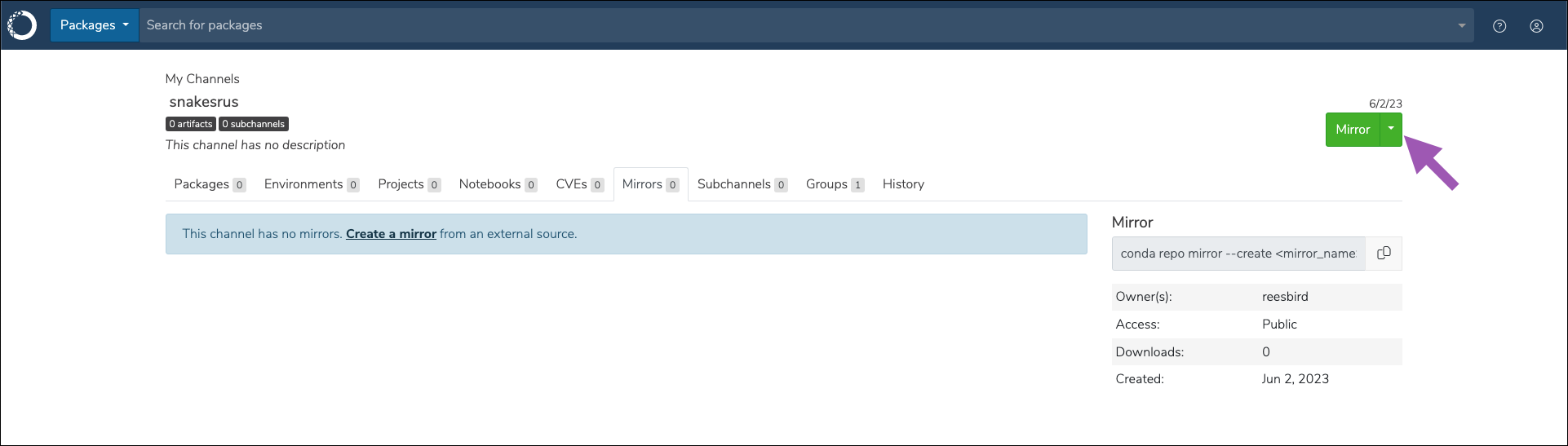 5. Complete the **Create mirror** form.
6. Allow the mirror time to complete.
7. Open the **Manage** dropdown menu and select *Unfreeze*.
### Create mirror form
The **Create mirror** form allows you to set the configurations for your mirror’s allowed packages. Let’s take a look at the different parts of the mirror form and what configurations they control.
5. Complete the **Create mirror** form.
6. Allow the mirror time to complete.
7. Open the **Manage** dropdown menu and select *Unfreeze*.
### Create mirror form
The **Create mirror** form allows you to set the configurations for your mirror’s allowed packages. Let’s take a look at the different parts of the mirror form and what configurations they control.
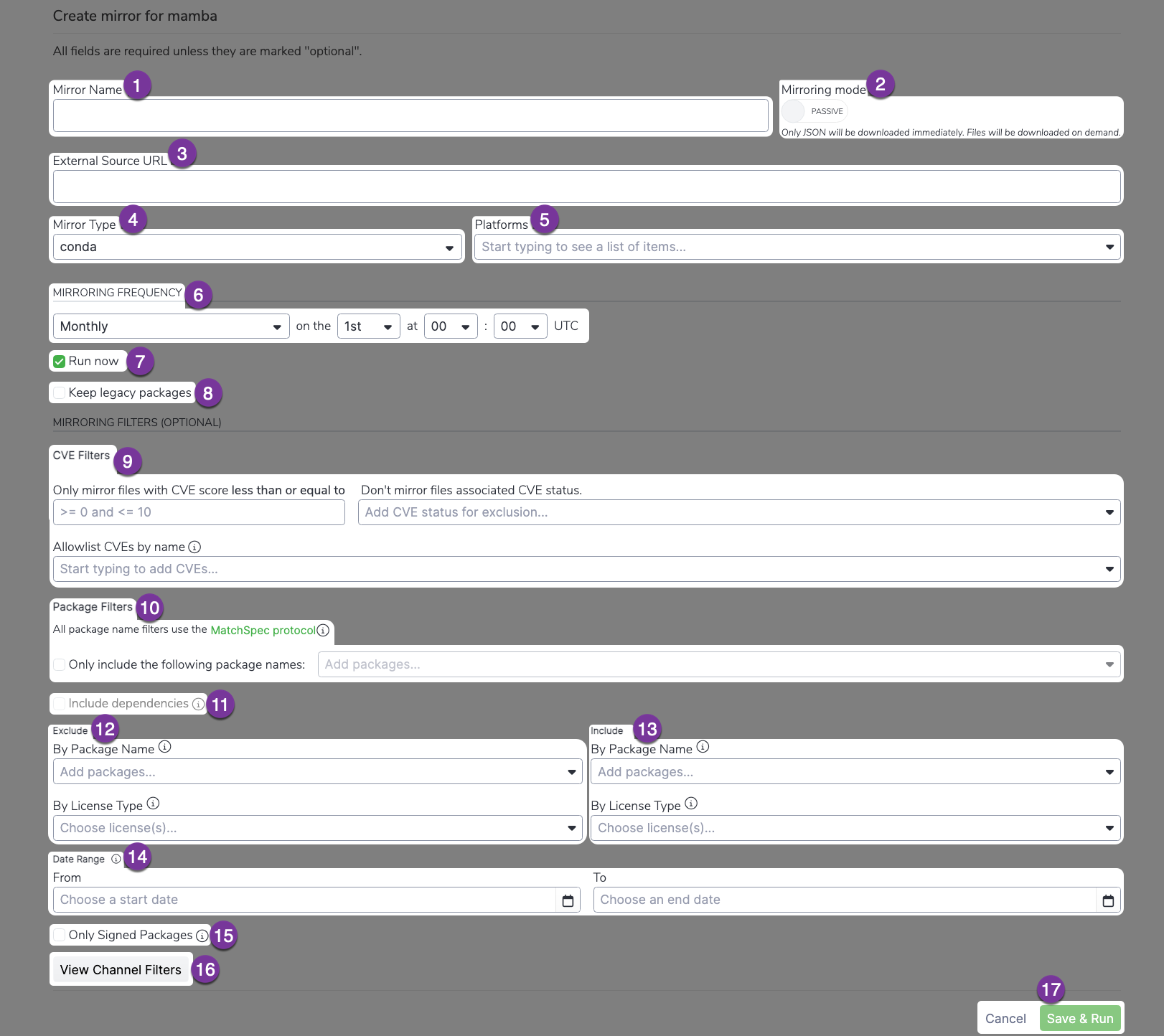 1. **Mirror Name**
Enter a name for your mirror. Anaconda recommends you name your mirror something descriptive for your end users. For example: `main_channel_no_filters` or `approved_software`.
2. **Mirroring mode**
Choose whether you want your mirror to be active or passive.
**Active mirroring**
Active mirroring will download all the packages not filtered out of your mirror immediately to your local server. These mirrors can be extremely large in size; the Anaconda’s public repository is 700GB, the conda-forge repository is 3TB, and the PyPI repository is 10TB in their entirety! Due to this, active mirrors can take a long time to complete.
**Passive mirroring**
Passive mirroring creates a metadata file that is a complete list of packages on the mirrored server. When a user needs a package, they can run conda install `` and the requested package will be downloaded from the source at that time.
Regardless of which mirror you choose to create, the packages will be the same. Anaconda recommends establishing your mirrors as passive.
3. **External Source URL**
This is the URL of the server/repository you want to mirror.
**Anaconda recommends creating mirrors for the following external source channels:**
* [https://repo.anaconda.cloud/pkgs/main](https://repo.anaconda.cloud/pkgs/main)
* [https://repo.anaconda.cloud/pkgs/msys2](https://repo.anaconda.cloud/pkgs/msys2)
* [https://repo.anaconda.cloud/pkgs/r](https://repo.anaconda.cloud/pkgs/r)
If your external source channel is another Package Security Manager channel, you *must* use the format `https:///api/repo/`.
***
If your external source channel is another Package Security Manager channel *that contains CRAN R packages*, you *must* use the format `https:///api/repo//cran`.
***
If your external source channel is a *virtual* channel from Package Security Manager (Cloud), you *must* use the format `https://repo.anaconda.cloud/repo/t///`.
***
If your external source channel is one of the **Anaconda Channels** or **Community Package Channels** from Package Security Manager (Cloud), you *must* use the format `https://repo.anaconda.cloud/t//repo/`.
***
When creating mirrors that use Package Security Manager (Cloud) channels as the external source, replace `` with your [organization access token](/docs/anaconda-platform/user/tokens), and `` with your [organization ID](/docs/anaconda-platform/admin/organizations#creating-an-organization).
4. **Mirror Type**
Set the type of packages that will be mirrored from the external source channel. This should align with the selection on the **Create Channel** form. Packages in this mirror that do not match the channel package type will be filtered out.
You can choose from conda, standard python, or standard R package types. *Make sure you have allowlisted the URLs listed at the top of this page before creating mirrors*.
5. **Platforms**
The same packages exist within the repository for multiple platforms. You can restrict the packages in your mirror to those that work with the platforms selected here. Many platform-specific packages will require a `noarch` (no architecture) dependency to run. Package Security Manager will automatically include these dependencies for you when you create your mirror.
**The most common platform selections are:**
* win-64
* linux-64
* osx-64
* osx-arm64
Standard python and standard R mirror forms are slightly different from
conda mirrors, and do not include this field.
6. **Mirroring Frequency**
Set the frequency you want your mirror to run and update your packages. The default value instructs the mirror to update at midnight on the first day of every month.
Custom frequencies use [cron expressions](https://crontab.cronhub.io/) to determine when they run.
Mirroring large channels can take several hours. Anaconda recommends
against setting a frequency greater than *Daily* to avoid collisions
between currently running and updating mirrors.
If you are mirroring the full PyPI repository, set your frequency to run
once yearly. Once the PyPI mirror is complete, any attempts to re-run the
mirror will cause issues.
7. **Run Now**
Check this box to start your mirror when you click **Save & Run**. If the **Run Now** box was not checked, your changes will be saved, and the mirror will run the next time its frequency configuration instructs it to do so.
8. **Legacy Packages**
Check the **Keep Legacy Packages** box to mirror both `.conda` and `.tar.bz2` package files. These are different file types of the same packages, and will effectively double your necessary storage space (only available for `conda` package types).
9. **CVE Filters**
Choose to restrict packages by common vulnerability and exposure (CVE) score and/or status. You can also choose to allowlist specific CVEs by their ID.
CVE filters are only available for conda type mirrors.
10. **Package Filters**
If you know the specific packages you want your mirror to contain by name, you can select the **Only include the following package names** checkbox and list the packages you want your mirror to contain individually. Enter the name of the package you want to include in your mirror and press the tab key, then enter the next package name, and so on. Click the info icon to see examples of how to utilize **MatchSpec protocol** to specify packages.
If the list of packages you want to provide your users is both very specific and very large, consider creating your mirror via the CLI to save time and effort! For information on mirroring via the CLI, see [Package Security Manager (On-prem) CLI](../user/cli).
Populating your channel with packages in this manner will not automatically populate the channel with their dependencies. If you do not have all the necessary packages, you will not be able to successfully create an environment from the channel with conda.
11. **Include dependencies**
Select this checkbox if you are using the **Only include the following package names** filter, but do not know what your dependencies are. Package Security Manager will automatically include the dependencies your listed packages need to operate correctly in this channel. You can download a report for your mirrors dependencies once the mirror completes. For more information, see [Download Dependency Report](#downloading-a-dependency-report).
12. **Exclude Packages**
If you know of specific packages you want to exclude from your mirror, you can filter them out here. Enter the name of the package you want to exclude from your mirror and press the tab key, then enter the next package name, and so on.
You can also exclude packages based on their license type. Open the dropdown selection and choose a license to exclude from your mirror. If you need to exclude multiple license types, open the dropdown menu again and select another license type to add to the filter. For more information on licenses, see [License types](../reference/licensetypes).
Packages can be excluded against non-exact values by including wildcard \* and >/\< ranges, where supported. For example, if you choose to exclude the package `p*`, Package Security Manager will exclude all packages that start with the letter “p”. For more information about using non-exact value search queries, see [Package match specifications](https://docs.conda.io/projects/conda/en/latest/user-guide/concepts/pkg-specs.html#package-match-specifications).
13. **Include Packages**
The include packages filter works in tandem with the exclude packages filter. You can choose to include specific packages that would otherwise be removed by the exclude packages filter by listing them here.
Following from the example above, to include `python` in your mirror, you must add it here to explicitly include that package, because all packages starting with the letter “p” were excluded by the exclude filter.
14. **Date Range**
Instruct the mirror to only include packages that were built within the range selected.
15. **Only Signed Packages**
Select this checkbox to only mirror packages with Anaconda signatures from the source mirror. The source mirror *must* be an Anaconda Business channel.
16. **View Channel Filters**
View the filters that are applied to your channel. Avoid setting filters in your mirror that will be counteracted by your channels filters.
17. **Cancel/Save & Run**
Select **Cancel** at any time to quit your mirror form completion and discard any set parameters. Select **Save & Run** to start your mirror.
## Editing mirrors
The **Edit mirror** form contains the information used in the **Create mirror** form.
1. Navigate to a channel’s details page.
2. Select the **Mirrors** tab.
3. Click the mirror’s actions icon, then click **Edit** to view the **Edit mirror** form.
1. **Mirror Name**
Enter a name for your mirror. Anaconda recommends you name your mirror something descriptive for your end users. For example: `main_channel_no_filters` or `approved_software`.
2. **Mirroring mode**
Choose whether you want your mirror to be active or passive.
**Active mirroring**
Active mirroring will download all the packages not filtered out of your mirror immediately to your local server. These mirrors can be extremely large in size; the Anaconda’s public repository is 700GB, the conda-forge repository is 3TB, and the PyPI repository is 10TB in their entirety! Due to this, active mirrors can take a long time to complete.
**Passive mirroring**
Passive mirroring creates a metadata file that is a complete list of packages on the mirrored server. When a user needs a package, they can run conda install `` and the requested package will be downloaded from the source at that time.
Regardless of which mirror you choose to create, the packages will be the same. Anaconda recommends establishing your mirrors as passive.
3. **External Source URL**
This is the URL of the server/repository you want to mirror.
**Anaconda recommends creating mirrors for the following external source channels:**
* [https://repo.anaconda.cloud/pkgs/main](https://repo.anaconda.cloud/pkgs/main)
* [https://repo.anaconda.cloud/pkgs/msys2](https://repo.anaconda.cloud/pkgs/msys2)
* [https://repo.anaconda.cloud/pkgs/r](https://repo.anaconda.cloud/pkgs/r)
If your external source channel is another Package Security Manager channel, you *must* use the format `https:///api/repo/`.
***
If your external source channel is another Package Security Manager channel *that contains CRAN R packages*, you *must* use the format `https:///api/repo//cran`.
***
If your external source channel is a *virtual* channel from Package Security Manager (Cloud), you *must* use the format `https://repo.anaconda.cloud/repo/t///`.
***
If your external source channel is one of the **Anaconda Channels** or **Community Package Channels** from Package Security Manager (Cloud), you *must* use the format `https://repo.anaconda.cloud/t//repo/`.
***
When creating mirrors that use Package Security Manager (Cloud) channels as the external source, replace `` with your [organization access token](/docs/anaconda-platform/user/tokens), and `` with your [organization ID](/docs/anaconda-platform/admin/organizations#creating-an-organization).
4. **Mirror Type**
Set the type of packages that will be mirrored from the external source channel. This should align with the selection on the **Create Channel** form. Packages in this mirror that do not match the channel package type will be filtered out.
You can choose from conda, standard python, or standard R package types. *Make sure you have allowlisted the URLs listed at the top of this page before creating mirrors*.
5. **Platforms**
The same packages exist within the repository for multiple platforms. You can restrict the packages in your mirror to those that work with the platforms selected here. Many platform-specific packages will require a `noarch` (no architecture) dependency to run. Package Security Manager will automatically include these dependencies for you when you create your mirror.
**The most common platform selections are:**
* win-64
* linux-64
* osx-64
* osx-arm64
Standard python and standard R mirror forms are slightly different from
conda mirrors, and do not include this field.
6. **Mirroring Frequency**
Set the frequency you want your mirror to run and update your packages. The default value instructs the mirror to update at midnight on the first day of every month.
Custom frequencies use [cron expressions](https://crontab.cronhub.io/) to determine when they run.
Mirroring large channels can take several hours. Anaconda recommends
against setting a frequency greater than *Daily* to avoid collisions
between currently running and updating mirrors.
If you are mirroring the full PyPI repository, set your frequency to run
once yearly. Once the PyPI mirror is complete, any attempts to re-run the
mirror will cause issues.
7. **Run Now**
Check this box to start your mirror when you click **Save & Run**. If the **Run Now** box was not checked, your changes will be saved, and the mirror will run the next time its frequency configuration instructs it to do so.
8. **Legacy Packages**
Check the **Keep Legacy Packages** box to mirror both `.conda` and `.tar.bz2` package files. These are different file types of the same packages, and will effectively double your necessary storage space (only available for `conda` package types).
9. **CVE Filters**
Choose to restrict packages by common vulnerability and exposure (CVE) score and/or status. You can also choose to allowlist specific CVEs by their ID.
CVE filters are only available for conda type mirrors.
10. **Package Filters**
If you know the specific packages you want your mirror to contain by name, you can select the **Only include the following package names** checkbox and list the packages you want your mirror to contain individually. Enter the name of the package you want to include in your mirror and press the tab key, then enter the next package name, and so on. Click the info icon to see examples of how to utilize **MatchSpec protocol** to specify packages.
If the list of packages you want to provide your users is both very specific and very large, consider creating your mirror via the CLI to save time and effort! For information on mirroring via the CLI, see [Package Security Manager (On-prem) CLI](../user/cli).
Populating your channel with packages in this manner will not automatically populate the channel with their dependencies. If you do not have all the necessary packages, you will not be able to successfully create an environment from the channel with conda.
11. **Include dependencies**
Select this checkbox if you are using the **Only include the following package names** filter, but do not know what your dependencies are. Package Security Manager will automatically include the dependencies your listed packages need to operate correctly in this channel. You can download a report for your mirrors dependencies once the mirror completes. For more information, see [Download Dependency Report](#downloading-a-dependency-report).
12. **Exclude Packages**
If you know of specific packages you want to exclude from your mirror, you can filter them out here. Enter the name of the package you want to exclude from your mirror and press the tab key, then enter the next package name, and so on.
You can also exclude packages based on their license type. Open the dropdown selection and choose a license to exclude from your mirror. If you need to exclude multiple license types, open the dropdown menu again and select another license type to add to the filter. For more information on licenses, see [License types](../reference/licensetypes).
Packages can be excluded against non-exact values by including wildcard \* and >/\< ranges, where supported. For example, if you choose to exclude the package `p*`, Package Security Manager will exclude all packages that start with the letter “p”. For more information about using non-exact value search queries, see [Package match specifications](https://docs.conda.io/projects/conda/en/latest/user-guide/concepts/pkg-specs.html#package-match-specifications).
13. **Include Packages**
The include packages filter works in tandem with the exclude packages filter. You can choose to include specific packages that would otherwise be removed by the exclude packages filter by listing them here.
Following from the example above, to include `python` in your mirror, you must add it here to explicitly include that package, because all packages starting with the letter “p” were excluded by the exclude filter.
14. **Date Range**
Instruct the mirror to only include packages that were built within the range selected.
15. **Only Signed Packages**
Select this checkbox to only mirror packages with Anaconda signatures from the source mirror. The source mirror *must* be an Anaconda Business channel.
16. **View Channel Filters**
View the filters that are applied to your channel. Avoid setting filters in your mirror that will be counteracted by your channels filters.
17. **Cancel/Save & Run**
Select **Cancel** at any time to quit your mirror form completion and discard any set parameters. Select **Save & Run** to start your mirror.
## Editing mirrors
The **Edit mirror** form contains the information used in the **Create mirror** form.
1. Navigate to a channel’s details page.
2. Select the **Mirrors** tab.
3. Click the mirror’s actions icon, then click **Edit** to view the **Edit mirror** form.
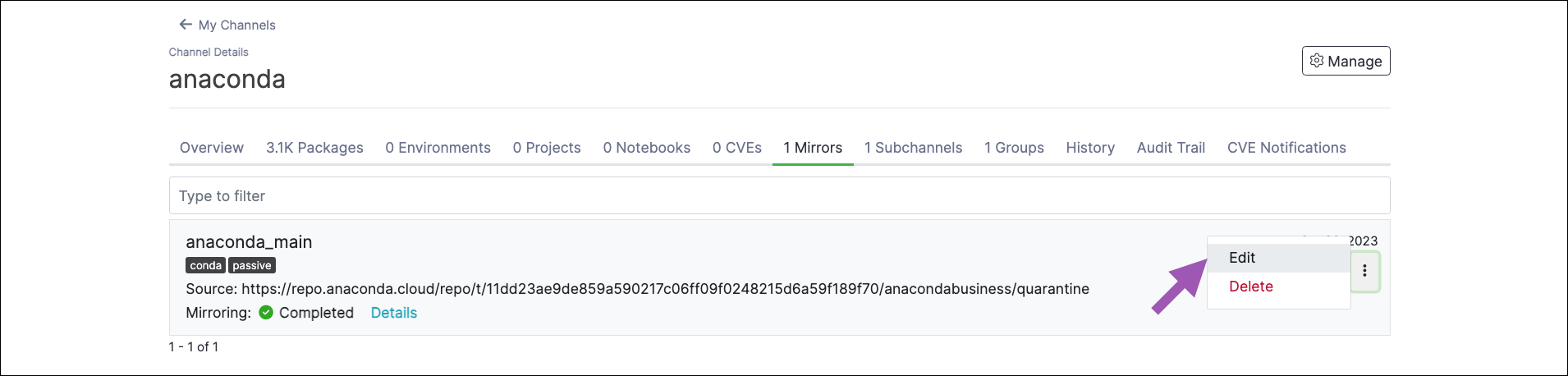 4. Make your changes, then click **Save**. If the **Run Now** box is not checked, your mirror will run the next time its frequency configuration instructs it to do so.
You cannot edit the mode of an established mirror.
## Viewing mirror history
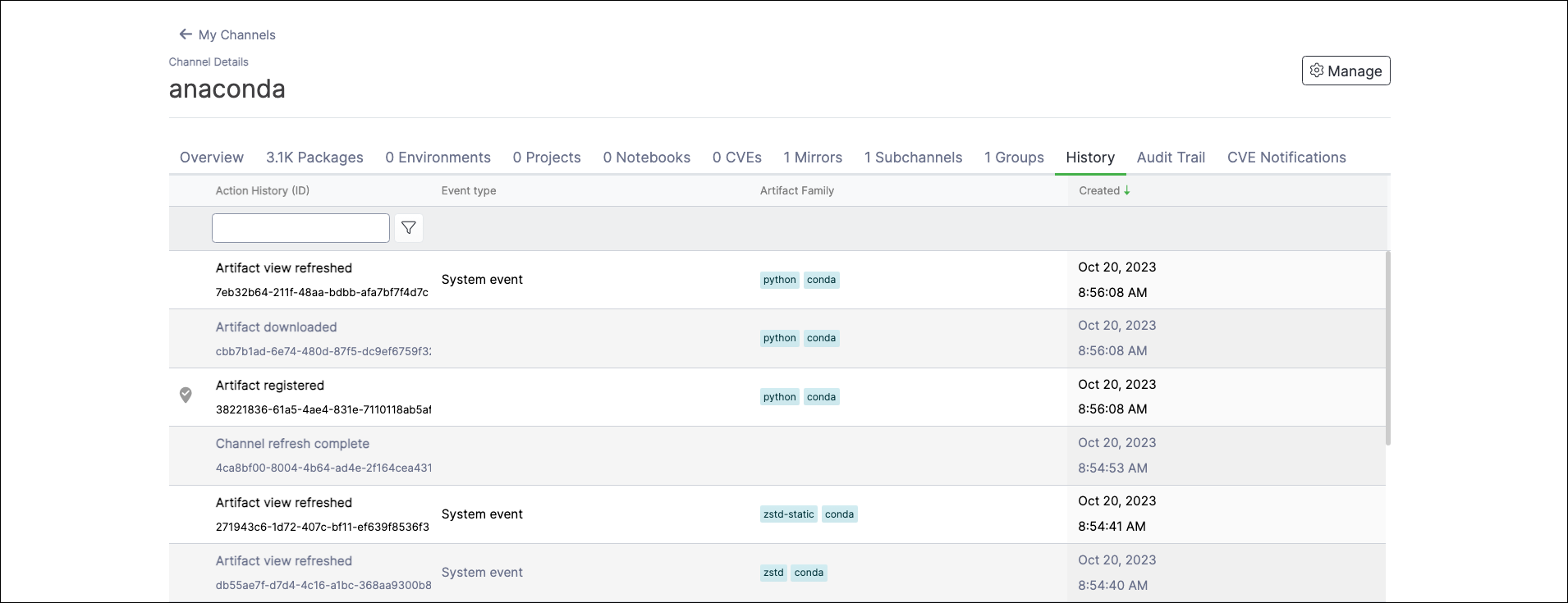
Mirroring events/actions can be viewed from the channel’s **History** tab. Events are listed in chronological order by default and include the event ID, type, artifact family (if applicable), and the date/time the event occurred. Select any historical event to view its metadata.
Historical events for mirrors are as follows:
* Mirror created
* Mirror started
* Mirror completed
* Mirror failed
* Mirror stopped
* Mirror restarted
* Mirror deleted
* Artifact registered
* Artifact generated
* Artifact removed
* Artifact metadata updated
4. Make your changes, then click **Save**. If the **Run Now** box is not checked, your mirror will run the next time its frequency configuration instructs it to do so.
You cannot edit the mode of an established mirror.
## Viewing mirror history
Mirroring events/actions can be viewed from the channel’s **History** tab. Events are listed in chronological order by default and include the event ID, type, artifact family (if applicable), and the date/time the event occurred. Select any historical event to view its metadata.
Historical events for mirrors are as follows:
* Mirror created
* Mirror started
* Mirror completed
* Mirror failed
* Mirror stopped
* Mirror restarted
* Mirror deleted
* Artifact registered
* Artifact generated
* Artifact removed
* Artifact metadata updated
 ## Viewing all repository mirrors
View mirror progress and results globally for all users from the **All Repository Mirrors** page.
## Viewing all repository mirrors
View mirror progress and results globally for all users from the **All Repository Mirrors** page.
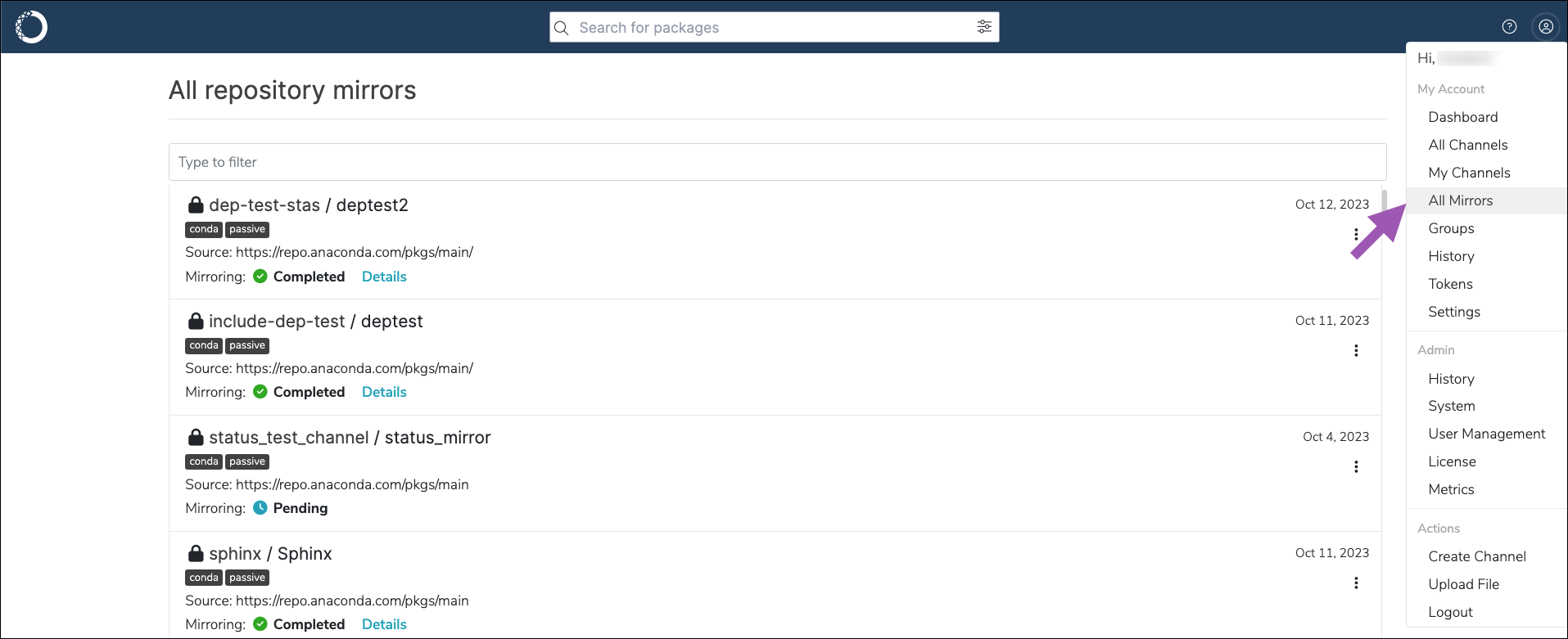 This page is available only to users whose role in Keycloak has the **mirror**
attribute set to **manage**.
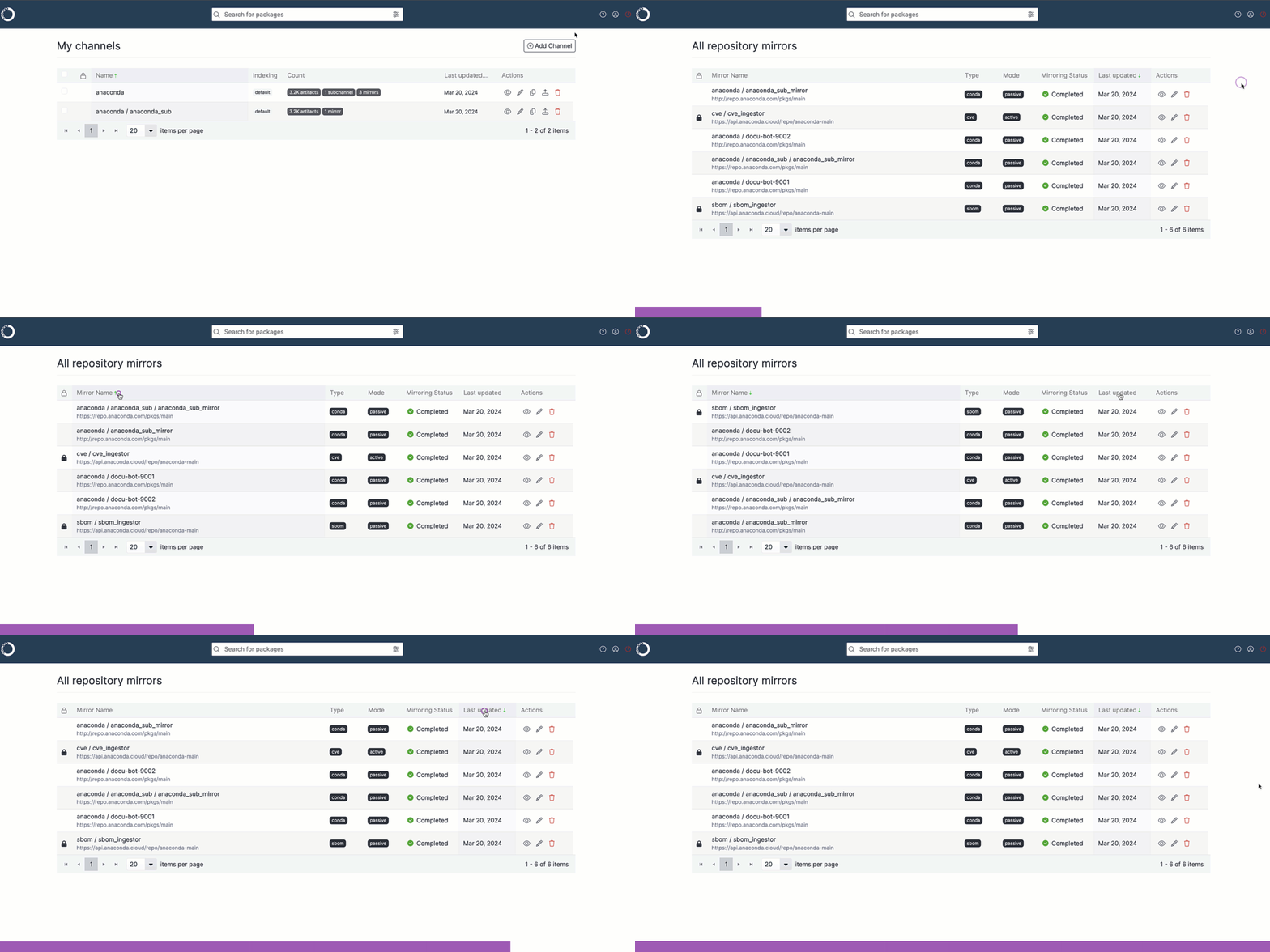
From this view, you can sort mirrors by name, type, mode, status, or last update time by clicking the corresponding column header in the table.
This page is available only to users whose role in Keycloak has the **mirror**
attribute set to **manage**.
From this view, you can sort mirrors by name, type, mode, status, or last update time by clicking the corresponding column header in the table.
 ## Viewing mirror status
Mirror status can be viewed from either the channel’s **Mirrors** tab or the **All Repository Mirrors** page. In progress mirrors display which step is currently being performed with a brief description of the operation.
## Viewing mirror status
Mirror status can be viewed from either the channel’s **Mirrors** tab or the **All Repository Mirrors** page. In progress mirrors display which step is currently being performed with a brief description of the operation.
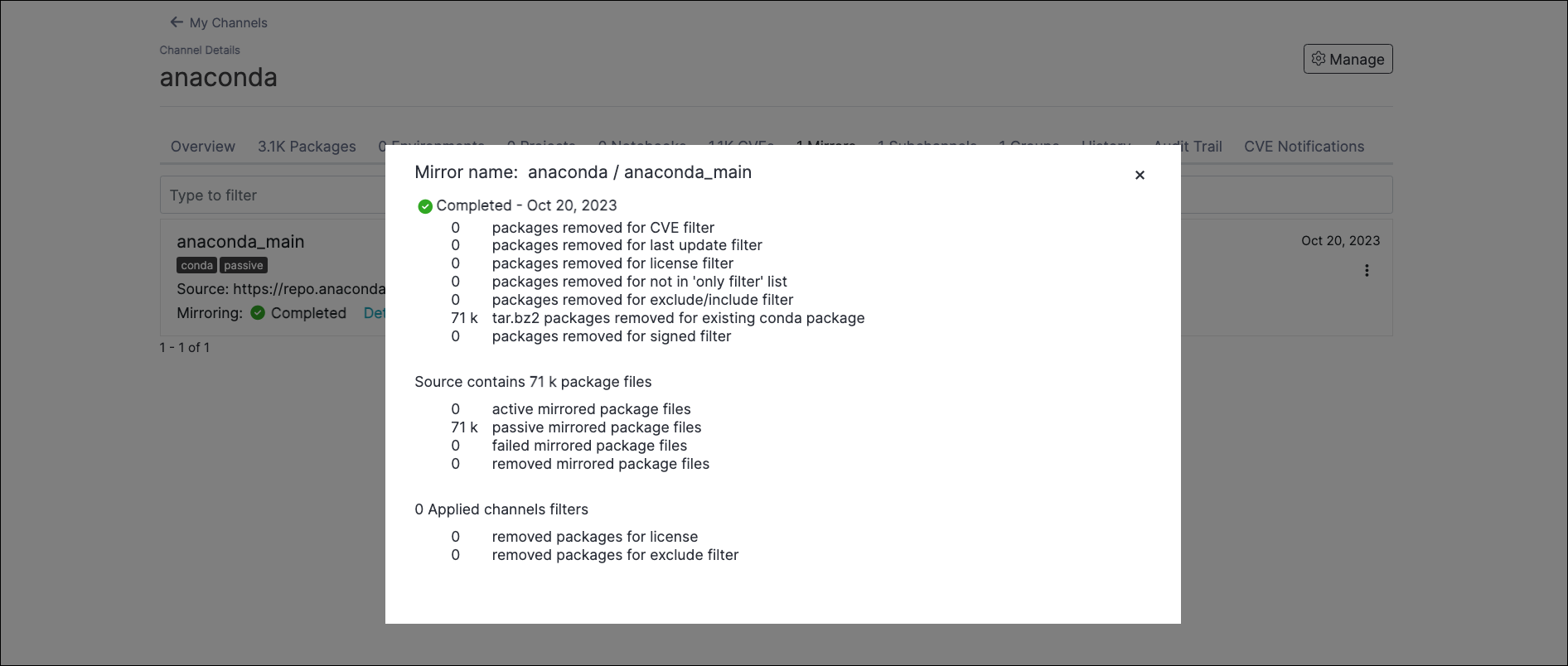
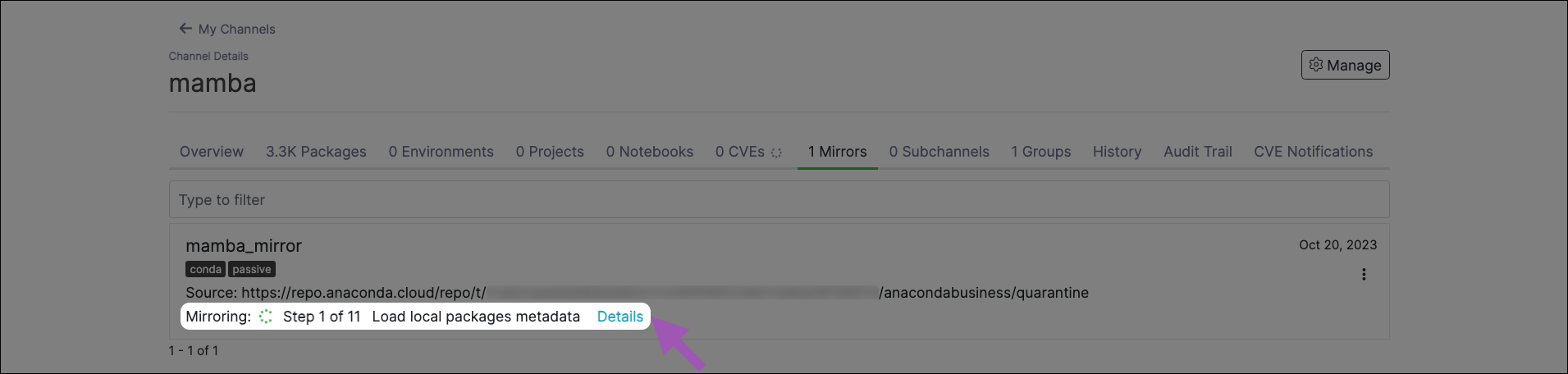 Click **Details** to get statistics about packages in your mirror. The **Mirroring Details** modal shows you information like when the mirror completed or failed, how many packages were filtered out of your mirror from its source, and for what reason (applied mirror/channel filters). It also shows how many packages were mirrored, how they were mirrored, how many failed to mirror properly, and how many have been removed from the mirror.
 ## Downloading a dependency report
If you select both the **Only include the following package names:** and **Include dependencies** checkboxes when you run your mirror, you will be able to download a `.json` formatted report that shows a list of package dependencies for the mirror.
To download a dependency report:
1. Navigate to your channel and select the **Mirrors** tab.
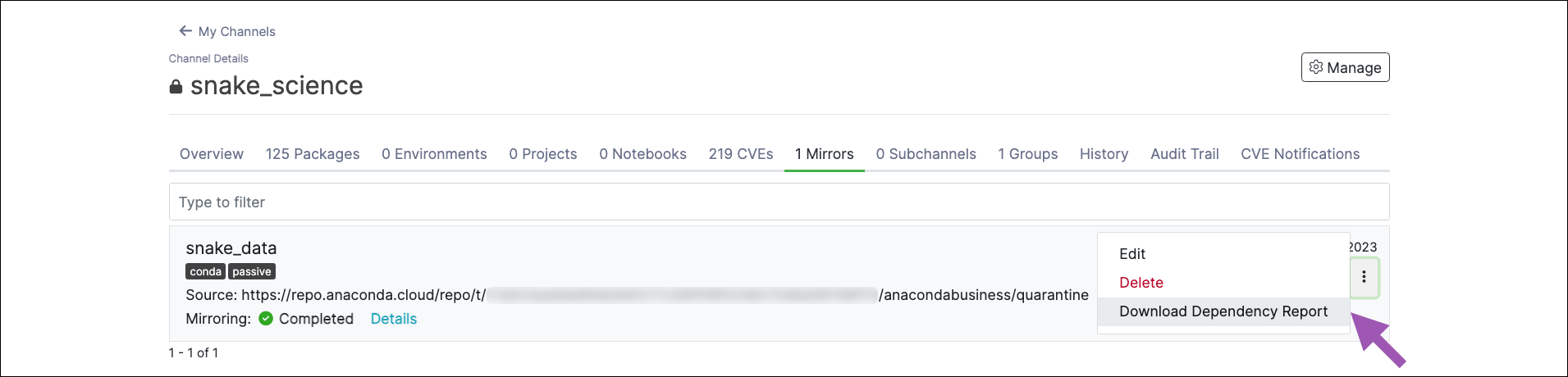
2. Click the mirror’s actions icon, then select **Download Dependency Report**.
## Downloading a dependency report
If you select both the **Only include the following package names:** and **Include dependencies** checkboxes when you run your mirror, you will be able to download a `.json` formatted report that shows a list of package dependencies for the mirror.
To download a dependency report:
1. Navigate to your channel and select the **Mirrors** tab.
2. Click the mirror’s actions icon, then select **Download Dependency Report**.
 ## Stopping and restarting a mirror
You can stop a running mirror from its channel’s **Mirrors** tab or the **All Repository Mirrors** page.
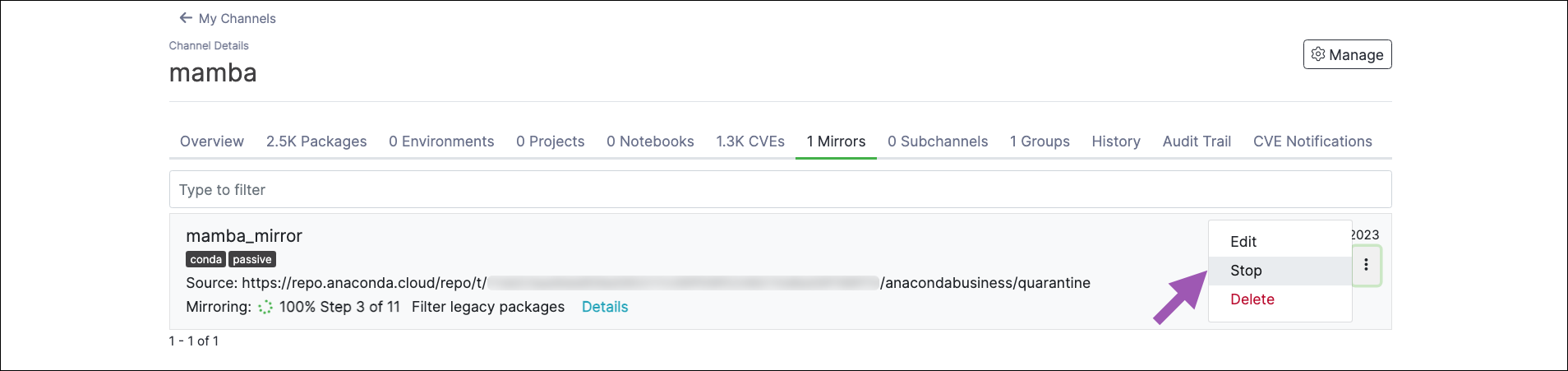
Click the mirror’s actions icon, select **Stop**, and then confirm you want to stop your mirror.
## Stopping and restarting a mirror
You can stop a running mirror from its channel’s **Mirrors** tab or the **All Repository Mirrors** page.
Click the mirror’s actions icon, select **Stop**, and then confirm you want to stop your mirror.
 It can take up to 10 minutes for a mirror to fully stop. A mirror in the
process of stopping will display **Stopping** as its mirroring status. Once it
is complete, it will display **Stopped** as its status. Stopping a mirror does
not discard the progress the mirror has made, and some packages may appear in
your channel’s **Packages** tab.
You can restart a stopped mirror from its channel’s **Mirrors** tab or from the **All Repository Mirrors** page.
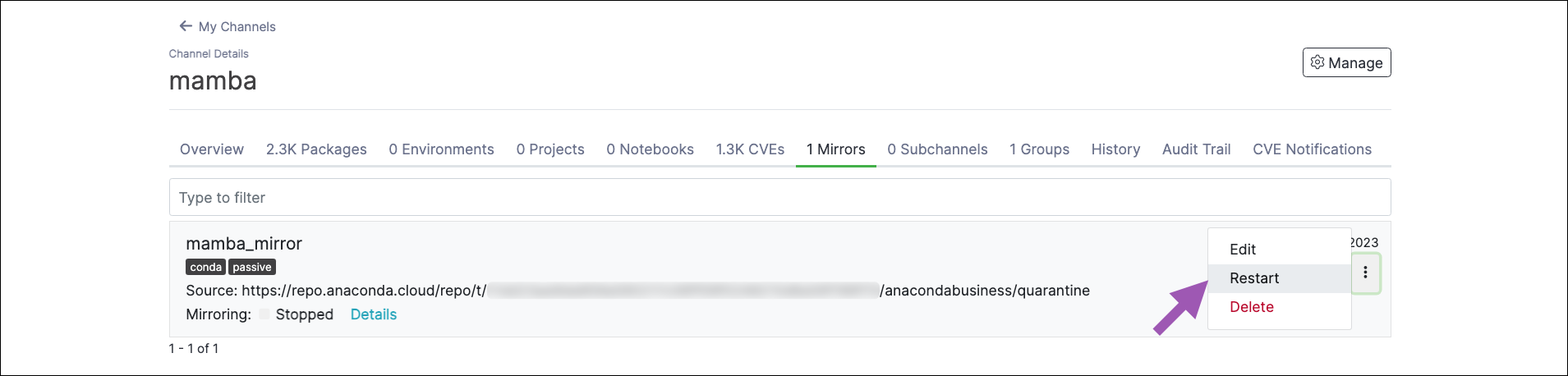
Click the mirror’s actions icon, select **Restart**, and then confirm you want to restart your mirror.
It can take up to 10 minutes for a mirror to fully stop. A mirror in the
process of stopping will display **Stopping** as its mirroring status. Once it
is complete, it will display **Stopped** as its status. Stopping a mirror does
not discard the progress the mirror has made, and some packages may appear in
your channel’s **Packages** tab.
You can restart a stopped mirror from its channel’s **Mirrors** tab or from the **All Repository Mirrors** page.
Click the mirror’s actions icon, select **Restart**, and then confirm you want to restart your mirror.
 The restart option is only available for mirrors that have been stopped.
Mirrors that have *failed* or *completed* must be run from the **Edit mirror**
page. Restarted mirrors run from the beginning of the mirroring process, not
from where you stopped the run.
## Deleting a mirror
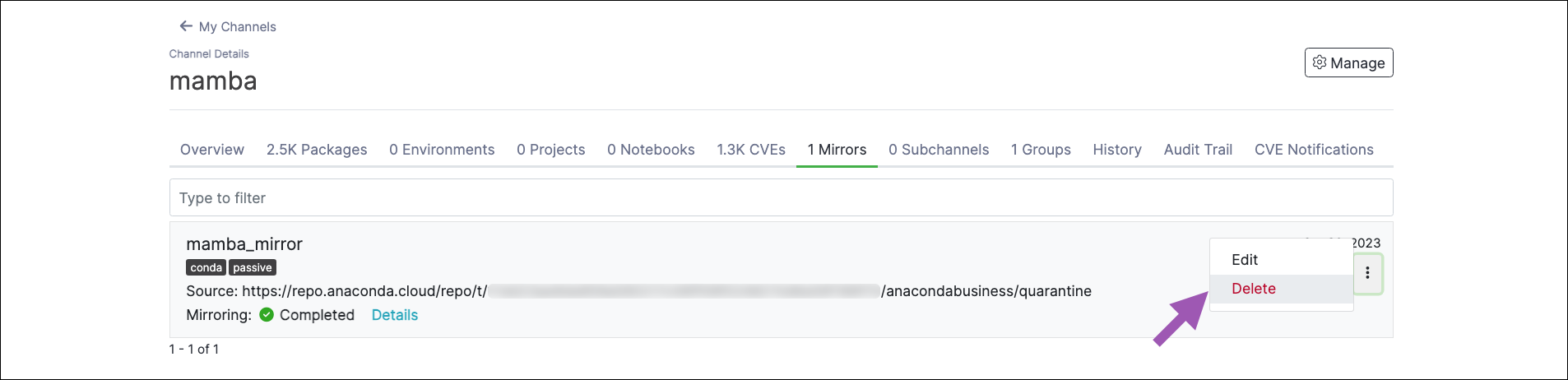
You can delete a mirror from its channel’s **Mirrors** tab or the **All Repository Mirrors** page.
Click the mirror’s actions icon, select **Delete**, and then confirm you want to delete your mirror.
The restart option is only available for mirrors that have been stopped.
Mirrors that have *failed* or *completed* must be run from the **Edit mirror**
page. Restarted mirrors run from the beginning of the mirroring process, not
from where you stopped the run.
## Deleting a mirror
You can delete a mirror from its channel’s **Mirrors** tab or the **All Repository Mirrors** page.
Click the mirror’s actions icon, select **Delete**, and then confirm you want to delete your mirror.