> ## Documentation Index
> Fetch the complete documentation index at: https://anaconda.com/docs/llms.txt
> Use this file to discover all available pages before exploring further.
# macOS terminal installer
export const TroubleshootSolution = ({children}) => <>
Solution
{children}
;
export const TroubleshootCause = ({children}) =>
Cause
;
};
export const BeginnerGlasses = () => {
return ;
};
* You might need to purchase a license to stay compliant with our [Terms of Service](https://www.anaconda.com/legal).
* If your company security policies do not allow admin privileges for end users, you will be unable to install Anaconda Distribution manually. Consider requesting that your IT admin add Anaconda Distribution to a software delivery or fleet management system (such as Kandji or Jamf).
This page provides instructions for installing Anaconda Distribution on macOS with the command line in Terminal.
## Installation steps
As of August 15, 2025, Anaconda has stopped building packages for Intel Mac computers (osx-64). Existing Intel (`MacOSX-x86_64`) installers are still available at [https://repo.anaconda.com/archive/](https://repo.anaconda.com/archive/), but new installers will no longer be created for Intel Macs. For more information, see [our blog on the end of Intel mac support](https://www.anaconda.com/blog/intel-mac-package-support-deprecation).
1. Download the latest `.sh` installer by opening a terminal and running the following command:
```sh theme={null}
curl -O https://repo.anaconda.com/archive/Anaconda3-2026.07-1-MacOSX-arm64.sh
```
For instructions on downloading an older installer version, see [Using older installer versions](/docs/getting-started/advanced-install/old-os).
2. (Optional) Anaconda recommends verifying the integrity of the installer after downloading it.
To ensure that your downloaded installer has not been tampered with or corrupted, generate its SHA-256 hash value and compare that hash to the official hash provided in the archive.
1. Open Terminal and run the following command:
```sh Hash comparison command theme={null}
shasum -a 256
```
```sh Example theme={null}
shasum -a 256 ~/Anaconda3-2026.07-1-MacOSX-arm64.sh
```
Replace \ with the file path to the downloaded installer file.
2. Note the generated SHA-256 hash value from the output.
3. Visit [repo.anaconda.com/archive](https://repo.anaconda.com/archive/) to find the official SHA-256 hash for your installer.
4. Compare the hash values. If they match, the installer is safe to use.
For more information, see [cryptographic hash verification](https://docs.conda.io/projects/conda/en/latest/user-guide/install/index.html#cryptographic-hash-verification) in the official conda documentation.
3. Install by running the following:
```sh theme={null}
bash ~/Anaconda3-2026.07-1-MacOSX-arm64.sh
```
4. Press Return to continue. You can review Anaconda's Terms of Service (TOS) at [https://anaconda.com/legal](https://anaconda.com/legal).
5. Enter `yes` to agree to the TOS.
6. Press Return to accept the default install location (`PREFIX=/Users//anaconda3`), or enter another file path to specify an alternate installation directory. The installation might take a few minutes to complete.
7. Choose `yes` when asked if you want to initialize conda. This modifies your shell configuration to initialize conda whenever you open a new shell and to recognize conda commands automatically.
8. The installer finishes and displays, "Thank you for installing Anaconda3!"
9. Close and re-open your terminal window for the installation to fully take effect, or use the following command to refresh the terminal:
```sh theme={null}
source ~/.zshrc
```
You should see `(base)` in the command line prompt. This tells you that you're in your base conda environment. To learn more about environments, see [Environments](/docs/getting-started/working-with-conda/environments).
## Verify your install
You can verify your installation was successful using Anaconda Navigator or your terminal application.
[Anaconda Navigator](/docs/legacy/anaconda-navigator/main) opens automatically when installation completes successfully.
If you need to manually open Anaconda Navigator, open Launchpad, then click the Anaconda-Navigator icon.
Open your terminal application and run `conda list`. If conda has been installed correctly, a list of installed packages appears:
```sh Command theme={null}
conda list
```
```sh Example output theme={null}
# packages in environment at /Users//anaconda3:
#
# Name Version Build Channel
ca-certificates 2024.9.24 h06a4308_0
certifi 2024.8.30 py312h06a4308_0
conda 24.9.2 py312h06a4308_0
openssl 3.0.15 h5eee18b_0
python 3.12.7 h5148396_1
...
```
## Choose how you want to work with conda
Anaconda Navigator provides a graphical user interface (GUI) to interface with conda, without using the command line.
If you prefer working at the command line, you can interface with conda directly through Anaconda Prompt (Windows) or your system's terminal (macOS and Linux) after you complete your installation.
Anaconda Navigator is not included with Miniconda. Follow the instructions on [Installing Navigator](/docs/legacy/anaconda-navigator/install) to manually install Navigator onto your computer.
Manage packages and environments with a desktop application
Use command-line tools for package and environment management
## Advanced install options
For more advanced installation options, such as installing with silent mode, installing on older operating systems, or installing for multiple users, see [Advanced installation](/docs/getting-started/advanced-install/main).
## Troubleshooting
### command not found: conda
The `command not found: conda` error occurs when your command line interface (CLI) can't find the conda command in order to use it. This might be because:
* You don't have conda properly initialized.
* You have set `auto_activate_base` to `false`.
* You're using a shell that conda doesn't support.
* Conda is not installed or the install was incomplete or corrupted.
These issues primarily occur on macOS/Linux computers. Anaconda Distribution and Miniconda installations on Windows include Anaconda Prompt, which opens with conda initialized by default.
If you recently installed Anaconda Distribution or Miniconda, make sure you closed and reopened your CLI to make conda's initialization take effect.
If you don't want to close your CLI, you can also use one of the following `source` commands to refresh your shell:
```sh bash theme={null}
source ~/.bashrc
```
```sh zsh theme={null}
source ~/.zshrc
```
```sh fish theme={null}
source ~/.config/fish/config.fish
```
```sh cshrc theme={null}
source ~/.cshrc
```
```sh xonshrc theme={null}
source ~/.xonshrc
```
Use the command that matches your shell.
You can also initialize conda directly from its `bin` directory:
```sh Initialization command theme={null}
/bin/conda init
```
```sh Examples theme={null}
miniconda3/bin/conda init
/opt/miniconda3/bin/conda init
anaconda3/bin/conda init
/opt/anaconda3/bin/conda init
```
Replace \ with a path to your conda installation.
To see the value for `auto_activate_base`, run the following command:
```sh theme={null}
conda config --describe auto_activate_base
```
If your terminal returns `false`, this means that conda is not automatically activating your base environment when you start a new shell. This behavior emulates your system Python, and some users prefer to have their conda environment be inactive until they need it. However, this is not conda's default behavior after installation.
To change the value of `auto_activate_base` to `true`, run the following command:
```sh theme={null}
conda config --set auto_activate_base true
```
If you have `auto_activate_base` set as `false`, the conda command will still be available as a shell function, but your base environment will not be active when a new shell is started. To activate your base environment, run `conda activate`.
For information on which shells conda supports, see [Conda activate](https://docs.conda.io/projects/conda/en/stable/dev-guide/deep-dives/activation.html#conda-activate) in the official conda documentation.
If you have tried to initialize conda in your shell but it didn't work, try uninstalling and reinstalling [Anaconda Distribution](/docs/getting-started/installation) or [Miniconda](/docs/getting-started/installation).
Make sure that you say yes to the initialization option, and, if installing from the CLI, reinitialize your shell by restarting it or using its `source` command. For more information, see [Initialize conda in your shell](#initialize-conda-in-your-shell).
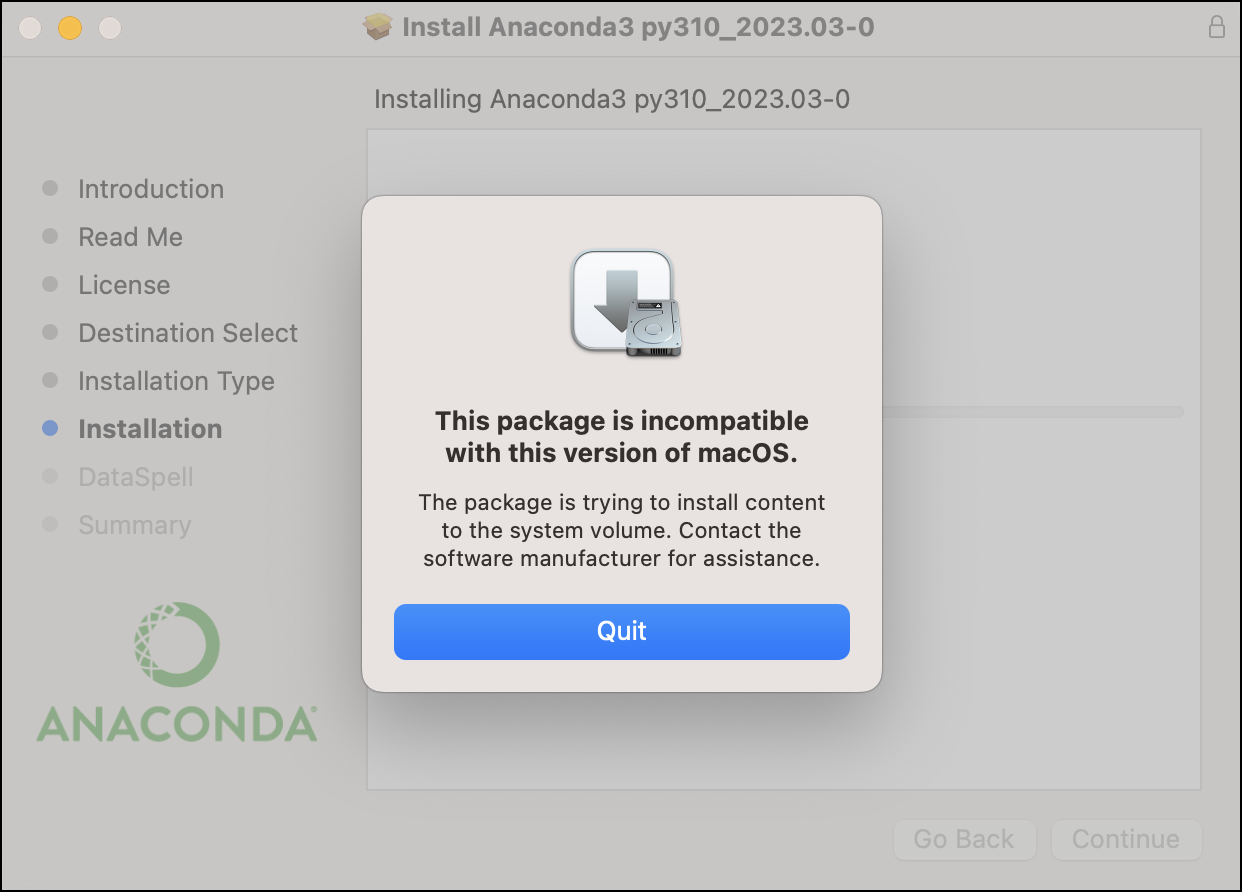
This package is incompatible with this version of macOS error when running a .pkg installer on OSX
When running the `.pkg` installer, you may encounter this error during the "Installation" step:
This error occurs when the installation attempts to write to a directory for which it does not have write permissions.
Manually select an appropriate install location. The following example shows how to select your user's home directory.
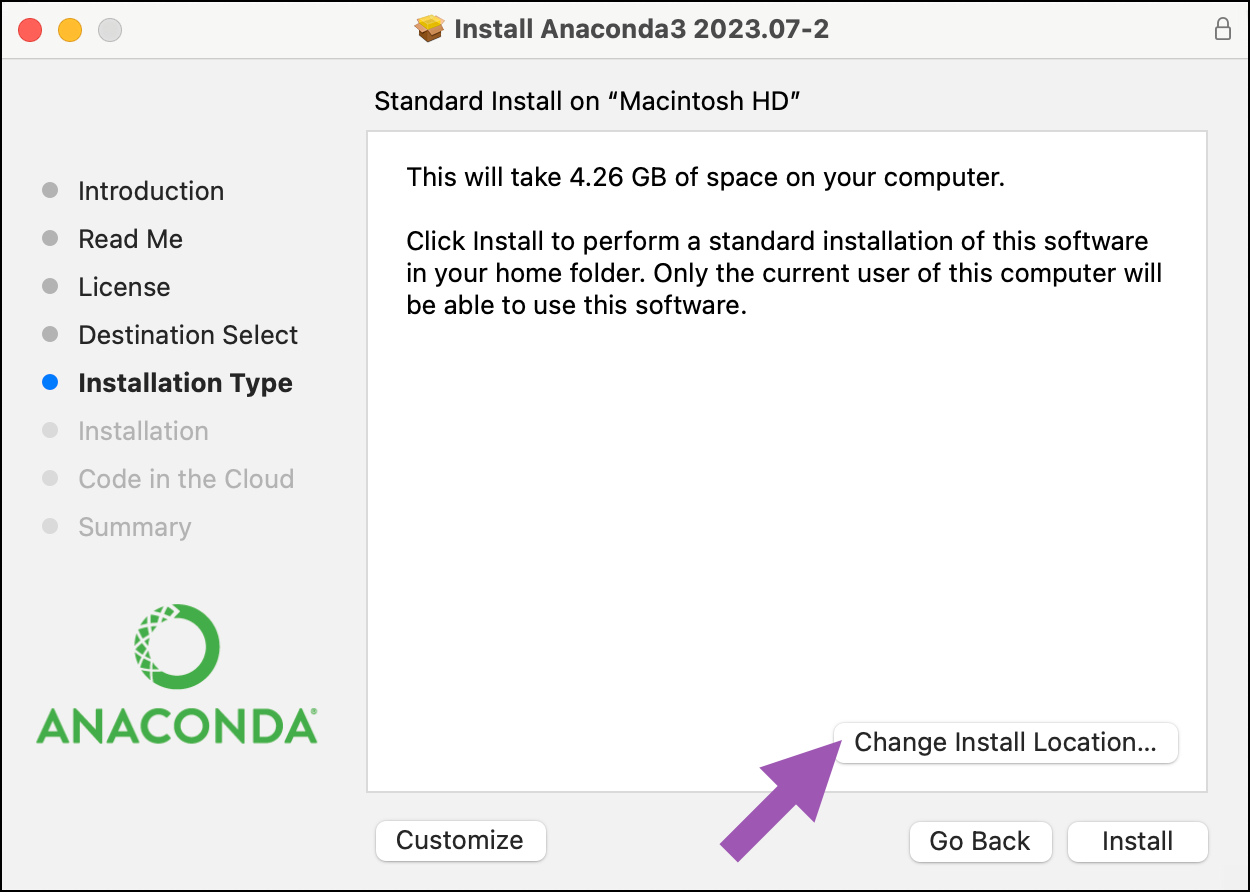
1. Re-run the installer and click through until you reach either the Installation Type or Destination Select page.
2. If you reach the Installation Type page first, click **Change Install Location…**. This will take you to the Destination Select page.
3. Click **Install on a specific disk…**.
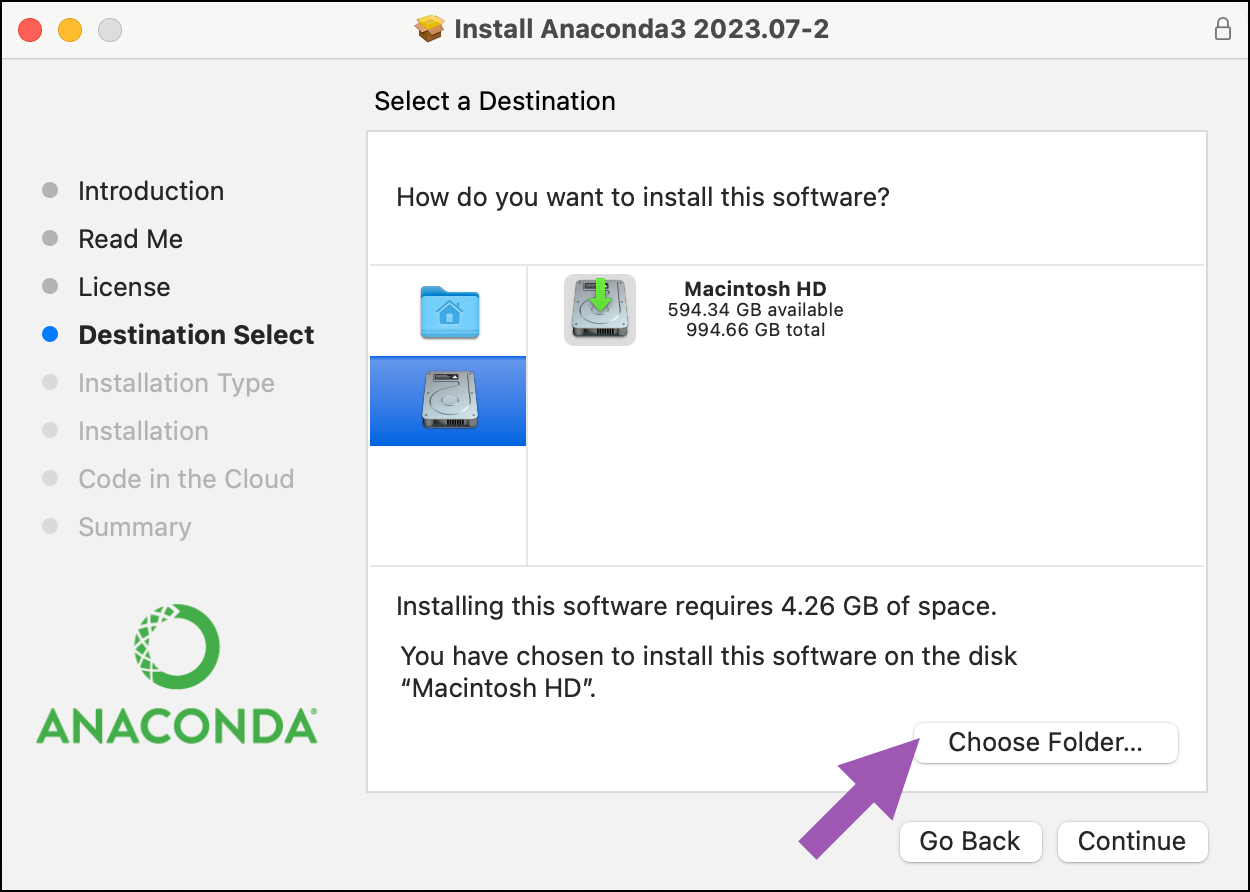
4. Click the appropriate destination drive. Then click **Choose Folder…**.
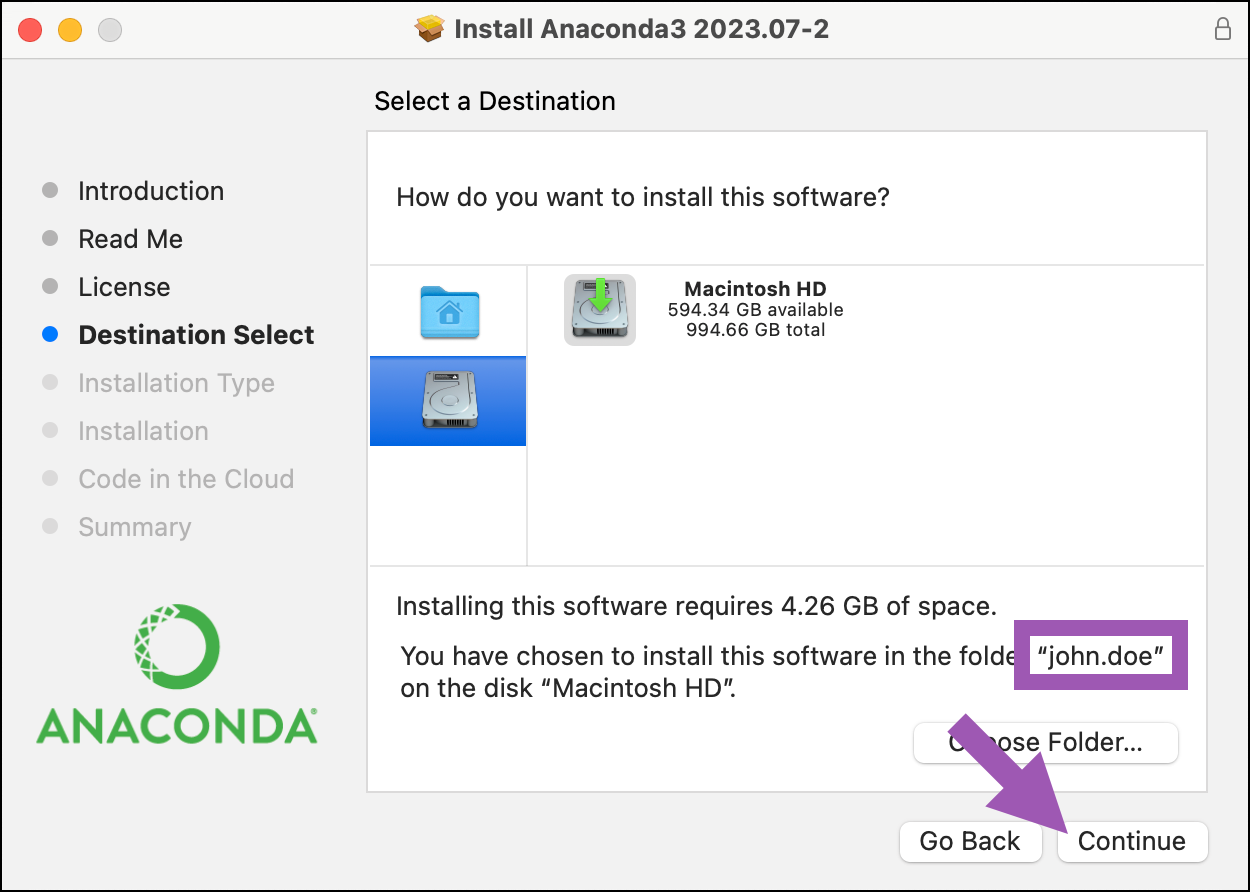
5. Click your user's home directory (for example, /Users/john.doe/). Then, click **Choose**.
6. In the message box, confirm the name of the install folder you chose in the previous step. Then click **Continue**.
7. Click **Install**, and then proceed with the rest of the installation.
If you continue to receive the same error message, please open an issue [here](https://github.com/ContinuumIO/anaconda-issues/issues/new/choose/), and be sure to include the installation log output from your `install.log` file, which can be found at `/var/log/install.log`.
### Recovering your Anaconda installation
If your Anaconda installation has become corrupted and is in a state where normal conda commands are not functioning, use the following steps to repair Anaconda and preserve your installed packages and environments.
1. Download a [new installer](https://repo.anaconda.com/archive/) for your operating system.
1. Open a terminal application, such as Command Prompt or PowerShell.
2. If necessary, navigate to the parent directory of your Anaconda installation (by default, this is your user profile).
3. Rename your existing installation directory so you do not overwrite it:
```sh Command Prompt theme={null}
move anaconda3 anaconda_old
```
```powershell PowerShell theme={null}
Move-Item anaconda3 anaconda_old
```
4. Run the new Anaconda installer. When prompted for an install location, choose the same directory as your original installation.
5. Copy your previous packages and environments to the new installation:
```sh theme={null}
robocopy anaconda_old anaconda3 /S
```
6. Delete your old Anaconda installation directory:
```sh Command Prompt theme={null}
rd /s /q anaconda_old
```
```powershell PowerShell theme={null}
Remove-Item -Recurse -Force anaconda_old
```
1. Open a terminal application.
2. If necessary, navigate to the parent directory of your Anaconda installation (by default, this is your home directory).
3. Rename your existing installation directory so you do not overwrite it:
```sh theme={null}
mv anaconda3 anaconda_old
```
4. Run the new Anaconda installer. When prompted for an install location, choose the same directory as your original installation:
```sh macOS theme={null}
bash ~/Downloads/Anaconda3-2026.07-1-MacOSX-arm64.sh
```
```sh Linux x86 theme={null}
bash ~/Downloads/Anaconda3-2026.07-1-Linux-x86_64.sh
```
```sh Linux arm64 theme={null}
bash ~/Downloads/Anaconda3-2026.07-1-Linux-aarch64.sh
```
5. Copy your previous packages and environments to the new installation:
```sh theme={null}
rsync -a anaconda_old/ anaconda3/
```
6. Delete your old Anaconda installation directory:
```sh theme={null}
rm -rf anaconda_old
```
2. Run `conda list` to view the packages from the previous installation.
3. Run `conda info --envs` to list the environments created in the previous installation, which are now available in the new installation.
### Proxy request sent, not found
Your company likely has security policies or a firewall in place that prevent communications with external servers or certain URLs.
1. First, work with your IT team to allowlist connections to the following URLs:
```txt theme={null}
https://anaconda.org
https://repo.anaconda.com
https://repo.anaconda.cloud
```
Allowlisting `https://repo.anaconda.cloud` is only necessary if your company has an Anaconda Platform organization and you require access to channels in that organization.
2. [Install](/docs/getting-started/main) Anaconda Distribution or Miniconda again.
Once your installation is complete, you might also need to connect your company's firewall/proxy server to your conda configuration file (`.condarc`). For more information on this, see [Using Anaconda behind a firewall or proxy](/docs/anaconda-platform/getting-started-with-anaconda-platform#using-anaconda-behind-a-firewall-or-proxy-optional).
 3. Click **Install on a specific disk…**.
4. Click the appropriate destination drive. Then click **Choose Folder…**.
3. Click **Install on a specific disk…**.
4. Click the appropriate destination drive. Then click **Choose Folder…**.
 5. Click your user's home directory (for example, /Users/john.doe/). Then, click **Choose**.
6. In the message box, confirm the name of the install folder you chose in the previous step. Then click **Continue**.
5. Click your user's home directory (for example, /Users/john.doe/). Then, click **Choose**.
6. In the message box, confirm the name of the install folder you chose in the previous step. Then click **Continue**.
 7. Click **Install**, and then proceed with the rest of the installation.
If you continue to receive the same error message, please open an issue [here](https://github.com/ContinuumIO/anaconda-issues/issues/new/choose/), and be sure to include the installation log output from your `install.log` file, which can be found at `/var/log/install.log`.
7. Click **Install**, and then proceed with the rest of the installation.
If you continue to receive the same error message, please open an issue [here](https://github.com/ContinuumIO/anaconda-issues/issues/new/choose/), and be sure to include the installation log output from your `install.log` file, which can be found at `/var/log/install.log`.